
November 18, 2025 | Jon Kelvey
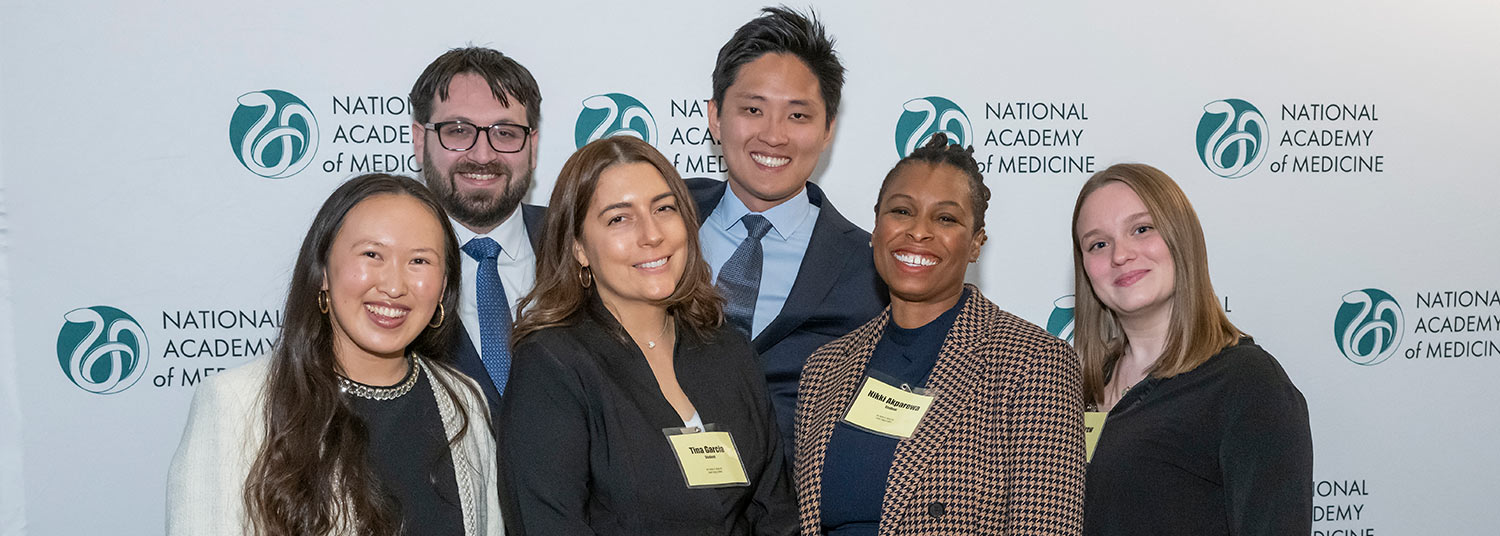
 On Oct. 17, a team of University of Maryland, Baltimore (UMB) students won the Wild Card prize at the National Academy of Medicine’s annual DC Public Health Case Challenge.
The UMB Interprofessional Education (IPE) team, led by team captain Jake Kim, a University of Maryland School of Medicine MD/MPH student, won the recognition on Oct. 17 for their School Partnership Reducing Obesity Using Technology (SPROUT) Pilot Program proposal. Kim’s teammates included Francis King Carey School of Law students Hannah Lowe and Elliott Klein, School of Social Work students Tina Garcia and Raina Crew, and School of Nursing student Nikki E. Akparewa, RN, MSN, MPH.
Rebecca Hall, JD, Managing Director of the Law & Health Care Program at the School of Law, served as Head Coach for the team, with UMSOM Associate Professor of Microbiology and Immunology and Assistant Dean for Student Research & Education Gregory B. Carey, PhD, serving as Assistant Coach.
Created by the National Academy of Medicine to promote interdisciplinary approaches to problem-based learning, the DC Public Health Case Challenge asks teams from regional universities to propose innovative solutions to real public health challenges. The 2025 challenge asked participants to propose technology and data-centric proposals for strengthening health and resilience against chronic disease in the District of Columbia that could be implemented over three years on a $1.5 million budget.
 The UMB IPE team focused on DC’s Ward 8, where obesity rates are highest in the District and access to healthy foods is limited.
“We thought a school greenhouse would be a great way to engage elementary school students with outdoor activities and get them to befriend vegetables,” Kim said of the team’s approach to the challenge. But they worried students might not stay engaged with a greenhouse project alone.
The key insight that led to SPROUT was Akparewa mentioning that her 5th-grade son would always choose the popular game Roblox over gardening. “We thought, ‘what if we transplant the element that makes Roblox so addictive into the greenhouse to make it fun?'” Kim said.
The team designed the SPROUT proposal to include both a greenhouse and a gamified app to a Ward 8 elementary school. Not only would it provide healthy food for students and a tool for maintaining engagement, but it would also seamlessly integrate with the 4th and 5th-grade science and STEM curricula.
“While greenhouse and gardening programs are a proven strategy to combat childhood obesity, sustaining student engagement remains a challenge for long-term success,” Professor Hall said. “The app addresses this by incorporating interactive quests and rewards that encourage participation in greenhouse activities, leveraging the same digital elements that typically draw children to screens to instead encourage hands-on learning.”
Contact
Jon Kelvey
JKelvey@som.umaryland.edu
Related stories
Wednesday, June 11, 2025
Rural-MD Scholars Prepare for Careers in Healthcare on Maryland’s Eastern Shore
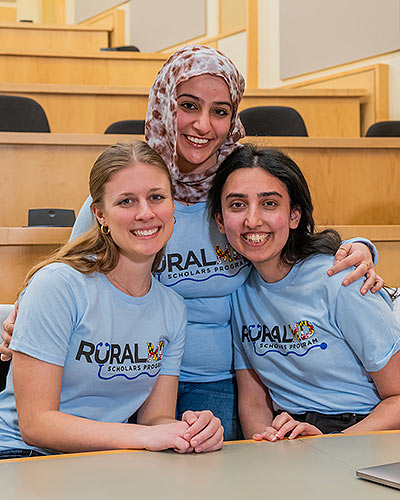
In an effort to address the healthcare shortage facing Maryland's nearly half-million residents who live on the rural Eastern Shore, the University of Maryland School of Medicine last year established a program to train and place students in rural healthcare settings. This academic year, three students who received full-tuition scholarships and were accepted into the newly named Rural-MD Scholars program started gaining insight into their future practice on the Eastern Shore through interactions with local healthcare professionals, community engagement, and hands-on clinical experiences.
Thursday, March 13, 2025
UMSOM Rising Third-Year Medical Students Celebrate Transition to Clinical Care Training at Annual Student Clinician Ceremony
The University of Maryland School of Medicine (UMSOM) celebrated 165 rising third-year medical students at the Annual Student Clinician Ceremony on March 4, as they prepare to begin their clinical care training. Over the next two years, students will transition from the classroom to the bedside to gain experience seeing patients through a wide variety of specialties within local healthcare organizations.