
New Research Simulates Cancer Cell Behavior
July 25, 2025 | Heide Aungst
Researchers at the University of Maryland School of Medicine Invent Software Fueled by Genomics into Mathematical Models to Predict Cancer Cell Behavior
In the same vein as weather forecast models that predict developing storms, researchers now have developed a method to predict the cell activity in tissues over time. The new software combines genomics technologies with computational modeling to predict cell changes in behavior, such as communication between cells that could cause cancer cells to flourish.
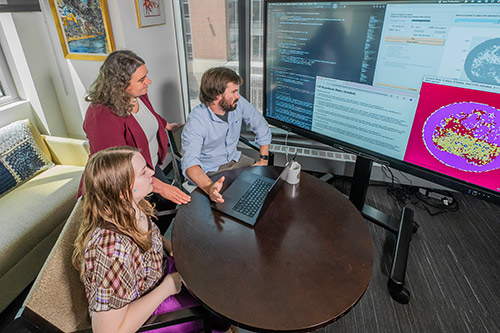 Researchers at the University of Maryland School of Medicine’s (UMSOM) Institute for Genome Sciences (IGS) co-led the study that published online on July 25 in the journal Cell. It is the result of a multi-year, multi-lab project at the interface of software development with important collaborations between bench and clinical team science researchers. This research eventually could lead to computer programs that could help determine the best treatment for cancer patients by essentially creating a “digital twin” of the patient.
“Although standard biomedical research has made immeasurable strides in characterizing cellular ecosystems with genomics technologies, the result is still a single snapshot in time—rather than showing how diseases, like cancer, can arise from communication between the cells,” said Jeanette Johnson, PhD, a Postdoc Fellow at the Institute for Genome Sciences (IGS) at UMSOM and co-first author of this study. “Cancer is controlled or enabled by the immune system, which is highly individualized; this complexity makes it difficult to make predictions from human cancer data to a specific patient.”
What makes this research unique is the use of a plain-language “hypothesis grammar” that uses common language as a bridge between biological systems and computational models and simulates how cells act in tissue.
Paul Macklin, PhD, Professor of Intelligent Systems Engineering at Indiana University led a team of researchers who developed the grammar to describe cell behavior. This grammar allows scientists to use simple English language sentences to build digital representations of multicellular biological systems and enabled the team to develop computational models for diseases as complex as cancer.
 “As much as this new ‘grammar’ enables communication between biology and code, it also enables communication between scientists from different disciplines to leverage this modeling paradigm in their research,” said Daniel Bergman, PhD, a scientist at IGS and Assistant Professor of Pharmacology and Physiology at UMSOM and co-leading author with Dr. Johnson.
Dr. Bergman and his colleagues at IGS then combined this grammar with genomic data from real patient samples to study breast and pancreatic cancer, with technologies such as spatial transcriptomics.
In breast cancer, the IGS team modeled an effect where the immune system cannot curtail tumor cell growth and instead promotes invasion and cancer spread. They adapted this computational modeling framework to simulate a real-world immunotherapy clinical trial of pancreatic cancer.
Using genomics data from untreated tissue samples of pancreatic cancer, the model predicted that each virtual “patient” had a different response to the immunotherapy treatment—showcasing the importance of cellular ecosystems for precision oncology. For example, pancreatic cancer is a difficult cancer to treat, in part, because it is often surrounded by a dense structure of non-cancerous cells called fibroblasts. The team used new spatial genomics technology to further demonstrate the ways fibroblasts communicate with tumor cells. The program allowed the scientists to follow the growth and progression of pancreatic tumors to invasion from real patient tissue.
“What makes these models so exciting to me as someone who studies immunology is that they can be informed, initialized, and built upon using both laboratory and human genomics data,” said Dr. Johnson. “Immune cells are amazing and follow rules of behavior that can be programmed into one of these models. So, for instance, we can take data and treat it as a snapshot of what the human immune system is doing, and this framework gives us a sandbox to freely investigate our hypotheses of what’s happening there over time without extra costs or risk to patients.”
 “Ever since my transitioning from my training in weather prediction at the University of Maryland, College Park into computational biology, I have believed that we could apply the same principles to work across biological systems to make predictive models in cancer. I am struck by how many rules of biology we don’t yet know,” said Elana J. Fertig, PhD, Director of IGS, Associate Director of Quantitative Sciences for the University of Maryland Marlene and Stewart Greenebaum Comprehensive Cancer Center, and Professor of Medicine and Epidemiology at UMSOM and a lead author on the study. “Adapting this approach to genomics technologies gives us a virtual cell laboratory in which we can conduct experiments to test the implications of cellular rules entirely in silico.”
Dr. Fertig calls the research “a tapestry of team science” with additional validation of the computational models coming from clinical collaborators at Johns Hopkins University and Oregon Health Sciences University.
The new grammar is open source so that all scientists can benefit from it. “By making this tool accessible to the scientific community, we are providing a path forward to standardize such models and make them generally accepted,” said Dr. Bergman. To demonstrate this generalizability, Genevieve Stein-O’Brien, PhD, the Terkowitz Family Rising Professor of Neuroscience and Neurology at Johns Hopkins School of Medicine (JHSOM) led researchers in using this approach in a neuroscience example in which the program simulated the creation of layers as the brain develops.
“With this work from IGS, we have a new framework for biological research since researchers can now create computerized simulations of their bench experiments and clinical trials and even start predicting the effects of therapies on patients,” said Mark T. Gladwin, MD, Vice President for Medical Affairs at the University of Maryland, Baltimore, and the John Z. and Akiko K. Bowers Distinguished Professor and UMSOM Dean. “This has important applications to enable digital twins and virtual clinical trials in cancer and beyond. We look forward to future work extending this computational modeling of cancer to the clinic.”
The study was funded by the National Cancer Institute, the Jayne Koskinas Ted Giovanis Foundation, the National Foundation for Cancer Research, the Cigarette Restitution Fund Program from the State of Maryland, and the Lustgarten Foundation.
The team of senior authors on this study include, Paul Macklin, PhD, Associate Dean for Undergraduate Education and Professor of Intelligent Systems Engineering at the Indiana School of Informatics, Computing and Engineering at Indiana University, Genevieve Stein-O’Brien, Bloomberg Assistant Professor of Neuroscience and Assistant Director Single-Cell Training and Analysis Center (STAC) at Johns Hopkins University, and Dr. Fertig are continuing efforts to disseminate this software and extend its integration with genomics data for automatic model formulation through the National Cancer Institute (NCI) Informatics Technology in Cancer Research Consortium, who funded this study. Additional benchmarking of this study and applications of the software to breast and pancreatic cancer are supported from numerous NCI grants, the Jayne Koskinas Ted Giovanis Foundation, the National Foundation for Cancer Research, the Cigarette Restitution Fund Program from the State of Maryland, and the Lustgarten Foundation.
Contact
Heide Aungst
Director, Media & Pub Relations
Institute of Genome Sciences
HAungst@som.umaryland.edu
Related stories
Thursday, May 21, 2026
Study Sheds Light On How Early Pancreas Lesions Become Cancerous
In an unexpected finding, a new study flips on its head researchers’ understanding of how precancerous pancreas lesions evolve into pancreatic cancer. The paradigm-changing discovery has tremendous implications for identifying people at higher risk of cancer or even, potentially stopping malignant transformation.
Wednesday, November 06, 2024
Genomic Databases Need More Diversity
It is commonly known that most genomic databases are biased toward people with European ancestry. Scientists have warned that leaving out other populations could skew results in areas such as drug development, diagnostic testing, and polygenic risk scores—which looks at many genetic variations in a person’s DNA to predict their disease risk.
Wednesday, August 28, 2024
Leading Computational Scientist and Oncology Researcher Elana Fertig, PhD, Appointed as New Director of the Institute for Genome Sciences at the University of Maryland School of Medicine
University of Maryland School of Medicine (UMSOM) Dean Mark T. Gladwin, MD, announced today the appointment of Elana J. Fertig, PhD, FAIMBE, as the new Director of the School’s Institute for Genome Sciences (IGS). She is an internationally-recognized researcher known for her work in integrating spatial multi-omics technologies with mathematical models to develop a new predictive medicine paradigm in cancer. Spatial technologies allow researchers to learn about any cell type inside of natural tissue, including gene activity and cell interactions.

Wednesday, August 24, 2022
UM School of Medicine Study Finds a New Way to Optimize Treatment Success for Fecal Transplants
Fecal transplants have been successful in treating serious diarrheal infections but have often failed when tried with other diseases. Up until now, no one could predict why these treatments sometimes failed to help restore healthy bacteria in the colon. Researchers from the University of Maryland School of Medicine’s (UMSOM) Institute for Genome Sciences (IGS) have discovered important clues that could lead more personalized approaches to optimize treatment success. They published their findings in Cell Reports Medicine online earlier this month.
Monday, July 18, 2022
New Genomic Research Shows Why Testing Malaria Vaccines in the Clinic is as Rigorous as Natural Exposure in the Field
Malaria is the deadliest mosquito-borne parasitic infection of humans. In 2021, after a century of research, the World Health Organization (WHO) approved the world’s first malaria vaccine. That vaccine reduces the incidence of malaria infections in young children aged 5-17 months by only 30 percent, meaning that it remains critical to continue developing and testing more effective vaccines.

Thursday, March 18, 2021
UM School of Medicine Helps Maryland Conduct State-Wide Sequencing of Variants in Positive COVID-19 Test Specimens
In an effort to monitor the spread of COVID-19 variants in the State of Maryland, University of Maryland School of Medicine (UMSOM) Dean E. Albert Reece, MD, PhD, MBA, announced that UMaryland Genomics at UMSOM will perform genome sequencing of variants in at least 10 percent of COVID-19 test samples, reaching an important benchmark set by the federal government to help control the spread of these variants.

Thursday, February 25, 2021
UM School of Medicine Researchers Participate in Landmark Study Detailing Sequencing of Full Human Genomes to Better Capture Genetic Diversity
Researchers at the University of Maryland School of Medicine (UMSOM) co-authored a study, published today in the journal Science, that details the sequencing of 64 full human genomes. This reference data includes individuals from around the world and better captures the genetic diversity of the human species. Among other applications, the work will enable population-specific studies on genetic predispositions to human diseases as well as the discovery of more complex forms of genetic variation.
Wednesday, February 26, 2020
Researchers Develop First Catalogue of Genes that Comprise Community of Microbes in Vaginal Microbiome
University of Maryland School of Medicine’s (UMSOM) Institute for Genome Sciences (IGS) researchers have created the first catalogue of genes that comprise the community of microbes, which inhabit the human vagina. The catalogue, called human vaginal non-redundant gene catalog (VIRGO), was recently released as a public resource that can be used by researchers to facilitate a more in-depth understanding of the role of vaginal microorganisms in women’s health and to potentially develop future treatments for certain gynecologic conditions.
Tuesday, December 03, 2019
UM School of Medicine Researchers Institute for Genome Sciences' Researchers Discover Potential New Treatment for Tropical Parasitic Disease Using Genomics
Using innovative RNA sequencing techniques, researchers at the University of Maryland School of Medicine (UMSOM) Institute for Genome Sciences identified a promising novel treatment for lymphatic filariasis, a disabling parasitic disease that is difficult to treat. The potential new therapy is an experimental cancer drug called JQ1 and targets proteins found prominently in the worm’s genome; it appears to effectively kill the adult worms in a laboratory setting, according to the study which was published today in the journal mSystems.

Wednesday, May 25, 2016
UMSOM Researchers Develop New Way to Decode Large Amounts of Biological Data
A University of Maryland School of Medicine researcher has helped develop an innovative computing technique that, on very large amounts of data, is both faster and more accurate than current methods. To spur research, a program using this technique is being offered for free to the biomedical research community.