
September 15, 2025

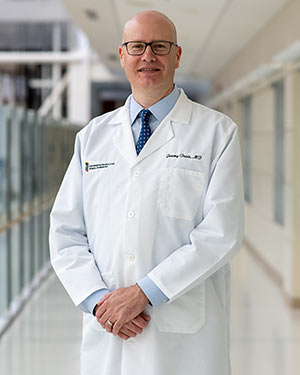 Jeremy L. Davis, MD, joined the University of Maryland School of Medicine (UMSOM) as Chief of the Division of Surgical Oncology in January 2025. He also serves as the Surgical Oncology Lead for the University of Maryland Marlene and Stewart Greenebaum Comprehensive Cancer Center (UMGCCC).
Prior to joining UMSOM, Dr. Davis spent a decade as a research physician and surgical oncologist with the National Cancer Institute (NCI) in Bethesda, Maryland, serving as Surgeon-in-Chief of the National Institutes of Health (NIH) Clinical Center from 2018 to 2023. Dr. Davis’s research at NCI included ground-breaking studies of hereditary stomach cancer and lobular breast cancers related to a mutation of the CDH1 tumor suppressor gene.
In an edited interview, Dr. Davis discussed his time at NCI and NIH, the types of research and collaboration he is most interested in, and how studying the molecular underpinnings of heritable stomach cancer is leading to changes in clinical practice.
Q: Can you tell us about your work at NCI and NIH before coming to the University of Maryland?
I focused almost all of my time at the NIH on understanding everything that I could about stomach cancer, taking care of patients with stomach cancer, and running clinical trials to find better ways to diagnose or detect cancer at an early stage. I developed a unique expertise in a hereditary form of stomach cancer, which is passed down from parent to child through a rare genetic mutation.
Q: What drew you to focus your research and practice on gastric cancers generally, and how does that connect with the heritable forms?
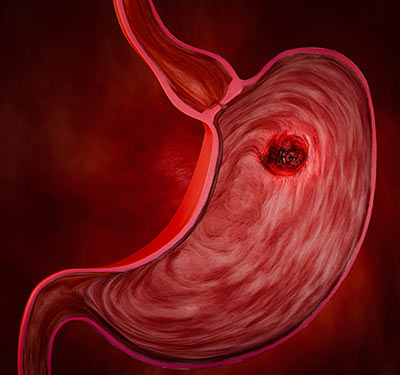 When I was a trainee and doing my surgical residency, I operated on a young woman from Illinois with stomach cancer. The operation went smoothly, but when we got her final pathology, I learned that her prognosis was quite poor: Even after chemotherapy, she still had cancer in her stomach and in her lymph nodes. That stuck with me.
Stomach cancer is not a common cancer in the United States — it doesn’t even break the top 10 — but the five-year survival rate of someone diagnosed with stomach cancer in the US is quite poor, only around 30%. That means that the vast majority of people diagnosed with stomach cancer in the United States are not alive five years after diagnosis. And stomach cancers are more common worldwide. After that operation on the woman from Illinois, I remember thinking, “This is a horrible cancer, and we need to find better ways of treating this.”
The problem is that most cancer centers don’t see many patients with stomach cancer, because, again, there are only around 30,000 cases a year in the United States. However, one way to study a rare cancer is to study people who have a genetic predisposition to that cancer, so I decided to explore that as the focus for my research.
There’s a gene, called the CDH1 tumor suppressor gene, that we all have. People born with a specific mutation in CDH1 appear to be at substantially increased risk of developing both a subtype of stomach cancer and a subtype of breast cancer, which I’ve been investigating to help develop precision-based treatments.
Q: How does your research work on the molecular underpinnings of cancers connect with your work as a surgeon?
Our growing understanding of genetic predispositions to stomach cancer over the last several years, along with the widespread availability of genetic testing, is changing the treatment paradigm. If anyone walked into my office 10 years ago with that specific mutation in CDH1, I would tell them to have their stomach prophylactically removed to prevent them from ever getting this cancer. Removing somebody's entire stomach is a major operation that really alters their life, an operation I don't want to do if I don't have to.
But in just the past five years, thanks to molecular data that we’ve acquired from patients with this CDH1 mutation, we’ve learned that their lifetime risk of getting stomach cancer is not as high as we once thought. At NCI, I launched clinical trials to see if we could detect the formation of these cancers early through an endoscopy or biomarkers in the blood, so that we could monitor patients with this genetic predisposition rather than jumping straight to major surgery. That’s work I am continuing here.
Q: What research efforts are you launching, or hope to launch soon, at UMSOM?
 I’m continuing the work I began at NCI on the early detection of stomach cancers, and we’re actively setting up my lab and opening clinical trials. In addition to using endoscopy and blood and fluid tests, we’re exploring using so-called nuclear imaging, using a special radio tracer to detect early signs of cancer.
I also plan on expanding my research into lobular breast cancer. It turns out women with the CDH1 mutation are at greater risk for lobular breast cancer as well as for stomach cancer, and the robust University of Maryland breast cancer program allows us to expand that part of the research.
From a basic research side, we’re working with our partners at the UMSOM Institute for Genome Sciences to study cells very early on during cancer formation. We’re learning that subsets of many cancers, not just stomach cancer, involve genetic predispositions. Studying patients with these inherited predispositions could help us unlock some mysteries around the formation of all kinds of cancer. That’s why I’ve named my lab the Precancer Genomics Lab, because we want to understand what cancer is before it even develops.
Q: Speaking of collaborating with IGS, are there other collaborations you would like to pursue in your research or clinical work?
Some people think that cancer research is all about working in a lab with cells on a dish. But the truth is, our research crosses a lot of disciplines.
I want to partner with our clinicians at UGMCCC who care for patients with a variety of genetic mutations that predispose them to many different cancers. A concentration of patients with those diagnoses in one clinical setting can provide important data for clinical research.
There are also opportunities for us to explore novel technologies in cancer detection, prevention, and treatment by partnering with my colleagues across UMB, in the undergraduate campus at College Park, and startup companies in the University of Maryland Biopark.
Watch the Video
Contact
Office of Public Affairs
655 West Baltimore Street
Bressler Research Building 14-002
Baltimore, Maryland 21201-1559
Contact Media Relations
(410) 706-5260