
Cutaneous larva migrans (CLM) is an acquired dermatosis
- Seen in patients returning from the tropics
- Often seen in patient with a history of sunbathing or in barefoot beachgoers
- Caused by the larvae of various nematode parasites of the hookworm family (Ancylostomatidae), with Ancylostoma braziliense the most frequently found in humans.
Clinical manifestations:
- Linear, serpentine erythematous lesions
- Intense pruritus
- Will often heal spontaneously over weeks or months without treatment
Treatment:
- Thiabendazole (applied topically)
- Oral alternatives include other anti-parasitic medications such as albendazole, ivermectin
- Oral thiabendazole as a single dose can be used, but is less effective than albendazole or ivermectin
- Consider antibiotics if there is secondary bacterial infections
- Freezing the leading edge has been previously used, but is considered ineffective and painful.
Bottom Line:
- Consider CLM the next time a patient complains of a linear, erythematous itchy rash after returning from their all-inclusive stay in a Caribbean resort
Show References
Attachments
There are multiple vasoactive infusions available for acute hypertensive emergencies, many having serious side effect profiles or therapeutic disadvantages.
Clevidipine (Cleviprex) is rapidly-titratable, lipid-soluable dihydropyridine calcium channel blocker which has become increasingly used in the ICU in recent years [1]:
- Onset of action 2-4 minutes
- Duration of action 5-15 minutes (half-life of 1 minute)
- Clevidipine is relatively inexpensive ($108/50mL bottle)
- Side effects include hypertriglyceridemia, hypotension and reflex tachycardia
ECLIPSE trial compares clevidipine, nicardipine, nitroglycerin and nitroprusside in cardiac surgery patients. .
Clevidipine was as effective as nicardipine at maintaining a pre-specified BP range, but superior when that BP range was narrowed (also studied in ESCAPE-1 and ESCAPE2 with similar results) [2-3]
TAKE-HOME: Clevidipine is an ultra short-acting, rapidly-titratable vasoactive with favorable cost, pharmacokinetics, and side-effect profile. Consider its use in hypertensive emergencies.
Show References
Femoral neck fracture
- The most commonly missed hip fracture
We typically think of the presentation of the displaced fracture severe pain, writhing in the bed, unable to ambulate, limited ROM
* However, patients with nondisplaced fractures (15 20%) may walk with a limp
* Occurs primarily in the elderly & osteoporotic population after a fall directly onto the hip
* Look for a cortical step-off in the femoral neck (w/ foreshortening)
* A patient with a minimally displaced fracture may only complain of hip, knee, or groin pain and may be able to walk (albeit with a limp)
* Almost 9% of hip fractures are radiographically normal (Nondisplaced or impacted fractures)
* Fractures which were initially nondisplaced, may become displaced upon re-presentation
* Remember the limitations of plain x-ray in the evaluation of femoral neck fractures!
* Because of the significant complication of overlooking a femoral neck fracture, MRI has become the recommended imaging modality of choice for a patient with a high suspicion for a femoral neck fracture, despite normal plain radiographs of the hip
Acute cocaine toxicity can manifest with several cardiovascular issues such as tachycardia, dysrhythmia, hypertension, and coronary vasospasm. A new systematic review collated all of the available evidence for potential treatment options. Here is what the review found (there is also an 'other agents' section for medications with less published reports):
-
Benzodiazepines and other GABA-active agents: Benzodiazepines may not always effectively mitigate tachycardia, hypertension, and vasospasm from cocaine toxicity.
-
Calcium channel blockers: Calcium channel blockers may decrease hypertension and coronary vasospasm, but not necessarily tachycardia.
-
Nitric oxide-mediated vasodilators: Nitroglycerin may lead to severe hypotension and reflex tachycardia.
-
Alpha-adrenoceptor blocking drugs: Alpha-1 blockers may improve hypertension and vasospasm, but not tachycardia, although evidence is limited.
-
Alpha-2-adrenoceptor agonists: There were two high-quality studies and one case report detailing the successful use of dexmedetomidine.
-
Beta-blockers and alpha/beta-blockers: No adverse events were reported for use of combined alpha/beta-blockers such as labetalol and carvedilol, which were effective in attenuating both hypertension and tachycardia.
-
Antipsychotics: Antipsychotics may improve agitation and psychosis, but with inconsistent reduction in tachycardia and hypertension and risk of extrapyramidal adverse effects.
-
Sodium bicarbonate: Twelve case reports documented treatment of dysrhythmia with IV sodium bicarbonate, with seven reporting successful termination.
The authors note that "publication bias is a concern, and it is possible that successful treatment and/or adverse events have not been reported in some of the publications, and in general."
Show References
Sunset Eye Sign
- The "sunset eye sign" can be seen in patients with increased intracranial pressure related to obstructive hydrocephalus or shunt malfunction.
- It describes an up-gaze paresis caused by compression of the dorsal midbrain.
- The lower portion of the pupil may be covered by the lower eyelid, appearing like a setting sun.
- The RUSH exam is a rapid way to identify the cause of shock using ultrasound. What's the RUSH exam? Click here
- The RUSH exam does not include an assessment of volume responsiveness (VR), but a new article by Blaivas, Aguiar, and Blanco suggests that it should be.
- VR has classically been assessed by determining the stroke volume before and after a passive leg raise or a fluid bolus. Click here for a video on how to calculate the stroke volume (skip to 21:30 in the video)
- The authors claim that VR can further be simplified by not measuring the left ventricular outflow tract (LVOT) and only comparing changes in the velocity-time integral (VTI). The assumption is that the LVOT is constant and doesn't change in most circumstances; a change of VTI that is greater than 15% suggests that the patient is VR
- Further validation is required to determine the degree of benefit to adding VTI to the RUSH exam, however measuring VTI is a skill that can be done with relatively little training and is clinically helpful.
Show References
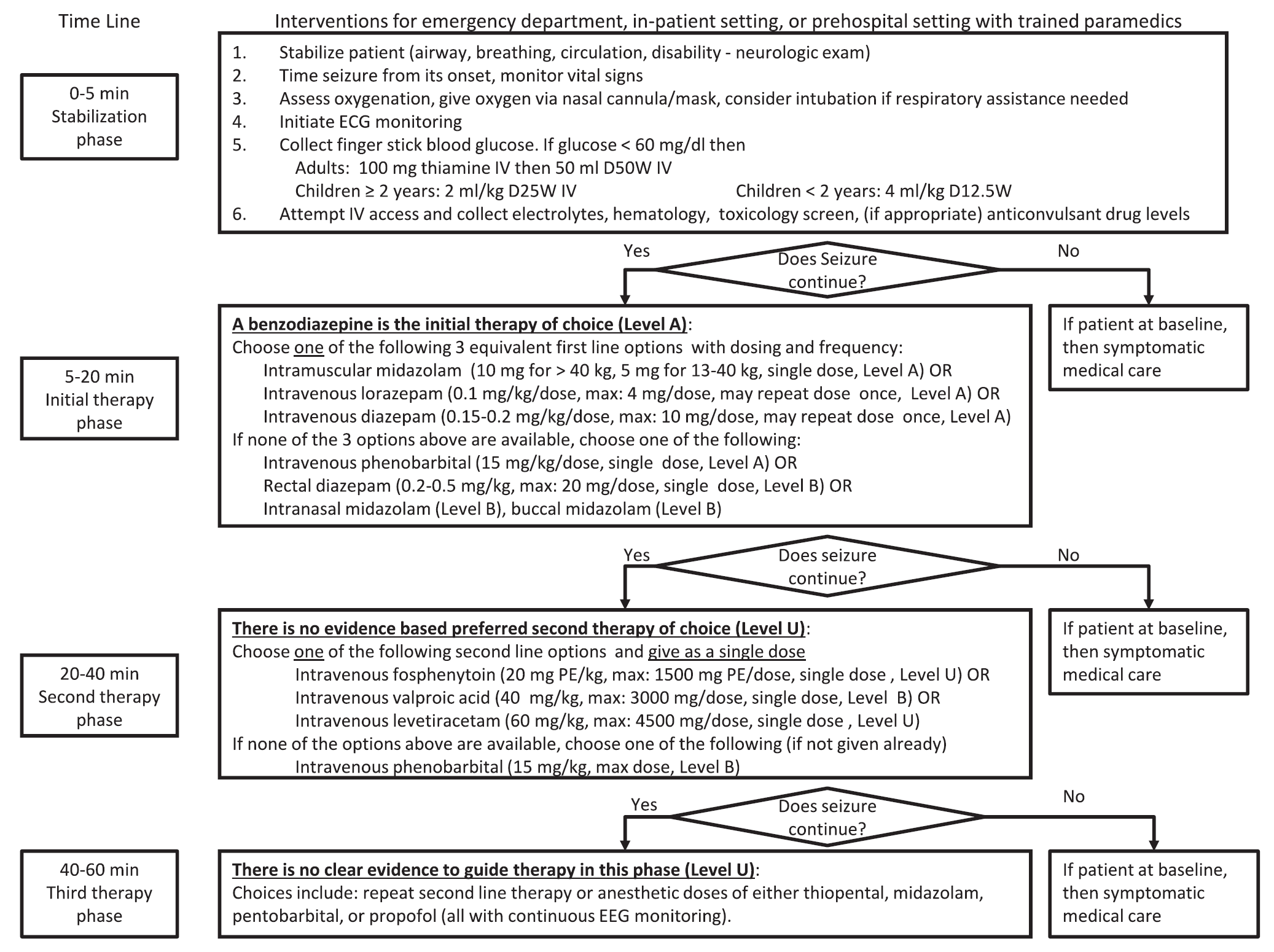
A new guideline for convulsive status epilepticus in adults AND children was recently published. [1] An insightful commentary was published alongside it (both are open access). [2] The proposed algorithm is below. Here are a few additional points to note:
- The guideline applies to convulsive status epilepticus.
- A new level of evidence rating of "U" is utilized. It means "data inadequate or insufficient; give current knowledge, treatment is unproven."
- It addresses 5 specific questions:
- Which anticonvulsants are efficacious as initial and subsequent therapy?
- What adverse events are associated with anticonvulsant therapy?
- Which is the most effective benzodiazepine?
- Is IV fosphenytoin more effective than IV phenytoin?
- When does anticonvulsant efficacy drop significantly?
- IM midazolam is incorporated as one of the recommended 1st choices of treatment.
- One of the second phase therapy recommendations is levetiracetam 60 mg/kg! It is a level U recommendation. Be prepared for neurology to request this dose. There is no data in adults to support this high of a dose.
Show References
Pure opioid agonists such as Morphine, Hydromorphone, and Fentanyl stimulate opioid receptors and are the most potent analgesics. Fentanyl and fentanyl analogues are up to 100 times more powerful than morphine and 30-50 times more powerful than heroin.
- Fentanyl abuse is causing significant problems worldwide. In the U.S., age-adjusted rate of death involving Fentanyl has increased 80% in 2014.
- Sources include production in illicit clandestine labs or diversion from legitimate pharmaceutical sales.
- 12 different analogues of Fentanyl have been identified in the U.S. drug traffic market.
- Commonly laced in heroin or cocaine or sold as fake Oxycodone or OxyContin tablets.
W-18 is a highly potent opioid agonist with a distinctive chemical structure which is not closely related to older established families of opioid drugs. While Fentanyl is approximately 100 times more powerful than Morphine, W-18 is about 100 times more powerful than Fentanyl.
- First discovered at the University of Alberta in 1982 in hopes of producing a non-addictive analgesic, 32 compound series named from W-1 to W-32, with W-18 being the most potent.
- Recently emerged on the streets of Canada when police in Calgary confiscated 110 green pills being sold as Fentanyl, known on the streets as "shady eighties" or "green beans pills" but chemical analysis revealed some pills containing W-18 instead.
- W-18 has never been used clinically as drug companies did not pick the patent, which lapsed by 1992 so little clinical experience.
- The effects of naloxone to reverse this synthetic opioid are unknown and higher doses are expected to to be required.
- Illicit drug manufacturers research pharmacological history in search of the more powerful, exotic, and new opioids to circumvent current legal regulations.
Show References
While the flu season this year has been mild, it is still important to recognize which patients are at high risk for flu-related complications:
- Children < 5 years old
- Especially children < 2 years old
- Adults > 65 years old
- Pregnant women
- Including women up to 2 weeks post-partum
- Residents of long-term care facilities, such as nursing homes
- American Indians and Alaskan Natives
- Patients with certain medical conditions, including:
- Respiratory diseases, such as asthma and COPD
- Neurological and neurodevelopmental conditions
- Heart disease, including CHF and CAD
- Blood disorders (e.g. sickle cell disease)
- Endocrine and metabolic disorders (e.g. diabetes)
- Kidney or liver diseases
- People <19 years old on long-term aspirin therapy
- Morbid obesity (BMI > 40)
- Immunocompromised, (e.g. chronic steroids, transplant patients, AIDS patients, chronic steroid use)
During the influenza season, when admitting a patient who 1) has respiratory symptoms and 2) is at high risk for influenza complications, consider testing them for influenza.
Show References
- A recent observational study was published looking at the ICU incidence and outcome of ARDS
- This international prospective cohort study looked at 459 ICUs and over 29,000 patients
- Incidence: 10.4% met ARDS criteria
- Severe ARDS occurred in 23.4%
- Clinical recognition of mild ARDS was only 51%
- Less than 2/3rds of patients with ARDS received a TV of 8 mL/kg or less
- Prone positioning was used in 16% of patients with severe ARDS
- Recognition of ARDS was associated with higher PEEP, greater use of neuromuscular blockers, and prone positioning
- Mortality ranged from 35% to 46%
- Pneumonia was the biggest risk factor for ARDS
Show References
Question
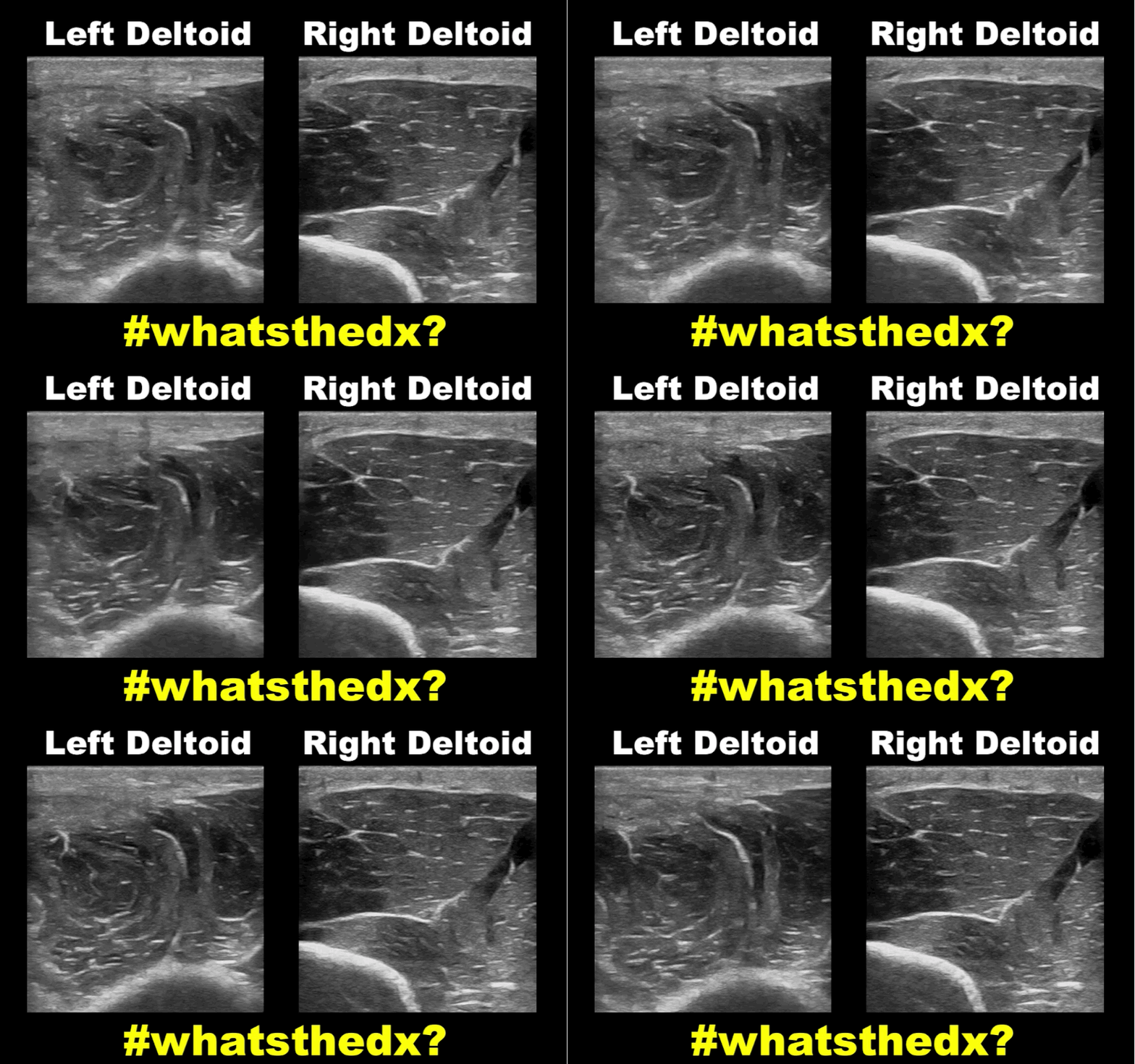
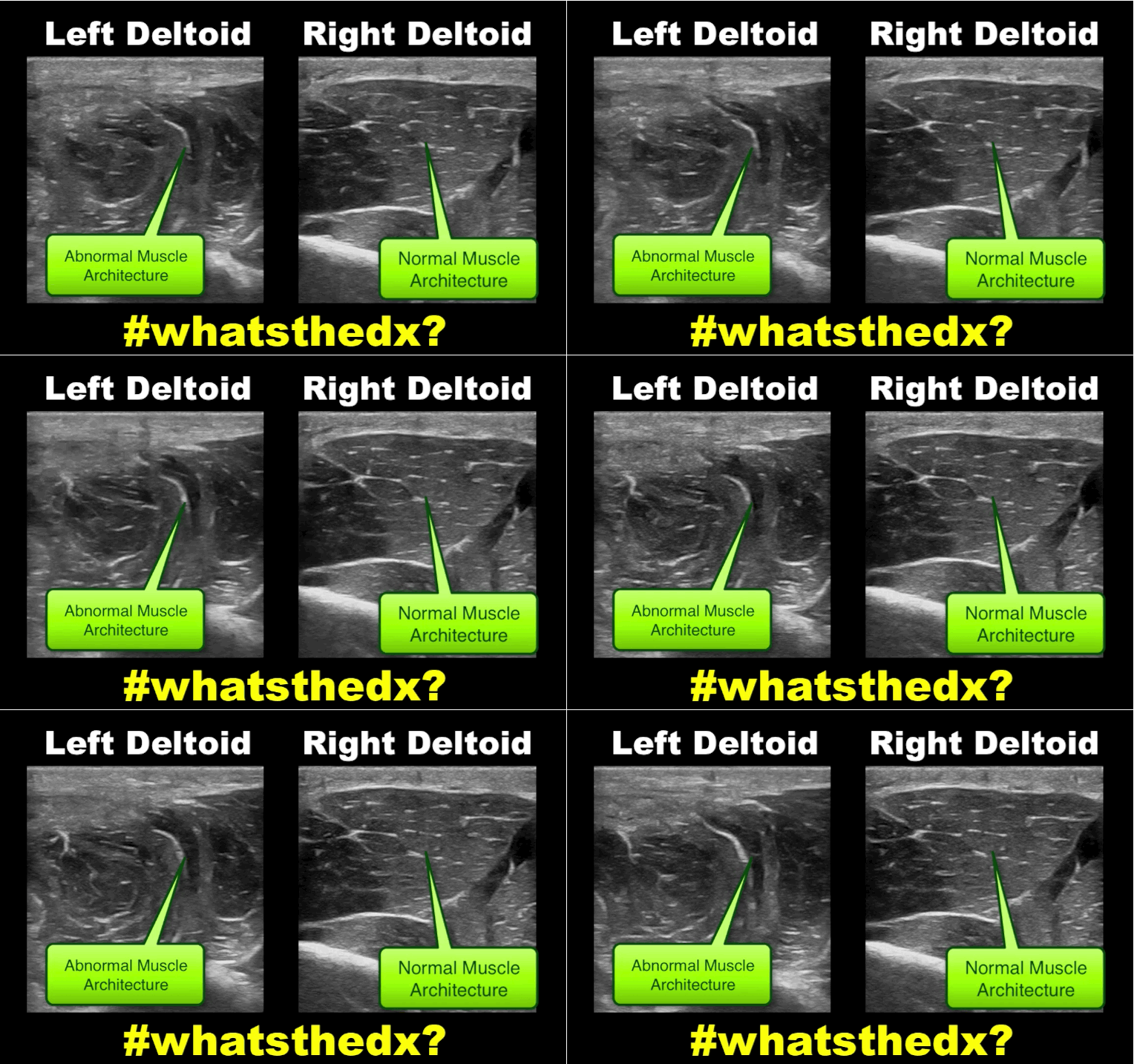
19 year-old male complaining of left arm pain one week after injecting anabolic steroids into his shoulder. What's the diagnosis?
Show Answer
Show References
Achilles tendon rupture
More common in
men, ages 30 - 40yo, s/p steroid injections, fluoroquinolone use, and episodic athletes "weekend warriors
Mechanism: usually during an athletic endeavor, sudden forced planar flexion or violent dorsiflexion of a plantar flexed foot
Location: Usually occurs 4 to 6 cm ABOVE the Achilles calcaneal insertion (hypovascular region)
Patient will report a sudden pop, gunshot like sound
History: Will report heel and calf pain and weakness/inability to walk
Physical examination: Palpable gap, weakness with plantar flexion, + Thompsons test
https://www.netterimages.com/images/vpv/000/000/007/7714-0550x0475.jpg
Consult orthopedics and splint in resting equinus
http://img.medscape.com/fullsize/migrated/408/535/mos0216.01.fig5b.jpg
Perianal Group A Strep is an infectious dermatitis seen in the perianal region that is caused by Group A beta-hemolytic Strep. Children will have a characteristic rash with a sharply-demarcated area of redness, swelling, and irritation around the perianal region. There may be associated swelling and irritation of the vulva and vagina (in girls) and penis in boys. Patients can have bleeding or itching during bowel movements.
The age range is often <10 years of age. There is often an absence of fever or other systemic symptoms.The diagnosis can be confirmed by obtaining a Rapid Strep swab from the area of interest. You can also collect a bacterial culture of the area.
Treatment requires a 14 day course of penicillin. Amoxicillin (40 mg/kg/day divided TID) and clarithromycin are alternative treatments. The additional of topical bactroban (mupirocin) can be effective, but it should not be used as monotherapy. Re-occurrence is common, so close follow-up is key.
Show References
Show References
Sepsis-3
- After nearly 2 decades, the definitions for sepsis and septic shock have been updated.
- Key findings from the Task Force convened by SCCM and ESICM include:
- Sepsis
- Definition: life-threatening organ dysfunction due to a dysregulated host response to infection
- ICU patients: organ dysfunction is defined as an increase of 2 points or more in the Sequential Organ Failure Assessment (SOFA) score
- ED patients: 2 or more of the following new qSOFA (quickSOFA) score may identify patients with increased mortality
- SBP less than or equal to 100 mm Hg
- RR greater than or equal to 22
- Altered mental status
- Septic Shock
- Definition: a subset of patients with sepsis and profound circulatory, cellular, and metabolic abnormalities
- Clinical Criteria:
- Persistent hypotension requiring vasopressors to maintain MAP greater than or equal to 65 mm Hg despite adequate volume resuscitation
- Lactate greater than or equal to 2 mmol/L
- The term "severe sepsis" is no longer used
- Sepsis
Show References
Colchicine is an alkaloid compound found in Colchicum autumnale that is often mistaken by foragers as wild garlic (Allium ursinum). Unintentional ingestion wild garlic or therapeutic misadventures among elderly population with history of gout often result in unintentional toxicity.
It is a potent inhibitor of microtubule formation and function involved in cell division and intracellular transport mechanism. Thus toxicity is related to diffuse cellular dysfunction of all major organs and results in significant morbidity and mortality.
Colchicine toxicity occurs in three phases:
| Phase | Time | Signs and symptoms | Therapy |
| I | 0 – 24 hr | · Nausea, vomiting, diarrhea · Salt and water depletion · Leukocytosis | · Antiemetic · GI decontamination · IV fluids · Observation for leukopenia |
| II | 1 – 7 days | · Sudden cardiac death (24 – 48 hr) · Pancytopenia · Acute kidney injury · Sepsis · Acute respiratory distress syndrome · Electrolyte imbalance · Rhabdomyolysis | · Resuscitation · G-CSF · Hemodialysis · Antibiotics · Mechanical ventilation · Electrolyte repletion |
| III | >7 days | · Alopecia (2-3 weeks later) · Myopathy, neuropathy, myoneuropathy. |
|
Management
- Primarily supportive care as no antidote is available.
- ICU admission due to risk of sudden cardiac death in symptomatic patients.
- Patients who does not manifest GI symptoms within 8 -12 hr are unlikely to be significantly poisoned.
There is not much data published on susceptabilities of urinary pathogens in infants. What resistance patterns are seen in infants < 2 months in gram negative uropathogens?
A retrospective study of previously healthy infants diagnosed with urinary tract infections in Jerusalem over a 6 year period examined this question. The standard treatment at this hospital included ampicillin and gentamycin for less than 1 month olds and ampicillin or cefuroxime for 1-2 month olds.
306 UTIs were diagnosed
74% were resistant to ampicillin
22% were resistant to cefazolin and augmentin
8% were resistant to cefuroxime
7% were resistant to gentamycin
Of the organisms cultured, 76% were E. coli and 14% were Klebsiella.
Bottom line: Know your local resistance patterns.
Show References
What are the criteria for dengue hemorrhagic fever?
- Fever lasting 2-7 days
- May be biphasic
- Hemorrhagic tendencies
- Positive tourniquet (aka Rumpel-Leede) test
- Petechiae, ecchymosis or purpura
- GI bleeding
- Thrombocytopenia (<100,000/mm3)
- Evidence of plasma leakage
- Increase in hematocrit >20% above age/sex normal
- Decrease in hematocrit >20% after volume replacement
- Signs of plasma leakage
- e.g. pleural effusions, ascites, hypoproteinemia
Show References
Spondylolysis
Prevalence 3-6% in the general population (Higher in athletes)
Location: L4 (5-15% of cases) & L5 (85-95% of cases)
Population: More likely in the skeletally immature athlete due to the vulnerability of the immature pars interarticularis to repeated stress
Symptoms: Lumbar pain worse with extension
Higher risk sports: Gymnastics, diving, weightlifting, wrestling
Treatment: Bracing and activity modification, physical therapy
- Good results in 80% with conservative management allowing return to play.
- Those who fail benefit from iliac crest bone grafting and posterolateral fusion.
-Return to play is controversial in this group
Please review th images below for anaomy and imaging appearence
http://orthoinfo.aaos.org/figures/A00053F01.jpg
http://www.sonsa.org/images/spondylolysis.jpg
http://www.physio-pedia.com/images/2/22/Spondylolysis_x_ray_.docx.jpg
Show References
Borrella mayonii a new species
There is a new bacteria that is causing Lyme disease. Borrella burgdorferi is the typical bacteria associated with lyme disease, but now several cases of Borrelia mayonii have been isolated from patients and ticks that live in Minnesota, Wisconsin and North Dakota. What is unique about this new species is that it is associated with nausea, vomiting, diffuse macular rashes, and neuro symptoms [e.g.: confusion, visual disturbance, and somnolence) along with the typical lyme disease symptoms of arthralgias and headaches.
Current lyme tests should detect this new species and treatment is the same as Borrella burgdorferi. The take home pearl is that we may see patients with "atypical" lyme disease symptoms so this should be on our differential for patients presenting with rashes, nausea, vomiting and neurologic complaints.