
Did you Know?
Our research faculty have received recognition for their work on the local, national, and international levels.
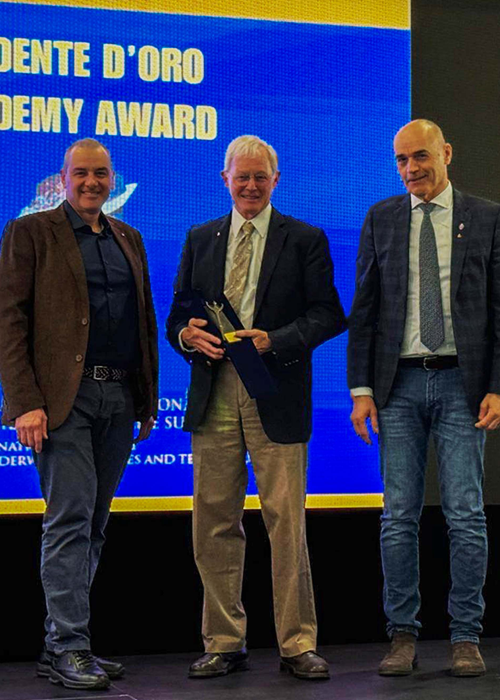
In February 2026, Professor Stephen Thom, MD, PhD, received the prestigious Tridente d’Oro (or Golden Trident) award from the International Academy of Underwater Sciences and Techniques.
The Tridente d’Oro award honors pioneers in exploration, science, and technology. It is known as the “Nobel Prize” of diving and is the most significant international recognition in the field.
As a relatively new medical specialty with extensive frontiers for new knowledge, Emergency Medicine is at an exciting crossroads. Our Department is committed to investing in research and harnessing the tools available to us to add to the depth and breadth of Emergency Medicine research.
Our Department currently hosts three labs and more than a dozen full-time research faculty, associates, and technicians.
In their research, our faculty explore topics including healthcare computing, data analytics, carbon monoxide, hyperbaric oxygen, critical care, trauma, allergic emergencies, sickle cell diseases, substance use disorders, population health, and social determinants of health, among others.
Our labs conduct basic science research as well as clinical research. We are renowned for our focus on microparticle research, and our labs are among the few in the world with the level of expertise required to isolate and analyze microparticles. Our labs also conduct clinical trials on a number of different topics, enroll patients in these trials, and ensure that all clinical research meets the highest ethical standards.
Our research faculty have received significant R-01 and K-01 level Federal funding, as well as grants from industry and other sources. Additionally, our faculty, residents, and fellows have successfully participated in the University of Maryland, Baltimore’s (UMB’s) Institutional Review Board, graduated from UMB’s Clinical and Translational Research Training (CARTI) Track, and served as peer reviewers for numerous journals.
We appreciate our strong partnerships throughout the University of Maryland School of Medicine (UMSOM), UMB, and the entire University of Maryland System. Given our Department's strengths in health informatics—as highlighted in our recently developed Center for Emergency Medicine Data Analytics and Reporting (CEDAR)—we are proud to partner with the University of Maryland's Institute for Health Computing. In addition to our longstanding associations with UMSOM’s departments of Epidemiology and Preventive Medicine and Neurology, we also maintain strong connections with the National Study Center for Trauma and Emergency Medical Systems, the Maryland Institute for Emergency Medical Services Systems, and the R. Adams Cowley Shock Trauma Center, among others.
As the first public medical school in the United States, UMSOM is one of the fastest-growing, top-tier biomedical research enterprises in the world. UMSOM generates nearly $600 million in research and development annually and consistently outpaces its peers in terms of medical research and education. We are proud of our Department's contributions to UMB's research development and look forward to continuing to strengthen our research focus in the years to come.