
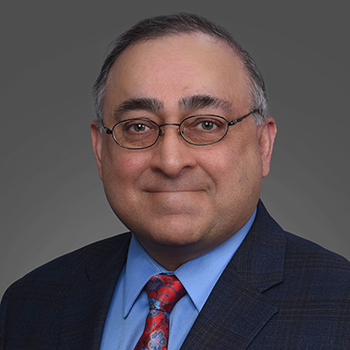
Dr. Amal Mattu, MD
Vice Chair of Education
Welcome from the Vice Chair of Education
Proudly cultivating the next generation of Emergency Medicine leaders
At the University of Maryland Department of Emergency Medicine, we have a well-earned reputation for fostering a learning culture that is, simply and unequivocally, unsurpassed.
Our faculty are some of the strongest educators in our profession. And we are dedicated to synthesizing, simplifying, and disseminating Emergency Medicine practice in ways that are relevant, engaging, and effective.
In addition to focusing on the scientific, medical, and technical competencies of emergency medicine, we also emphasize the leadership and humanity skills required to excel in our specialty. After graduating from our programs, our alumni have gone on to become renowned physicians, educators, researchers, administrators, innovators, and leaders in our field.
Our comprehensive training curriculum is designed for learners at every end of the educational spectrum—from medical students, to residents, fellows, and faculty.
Medical Student Training
Over the years our faculty have trained thousands of undergraduate medical students. All third-year students are now required to participate in a four-week clerkship rotation in Emergency Medicine (EMER530), which includes a procedure lab, suture lab, splint lab, and ultrasound lab, in addition to clinical shifts, weekly conferences, and other special events and offerings.
Residency Training
Our residency curriculum boasts innovative educational curricula, with focus on risk management, critical care, cadaver-based procedure and airway skills, geriatric EM, simulation, leadership, advanced electrocardiography and cardiology, and a reading curriculum based on cutting-edge literature.
We offer three training pathways:
-
- a 3-year categorical Emergency Medicine residency;
- a 5-year Emergency Medicine/Pediatrics combined residency; and
- a 5-year Emergency Medicine/Internal Medicine combined residency, with the option to extend and pursue a triple residency in EM/IM/CC.
Our residents all receive outstanding clinical and academic training. They write manuscripts, have the opportunity to conduct guided research, and participate in committees; they also gain experience in ED leadership through our unique didactic curriculum.
Fellowship Programs
Tailor-made to suit an individual’s interests and career goals, our fellowships are directed by members of our faculty who have already developed their careers in those respective areas.
In recent years, we’ve created fellowships in
-
- emergency cardiovascular medicine,
- faculty development,
- risk management,
- health policy and leadership,
- simulation, and
- ultrasound.
In the near future, we hope to create fellowships in hyperbarics/undersea medicine, research, EMS, and emergency geriatrics.
Faculty Development
Every year, our faculty receive some of the highest, national level awards for contributions to EM education and leadership. To that end, I am personally committed to ensuring our faculty—especially our junior faculty—are equipped to succeed. Faculty attend local and national courses that focus on teaching, writing, and research skills. We consistently sponsor junior faculty to attend the ACEP Teaching Fellowship in Dallas and now have more Teaching Fellowship graduates than any EM Department in the country.
We also encourage faculty to engage in local and national service activities, edit textbooks, publish manuscripts, and collaborate in research. There is no Department more involved in national and international lecturing; faculty development promotion; or textbook publication, than ours.
There is much more to say, but I’ll leave it at this: our Department has and always will be a special place for Emergency Medicine education. We believe that the great hope for the future success of Emergency Medicine lies in the hands of teachers, and we are proud to host and cultivate those teachers here at the University of Maryland.
Amal Mattu, MD
Distinguished University Professor and Vice Chair of Academic Affairs
Department of Emergency Medicine
University of Maryland School of Medicine