
Study Sheds Light On How Early Pancreas Lesions Become Cancerous
May 21, 2026 | Heide Aungst
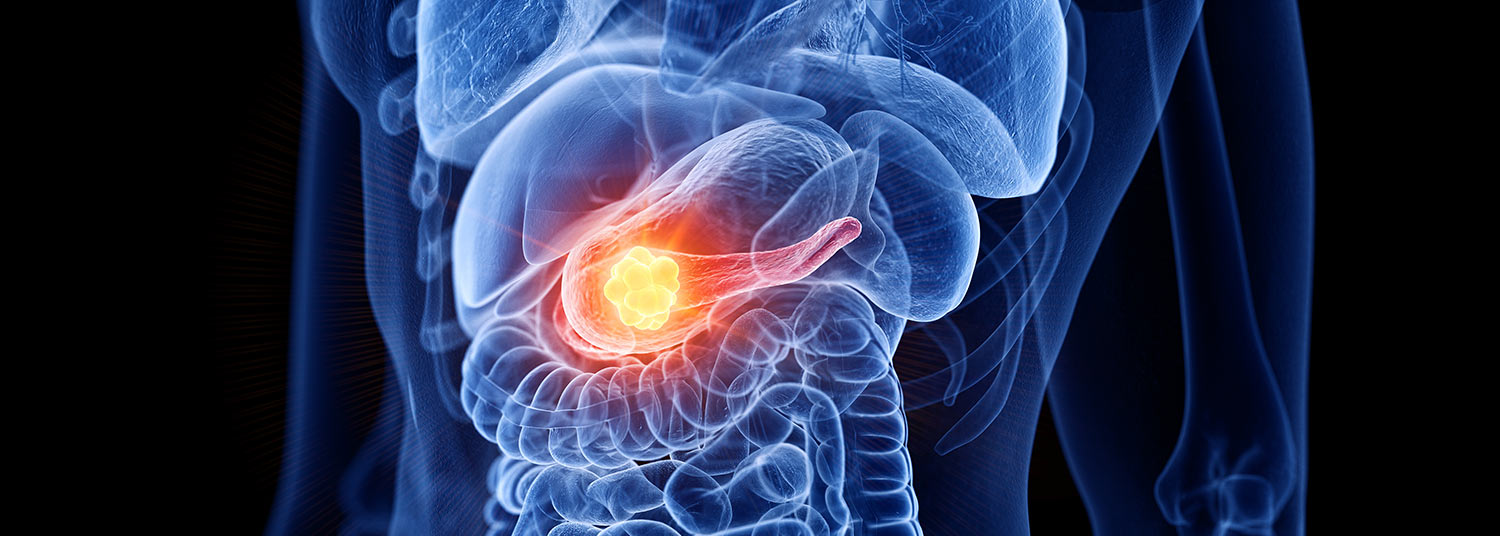
Findings Help Explain Why Many Precursor Lesions Never Develop Into Pancreatic Cancer
In an unexpected finding, a new study flips on its head researchers’ understanding of how precancerous pancreas lesions evolve into pancreatic cancer. The paradigm-changing discovery has tremendous implications for identifying people at higher risk of cancer or even, potentially stopping malignant transformation.
In a study just out in the American Association for Cancer Research’s journal Cancer Discovery, scientists from the University of Maryland School of Medicine and the University of Michigan combined cutting-edge technologies, including spatial transcriptomics and single-cell RNA sequencing, with advanced computational and bioinformatics approaches to precisely map the cellular architecture surrounding precancerous pancreas lesions that occur sporadically relative to those that are cancer-associated to learn how the lesions might progress to cancer.
 Typically in tumors, cancer cells induce surrounding non-malignant cells (the microenvironment) to become “helpers” and promote tumor growth. Precursor lesions also have a microenvironment of other cells and express a similar set of genes as cancer cells but less strongly. When researchers looked at the cells in the environment surrounding the lesions, they expected to see the same “tumor light” features. Surprisingly, the microenvironment of the precursor lesions was entirely different.
Researchers at the Institute for Genome Sciences (IGS) at the University of Maryland School of Medicine (UMSOM) developed and applied cutting-edge spatial analysis and bioinformatics pipelines that enabled the team to interpret the cellular maps of pancreatic precursor lesions.
“It is incredible to see how we can uncover the fundamental cellular mechanisms of disease etiology by blending new computational methods and cutting-edge spatial transcriptomics technologies. That allowed us to delve into the unknown dynamics of pancreatic tumor evolution,” said co-senior author Elana Fertig, PhD, FAIMBE, Director of IGS; Associate Director for Quantitative Science at The University of Maryland Marlene and Stewart Greenebaum Comprehensive Cancer Center; and Professor of Medicine at UMSOM. “Through advanced spatial and computational technologies, we were able to visualize how malignant cells in these early lesions interact with their environment to delineate the interplay of precancer cellular ecosystems.”
Study lead senior author Marina Pasca di Magliano, PhD, Maud T. Lane Professor of Surgical Immunology and co-director of the Rogel and Blondy Center for Pancreatic Cancer at the University of Michigan, said the results took the researchers by surprise.
“It turns out, the microenvironment of these precursor lesions is the same as the microenvironment of the normal pancreas,” said Dr. Pasca di Magliano. “The lesions have not convinced any of the cells around them to change. That’s not what we were expecting. We were expecting the two components, the cells and the microenvironment, to evolve in lockstep. They did not.”
This discovery likely explains earlier research from the team that showed precursor lesions are common, including in younger people, while pancreatic cancer remains relatively rare.
The transformation of normal pancreas cells into pancreatic cancer has been challenging to study in humans. Microscopic precursor lesions are extremely difficult to isolate in the pancreas and have typically been recovered during surgery when a nearby tumor is removed. At this point, the PanIN microenvironment is likely influenced by the nearby tumor.
“These lesions are like needles in a haystack. The prior way of looking at this was to look at the entire haystack. You get a lot of information about hay and very little information about the needle. These new techniques allow us to just focus in on the needle so we can look at multiple needles using the same amount of computing power and resources,” said co-senior author Timothy Frankel, MD, Maud T. Lane Professor of Surgical Oncology and co-director of the Rogel and Blondy Center for Pancreatic Cancer at U-M.
With an extensive tumor microenvironment—including fibroblasts and immune cells that play complex roles in the biology of the tumor—the study suggests that something else needs to happen to trigger cancer growth – inflammation, pancreatitis, smoking, age, obesity or other stressors linked to pancreatic cancer.
In addition to their collaboration with IGS, U-M researchers benefitted from a unique collaboration between the U-M Rogel Cancer Center and Gift of Life Michigan that allowed researchers to procure healthy donor pancreases for research. From this partnership, researchers isolated PanIN lesions from more than 150 donated pancreases from individuals ages 20-70.
The study reflects the critical role of multidisciplinary team science that integrates cancer biology, spatial genomics, pathology, and computational biology, empowered uniquely by multi-institutional support in NCI Consortia.
To foster further discovery, the authors have created an open access website and interactive tool to allow other researchers to query the data. The tool is available at https://pascadimagliano-lab.github.io/PancAtlas/.
Contact
Heide Aungst
HAungst@som.umaryland.edu
216-970-5773 (cell)
Related stories
Friday, July 25, 2025
New Research Simulates Cancer Cell Behavior
In the same vein as weather forecast models that predict developing storms, researchers now have developed a method to predict the cell activity in tissues over time. The new software combines genomics technologies with computational modeling to predict cell changes in behavior, such as communication between cells that could cause cancer cells to flourish.