
Have you ever had to give a national presentation, but can't find that one ultrasound clip or image that you really need? You could "borrow" it from someone on the internet, but you are secretly afraid that the "owner" of the clip is lurking somewhere in the audience. Well, the guys at the Ultrasound Podcast (www.ultrasoundpodcast.com) have come to your rescue by creating SonoCloud, a free access ultrasound library. At Sonocloud, you will find several categories of ultrasound clips and images for you to view and share,...and again it's FREE. In fact, the only thing you are expected to do is upload some of your own ultrasounds to share.
Show References
[Pearls provided by Dr. Semhar Tewelde]
Cocaine...
1. causes systolic and diastolic dysfunction, arrhythmias, and atherosclerosis even in young users with relatively few cardiac risk factors, typically TIMI risk score <1
2. decreases myocardial contractility and ejection fraction by blocking sodium and potassium channels within the myocardium
3. prolongs the PR, QRS, and QT intervals on the ECG
4. users have a higher overall incidence of MI (odds ratio 3.8 to 6.9)
5. -induced chest pain is associated with acute MI in approx. 6% of cases
6. increases the risk of MI by 24-fold in the first hour after use
7. contributes to approx. 1 of every 4 MIs between 18 and 45 years of age
Show References
First Metacarpal Fractures:
There are two types of fractures that commonly occur at the base of the 1st metacarpal. They are:
Bennett Fracture: This is an intraarticular fracture at the base of the 1st metacarpal that always involves some degree of subluxation or dislocation of the 1st carpometacarpal joint.
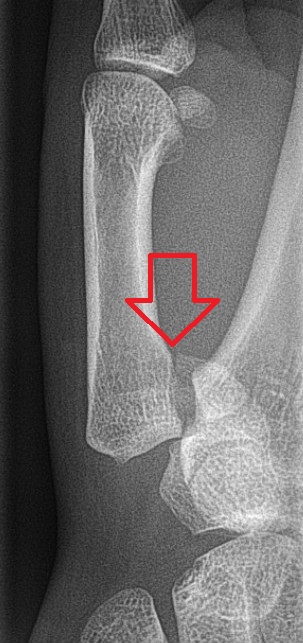
Image from Wikipedia Commons
- This is the most common fracture of the thumb.
- This fracture is typically caused by axial loading the thumb while the metacarpal is partially flexed. A common mechanism is when a person punches a wall or hard object with their thumb take the brunt of the force.
- Most of these fractures will require surgical repair but can be treated in the ED with a Thumb Spica Splint.
Rolando Fracture: This is a communited intraarticular fracture at the base of the first metacarpal that typically has a T or Y shaped configuration with 3 fragments.

Image courtesy of WikiPedia Commons
- Less common then Bennett Fractures
- Associated with a worse prognosis
- Requires surgical repair but can be splinted in the ED with a thumb spica splint.
Submitted by Dr. Lauren Rice
The summertime can be full of lots of fun activities (beach, fireworks, cookouts, and campfires) that can put children at risk of burns.
Burn depth classification:
1. Superficial (first-degree): red and blanching with minor pain, resolves in 5-7 days
2. Partial thickness (second-degree): red and wet with blisters, very painful, resolves in 2-5 weeks
Treatment: clean with soap and water twice daily, and apply silvadene wrap with gauze, kerlex
3. Full thickness (third-degree): dry and leathery without pain, no resolution after 5-6 weeks, may require graft
Treatment: wound debridement and dressings as above
Parkland formula: 4ml/kg/%TBSA in 1st 24 hours with 50% of total volume in 1st 8 hours
Calculate burn surface area:
-SAGE: free computerized burn diagram available at www.sagediagram.com
-Rule of Nines > 14 years old
-Rule of Palm <10 years old
Burn Center Referral
-Extent: partial thickness of >30% TBSA or full thickness of >10-20%
-Site: hands, feet, face, perineum, major joints
-Type: electrical, chemical, inhalation
Show References
Pathology at the umbilicus can manifest as inflammation, drainage, a palpable mass, or herniation.
Omphalitis - A cellulitis of the umbilicus. Mild cases often respond to local application of alcohol to clean the area, but due to the possibility of rapid progression and abdominal wall necrotizing fasciitis, admission for observation and IV antibiotics is usually warranted. Cover staph, strep, and GNRs.
Umbilical granuloma - As the umbilical ring closes and the cord sloughs off, granulation tissue formation is a normal part of umbilical epithelialization. There is sometimes an overgrowth of granulation tissue which can be treated once or twice with silver nitrate. Should the tissue not regress after a 1-2 treatments, the patient should be referred to pediatric surgery for excision and evaluation of other pathology (urachal or vitelline remnants).
Umbilical fistula - This is a patent vitelline duct and is characterized by persistent drainage that is bilious or purulent. A fistulogram using a small catheter and radio opaque dye can sometimes be helpful in determining the source of drainage (dye should be seen in the small bowel).
Umbilical polyp - Often confused with an umbilical granuloma with its glistening cherry red appearance, this is actually a vitelline duct remnant and contains small bowel mucosa. It does not regress with silver nitrate.
Vesicoumbilical fistula/sinus - The urachal versions of the umbilical fistula. This are a failure of complete closure of the urachus, resulting in persistent drainage of urine from the umbilicus, and infection (including recurrent UTIs). A fistulogram can be helpful for diagnosis.
Though an uncommon event, Drug-Induced Autoimmune thrombocytopenia occurs in a variety of drugs. Having recently diagnosed a patient that was receiving the "double-dose" bactrim for an MRSA abscess, it is worth mentioning the other drugs that have been reported to do it. Platelet count can go down to lethal levels and result in death due to the coagulopathy. Treatment is effective with platelets and no contraindication like in TTP.
Drugs that have been reported to do it:
abciximab, acetaminophen, amiodarone, amphotericin B
Carbamazepine, danazol, diclofenac, digoxin
Methyldopa, procainamide
Rifampin, trimethoprim-sulfamethoxazole, vancomycin
Acute Kidney Injury and Tumor Lysis Syndrome
- Tumor lysis syndrome (TLS) is characterized by hyperkalemia, hyperphosphatemia, hypocalcemia, and hyperuricemia.
- Acute kidney injury in TLS increases patient mortality and can be caused by an obstructive uropathy from calcium phosphate crystalluria or uric acid crystal precipitation.
- Fluid resuscitation remains the primary treatment for TLS.
- Urine alkalinization, however, is no longer recommended, as it can result in calcium phosphate crystal precipitation.
- Recombinant urate oxidase rapidly decreases uric acid levels and should be given to patients at high-risk for TLS and those with pre-existing kidney disease and high uric acid levels.
Show References
Question
77 year old male presents to the Emergency Department one week after a motor vehicle crash in which he suffered minor facial injuries. He is now concerned because his eye looks like this. Diagnosis?

Show Answer
Show References
LBBB is defined by 3 criteria QRS >125msec, V1- QS or rS, and R wave peak time 60ms with no q wave in leads I, V5, V6
Show References
I am often asked whether physical activity has a positive or negative effect on the overall health of knee cartilage. The answer is unclear. Published data are conflicting.
What is known and generally agreed on:
1) Physical activity has been shown to facilitate cartilage development in children
2) Forced immobility (spinal cord injury) results in rapid cartilage loss
3) The medial knee compartment experiences significant mechanical loads during weight-bearing activity and is often the primary site of knee OA
A recent study attempted to answer whether 1) long-term (10yrs) participation in vigorous physical activity would benefit knee cartilage in healthy adults and 2) whether there were certain subgroups with asymptomatic preexisting structural knee changes which predict a harmful cartilage response to long-term physical activity.
Vigorous = activity generating sweating or SOB at least 20min 1/wk
Healthy older adults (mean age 57.8 yr) performing persistent vigorous physical activity had an increased risk (odds ratio 1.5) of worsening medial knee cartilage defects but not of a change in cartilage volume
In those w/ asymptomatic preexisting structural knee changes, there was worsening of cartilage defects (odds ratio 3.4) and a trend toward increased rate of loss of cartilage volume (again in the medial knee compartment)
Long-term effects of vigorous physical activity may depend on the preexisting health of the joint
Show References
Intussusception is the telescoping or prolapse of one portion of the bowel into an immediately adjacent segment.
- age: 3 months to 6 years, most common among 3-12 months (although case reports exist in adults)
- after constipation, most common cause of abdominal pain in infants and pre-school aged children
- classic triad: colicky abdominal pain, vomiting, and red currant jelly stools
- occurs in only 10% -20% of cases
- although colicky pain is the most common symptom, 15-20% experience no pain
- vomiting is often the earliest symptom, but may be absent in 30-40% cases
- most patients (75%) without grossly bloody stool, may be positive for occult blood
- plain abdominal radiographs may be normal in 30% of cases
- consider in differential for intants with altered mental status/ lethargy
- TIPS AEIOU - one of the "I"s is for intussusception
- choice of radiographic evaluation is institution-dependent
- ultrasound may be diagnostic but is not therapeutic
- air or contrast enema can diagnose and treat
- both are operator dependent
Transplant patients are the norm now in the ED. Their drug lists are immense and are usually on some form of immunosuppression to prevent rejection of the transplanted organ. Two common medications are cyclosporine and tacrolimus. They share many adverse effects like hepatotoxicity, nephrotoxicity and hypertension. Here is the mechanism of action and some unique adverse effects to these powerful immunosuppressants (there are many more so be wary):
1) Cyclosporine - suppresses T-cell activation and growth. Unique toxicity - painful neuropathy of the fingertips and toes, cortical blindness
2) Tacrolimus - simiar to cyclosporine but actually hampers T-cell communication/signal transduction. Unique toxicity - can also cause cortical blindness but is also known to cause diabetes/hyperglycemiad
Two recently presented abstracts at the 2012 Society of Critical Care Medicine conference suggest that the combination of vancomycin and piperacillin-tazobactam may lead to acute kidney injury (AKI) in the critically ill. There may also be evidence to suggest that piperacillin-tazobactam alone increases the risk of AKI.
Both abstracts retrospectively compared patients who received either vancomycin alone or the combination of vancomycin and piperacillin-tazobactam. In both studies, the rates of AKI were significantly lower in patients treated with vancomycin alone as compared to patients receiving both vancomycin and piperacillin-tazobactam.
Bottom line: Although the current evidence does not support a change in our clinical practice, more prospective studies exploring this topic are necessary.
Show References
Question
79 year old male with headaches, ataxia, falls, and difficulty urinating. What's the diagnosis?

Show Answer
For patients presenting to the ED with chest pain, we've been taught that “classic” or “typical” presentations for ACS (chest pressure with radiation to the left neck/jaw/shoulder/arm, dyspnea, diaphoresis, nausea, vomiting, lightheadedness) are most worrisome. Yet, many of the patients that present with typical symptoms end up having negative workups for ACS. What are the symptoms that truly predict ACS? Three major studies have demonstrated that the best predictors of ACS in patients presenting to the ED with chest pain are (not necessarily ranked in order):
1. chest pain that radiates to the arms, especially if the pain radiates bilaterally or to the right arm
2. chest pain associated with diaphoresis
3. chest pain associated with vomiting
4. chest pain associated with exertion
The description of the chest pain (e.g. "pressure" or "squeezing," etc.), the dyspnea, nausea, lightheadedness, and pain at rest were, surprisingly, not helpful at predicting ACS.
The simple takehome point is the following: always ask your patient with chest pain if the pain radiates, if there was associated diaphoresis, if there was associated vomiting, and if the pain is associated with exertion. If the answers to any of these 4 questions is "yes," think twice before labeling the patient with a non-ACS diagnosis.
Show References
Contrast Allergy:
Many patients will report that they have a allergy to iodinated contrast by saying that they are allergic to iodine
Iodine, itself, is not an allergen and is a required element for thyroid homrone production. Plus could you imagine the hordes of people that would be having allergic reactions everyday when they add salt to their french fries. Our EDs would be completely swamped.
A recent meta-analysis by Drs. Schabelman and Witting also showed the following:
- The risk of a reaction to contrast ranges from 0.2% to 17% depending on the type used, and the severity of the reaction considered.
- The risk of a reaction in patients with a seafood allergy is similar to that in patients with other food allergies or asthma. Seafood is not unique to contrast media.
- A history of prior reaction to contrast increases the risk of mild reactions to as high as 7-17% but has not been shown to increase the rate of severe reactions.
- The risk of death due to contrast is estimated to be 0.0006 - 0.006%.
As we enter Crab eating season in Maryland, lets stop giving shellfish a bad name. A patent with any allergy is at increased risk, but shellfish is no higher a risk than those allergic to Strawberries.
Show References
Definition: Fracture of the humerus just proximal to the epicondyles.
- Extension type (majority >80%; distal fx segment displaced posteriorly)
- Flexion type (distal fx segment displaced anteriorly)
- Any diminished pulsations or capillary refill should cause concern for vascular compromise (arterial compression, tear, or compartment syndrome).
- Place a continuous pulse oximetry probe on the affected hand to monitor bloodflow.
- The radial, median, or ulnar nerves may be affected and should be assessed.
-Nondisplaced fractures may follow up with orthopedics within 1 week after posterior long arm splinting (elbow at 90 degrees & forearm in neutral position)
-Displaced fractures require prompt pediatric orthopedic consultation for closed reduction in OR vs operative repair.
-Obtain emergent orthopedic consultation for compartment syndrome, neurovascular compromise, or open fracture.
-Partial reductions in ED likely just increase soft tissue swelling and delay definitive reduction and should be reserved for rare cases of vascular compromise.
References:
Wheeless, CR. Pediatric Supracondylar Fractures of the Humerus. Wheeless’ Textbook of Orthopedics. [Accessed online 4/22/12.] http://www.wheelessonline.com/ortho/pediatric_supracondylar_fractures_of_the_humerus
Ryan, LM. Evaluation and management of supracondylar fractures in children. UpToDate. [Accessed 4/22/2012]. http://www.uptodate.com/contents/evaluation-and-management-of-supracondylar-fractures-in-children
- Several macrolide antibiotics can cause QTc prolongation and dysrhythmias (e.g., erythromycin), but azithromycin is thought to have little cardiotoxicity.
- A cohort of patients taking azithromycin was compared to those taking no antibiotics, amoxicillin, ciprofloxacin, or levofloxacin.
- When compared to no antibiotics, amoxicillin, and ciprofloxacin, azithromycin was associated with a small but significant increased risk of cardiovascular death. Azithromycin was similar to levofloxacin.
- Important points:
- Increased risk translates to 47 additional deaths per 1 million prescriptions.
- Increased risk only occurs during the 5 day course and does not carry on after discontinuation.
- Patients most likely to die were in the highest risk category based on preexisting cardiovascular diseases (245 deaths per 1 million prescriptions).
- Bottom line: Patients may start asking about this study finding when given a prescription for azithromycin. Although a small risk, it may be prudent to prescribe an alternative if patients have preexisting cardiovascular disease.
Show References
Use the Measured Sodium Concentration!
- During a recent shift, a question arose regarding whether to use the measured or corrected sodium to calculate the anion gap in a critically ill patient with DKA.
- Recall that the anion gap provides an estimation of unmeasured anions - in this case acetoacetate and beta-hydroxybutyrate.
- Glucose is electrically neutral and therefore does not affect the anion gap.
- When calculating the anion gap in a patient with DKA, use the actual (measured) serum Na, rather than the corrected value.
Show References
Question
19 year-old male presents with L ankle pain and obvious deformity after jumping out of a window and landing on his inverted foot. What's the diagnosis?
