
University of Maryland and its School of Medicine Ranked Among Top Universities Nationwide for Research by National Science Foundation
January 20, 2026 | Jon Kelvey
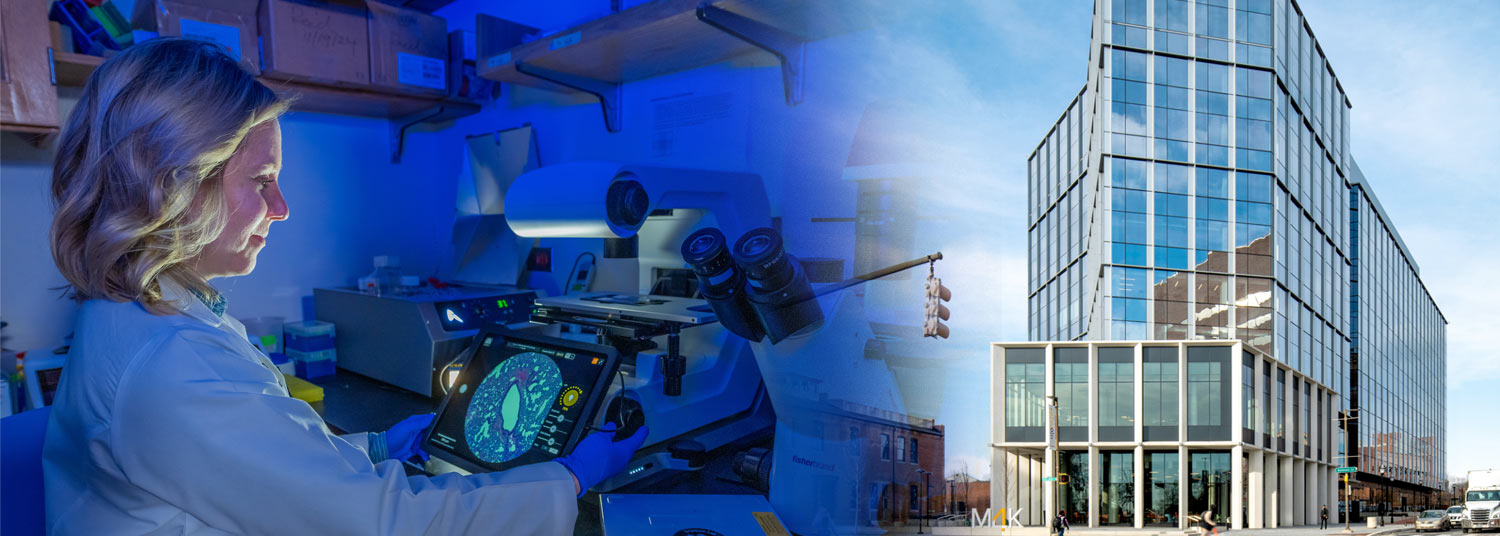
Growing Research Portfolio Drives Innovation and Technology in the Baltimore-DC Corridor
The University of Maryland has climbed to No. 14 among all U.S. universities and No. 9 among public universities for research and development (R&D) spending, with its School of Medicine ranking No. 27 among all U.S. medical schools and No. 14 among public medical schools, according to the National Science Foundation’s Higher Education Research and Development (HERD) Survey.
 Together, the combined University of Maryland, Baltimore (UMB) and University of Maryland, College Park (UMCP) research enterprise achieved record-breaking expenditures of $1.54 billion in Fiscal Year 2024, an increase of more than $154 million from the previous year. The University of Maryland School of Medicine contributed significantly to this achievement, reporting $586.9 million in R&D expenditures and earning its place among the nation’s top medical research institutions.
"The University of Marland School of Medicine’s competitive research grant portfolio of greater than $500 million dollars a year directly creates jobs in Baltimore and in the State of Maryland, and advances fundamental and translational science that improves the health of our nation. Increasing research and development expenditures directly strengthen our ability to translate ideas into new technologies, launch high-impact start-ups, and attract industry and venture capital partners," said Mark T. Gladwin, MD, Dean of UMSOM who is also the Vice President for Medical Affairs, University of Maryland, Baltimore (UMB), and the John Z. and Akiko K. Bowers Distinguished Professor. "This momentum and the NSF rankings reflect the extraordinary creativity of our faculty and the robust ecosystem we've built to support them. Together, we are transforming pioneering research into real-world solutions, and shaping Maryland's emergence as a national leader in biomedical innovation."
 The HERD survey, widely regarded as the national benchmark for academic R&D activity, reflects the combined strength of the University of Maryland, College Park and the University of Maryland, Baltimore. The partnership unites UM-College Park’s leadership in engineering, quantum computing and cybersecurity with UM-Baltimore’s expertise in AI and medical technology, life sciences research and human services; this synergy accelerates the translation of discovery into patient care and community benefit.
“The growth of our research enterprise reflects the growing impact of our work together,” said Bruce E. Jarrell, MD, FACS, President of UMB. “Our researchers do more than advance knowledge in their fields; they work tirelessly to ensure that the discoveries they make improve the health and well-being of people world-wide. In this way, our ranking is much more than a scorecard; it is a testament to the critical importance of public higher education and research institutions here in Maryland.”
School of Medicine Investments from Bench to Bedside
 Recent research initiatives at the UMSOM include the development of shelf-stable synthetic blood, the use of focused ultrasound to deliver chemotherapy for brain cancer across the blood-brain barrier, and the development of protein-based therapies to use as rapid antidotes to carbon monoxide poisoning. University of Maryland and UMSOM investments not only support the basic, translational, and clinical research necessary to make such important discoveries, but also provide the infrastructure necessary for commercial development. Programs such as the University of Maryland Baltimore Life Science Discovery (UM-BILD) life sciences accelerator and UM Ventures have provided much needed funding, lab space, device prototyping, and mentorship to UMSOM researchers. This has enabled faculty to generate innovative and entrepreneurial ventures resulting in 199 patent filings, 27 license agreements, and the launch of eight start-up companies in Fiscal Year 2025 alone.
“Turning life science discoveries into commercialized treatments and technologies for patients is a challenging pathway with a formidable set of obstacles,” said Jason Rose, MD, MBA, a UMSOM Associate Professor of Medicine, the Associate Dean of Innovation and Physician Science Development, and Director of Faculty Entrepreneurship. “At the University of Maryland, we distinguish ourselves by providing an exceptional ecosystem of resources for our innovative researchers, ranging from early-stage technology investments, to assistance navigating through complex regulatory landscapes. Our goal is to help our innovators take new therapies from lab bench to patient bedside.”
Maryland as an Emerging Med-Ed-Tech Leader
The greater Baltimore‑Washington corridor has emerged as a formidable hub for technology, research, and innovation. Maryland has the highest number of public sector research labs in the nation, which has enabled important collaborations and landmark discoveries with neighboring academic institutions. Such discoveries have fueled biotech startups on university campuses that have become full-fledged commercial ventures, providing new therapies for patients nationwide.
Federal and State of Maryland resources and programs that place UMSOM in the center of a region poised for growth include:
- One of the highest concentrations of research labs in the nation, including the 27 institutes and centers of the NIH, and multiple Army Research Lab, FDA, and Federally Funded Research and Development Center facilities.
- Maryland’s status as the Cybersecurity Capital, due to proximity to the NSA, US Cyber Command, and more than 300 cybersecurity companies.
- The US Economic Development Administration naming the Baltimore region one of 31 Regional Technology and Innovation Hubs.
- The Maryland/DC/Virginia region is a Top-3 Biopharma cluster, leading the nation with more than 79,000 new patents in 2025. Maryland alone hosts more than 1,700 bioscience companies and facilities, including AstraZeneca’s new $300 million cell therapy plant in Rockville.
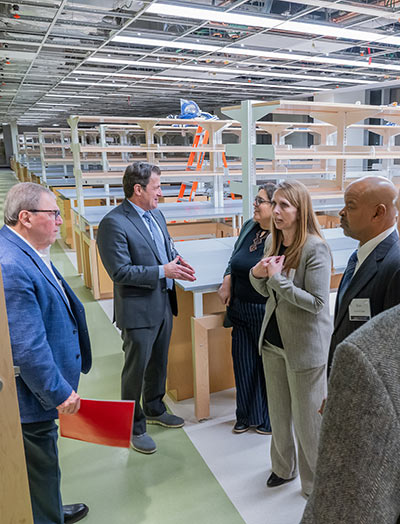 To maximize the impact of University of Maryland investments and leverage the region’s leadership in biomedical research and education, UMSOM and its partners recently launched an Innovation Alliance, which brings entrepreneurs and investors together with physician-scientists, surgeons, and medical technologists. The initiative, launched in 2025, aims to attract venture capital, foster start-ups, and establish the Baltimore region as a major national hub for new biomedical ventures.
In addition to UM Ventures and UM-BILD, other University of Maryland initiatives leveraging regional resources to drive innovation include:
- The Edward and Jennifer St. John Center for Translational Engineering in Medicine (CTEM), a collaboration between UMSOM and University of Maryland, College Park bringing together biomedical researchers and engineers.
- The University of Maryland Institute for Health Computing (UM-IHC), which offers cutting-edge AI, bioinformatics, and AI support for researchers in all fields and across all University of Maryland campuses.
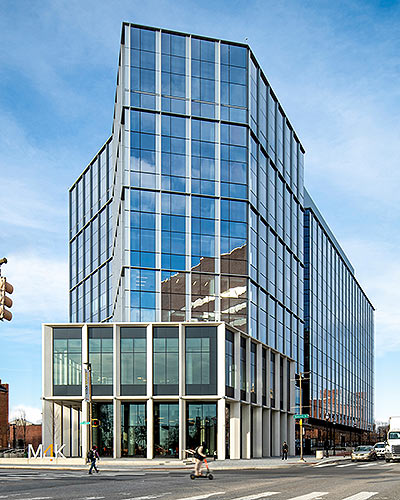
- The University of Maryland BioPark on the UMB campus, which includes more than 160,000 square feet of wet lab space in the new 4 MLK building.
Contact
Jon Kelvey
JKelvey@som.umaryland.edu
Related stories
Wednesday, January 15, 2025
University of Maryland, Baltimore and Wexford Science & Technology Cut Ribbon on 4MLK Building
The University of Maryland, Baltimore (UMB) and Wexford Science & Technology, LLC, celebrated the grand opening of 4MLK, the newest addition to the University of Maryland BioPark, with a ribbon-cutting ceremony. The event brought together distinguished guests, including Lieutenant Governor Aruna Miller and Mayor Brandon Scott, alongside University and Wexford leaders, neighborhood representatives, innovation community members, economic development officials, and BioPark tenants.