
AIDS Memorial Quilt Brings HIV History and Community Legacy to UMSOM
October 01, 2026 | Jennifer Gonzales
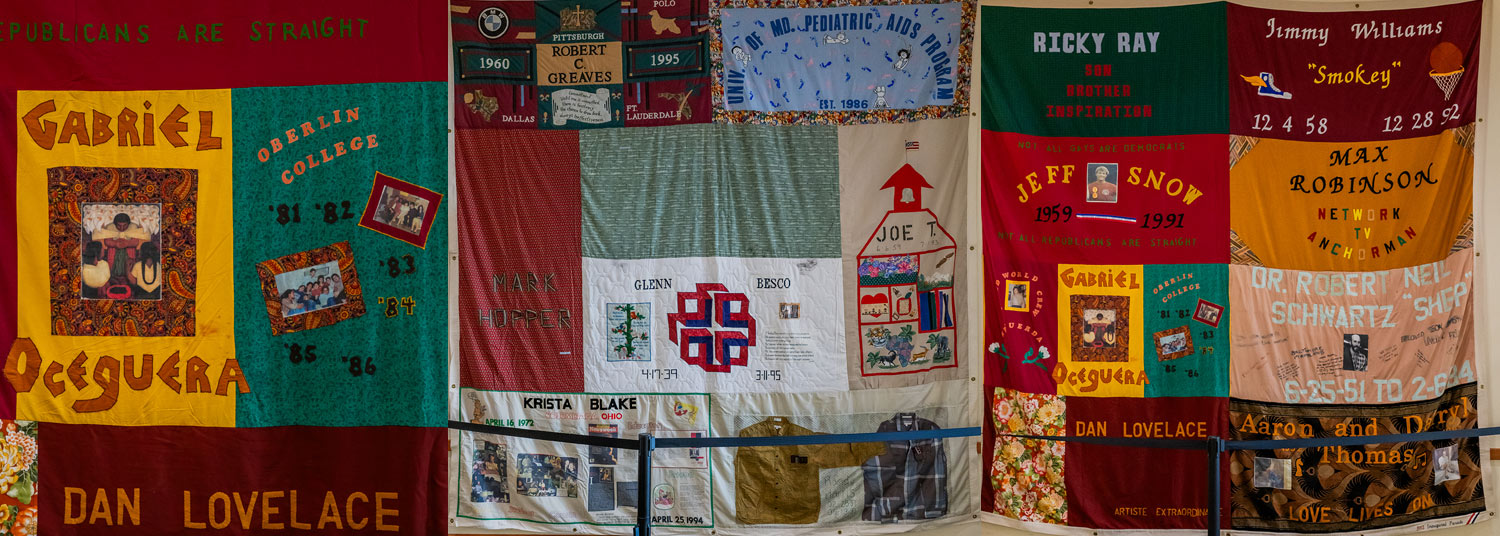
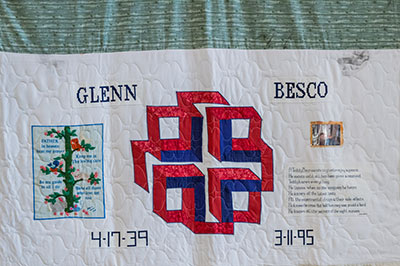
For a week in mid-September, sixteen panels from the famous AIDS Memorial Quilt were displayed at the University of Maryland, School of Medicine (UMSOM), helping to connect the University community with the history of the HIV/AIDS epidemic and the people whose lives were lost to HIV/AIDS.
The AIDS Memorial Quilt was conceived in November 1985 by longtime human rights activist Cleve Jones as a way to honor and remember people lost to HIV/AIDS. In 2019, the National AIDS Memorial became the Quilt’s permanent caretaker and steward, returning it to San Francisco, where its story began.
 Today, the Quilt comprises approximately 50,000 panels commemorating more than 110,000 people, preserving individual stories while reflecting the broader history of the HIV/AIDS epidemic.
The display, presented in the SMC Campus Center, was part of a larger program that included a screening of Gert’s Boys, a documentary about Cindy “Gert” McMullin, one of the Quilt’s co-founders and its longtime conservator.
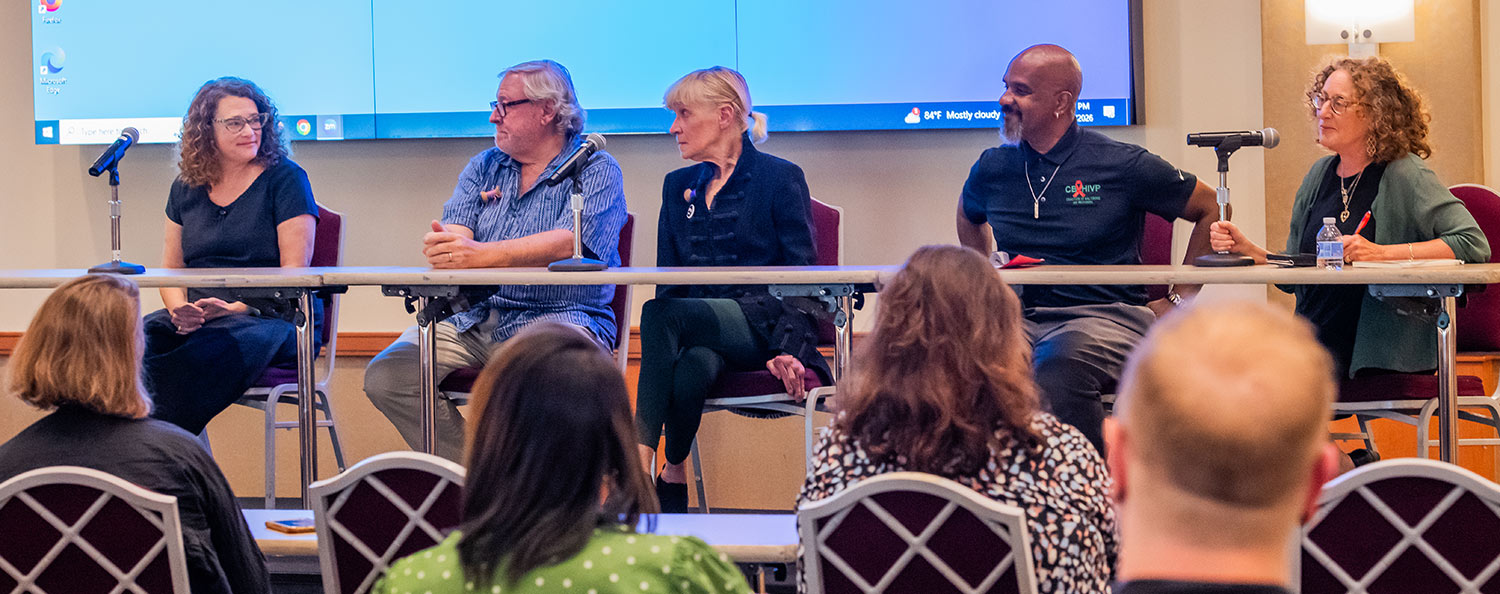
The screening was followed by a panel discussion and reception hosted by the UMSOM’s Institute of Human Virology (IHV). The event provided an opportunity for students, faculty, staff, health care professionals, and community members to consider the history of HIV/AIDS and the evolution of treatment, research, advocacy, and care.
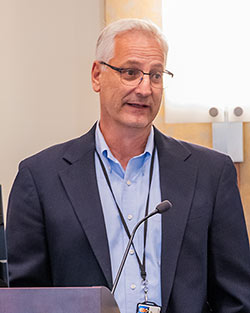
Anthony Amoroso, MD, professor of medicine at UMSOM, Director, IHV Clinical Community Health Programs and Director, IHV Clinical Innovation Programs, opened the program by placing the AIDS epidemic in historical perspective. Today, infection with HIV, the virus that causes AIDS, is considered a highly treatable medical condition, and advances in treatment and prevention through new medications have enabled people with HIV to live long and healthy lives and to avoid transmitting their infections to others.
From Remembrance to Resilience
 That was not the reality during the 1980s and much of the 1990s, when an HIV diagnosis could be followed by severe illness and death. Baltimore was significantly affected by the epidemic. Dr. Amoroso joined UMSOM in 1998, when the city was still caring for large numbers of people with advanced HIV disease. He recalled caring for patients on dedicated AIDS wards during a period that profoundly affected Baltimore families, communities, and health care institutions.
The epidemic was also accompanied by significant stigma. People experienced discrimination in families, communities, and health care settings, while some families were reluctant even to acknowledge that a loved one had died from AIDS. The AIDS Memorial Quilt emerged from this environment.
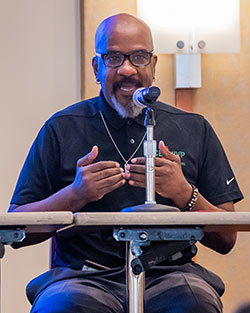
“I didn't expect it to be so emotional,” said Eric Anderson who participated in the panel discussion that followed the documentary screening. “And such a reminder of a rough time. But I appreciate it, because sometimes we need to remember.”
Mr. Anderson has lived with HIV for decades and has spent much of his career working with Baltimore’s HIV community. He is a Ryan White HIV/AIDS Eligibility Specialist with IHV’s THRIVE program and president of the Coalition of Baltimore HIV Providers.
In 1996, while seriously ill, he traveled to Washington, D.C., to see the AIDS Memorial Quilt displayed on the National Mall. He recalled the experience of walking among the panels and seeing the emotional response of others gathered there. At the time, Anderson wondered whether a panel would one day be created in his memory.
 “I was very sick,” he recalled. “And that was my thought. Who would do a panel for me?”
For Baltimore, the Quilt provides a way to remember people affected by the epidemic and to recognize the communities, families, and advocates who worked to preserve their stories.
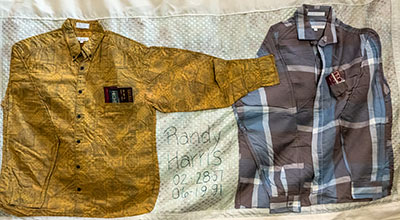
The Quilt display also included direct connections to the University of Maryland Medicine. One of the memorial panels recognizes an UMSOM graduate, while another honors a former patient of the University of Maryland Golisano Children’s Hospital Pediatric AIDS Program. Those connections reflect the University’s longstanding involvement in HIV care and research in Baltimore.
The event’s panel discussion spoke about the changes throughout the years with the Baltimore HIV community, including the transformation of HIV treatment and care. Many of the systems supporting people with HIV today developed through decades of advocacy and collaboration. Across the University of Maryland, Baltimore, that work has included medicine, law, dentistry, social work, public health, and community-based services.
History that Continues to Shape Future
 While much progress has been made thanks to scientific research, advances in clinical care, and public health programs, HIV remains an important public health issue. Mr. Anderson noted that Maryland recorded 745 new HIV infections in 2024, underscoring the continuing need for prevention, testing, treatment, and access to care. For UMSOM and IHV, the history of HIV in Baltimore is closely connected to the University's continuing work in research, clinical care, education, and community health. IHV's work extends beyond Baltimore as well, contributing to efforts to address HIV and other infectious diseases through research and global health partnerships. The University's local experience provides an important foundation for that broader work.
The AIDS Memorial Quilt display offered a tangible connection between the history of the HIV epidemic and the work being done today.
For UMSOM and IHV, that history remains relevant not only as something to remember, but as context for the work ahead: advancing research, improving care, strengthening public health, and supporting the communities affected by HIV in Baltimore and around the world.
The event served as a reminder of how far HIV care has progressed and of the continued importance of the partnerships among researchers, clinicians, public health professionals, advocates, and communities that have helped make that progress possible.
Contact
Jennifer Gonzales
Jennifer.Gonzales@ihv.umaryland.edu
Related stories
Friday, May 20, 2022
NIH Grant Awarded to Study HIV Drug-Resistant Genetic Mutations Across Africa
University of Maryland School of Medicine (UMSOM)’s Institute of Human Virology (IHV) researchers received funding from the National Institutes of Health’s National Institute of Allergy and Infectious Diseases (NIAID) for $2.7 million to study genetic changes in two genes from the HIV-1 virus that may make it resistant to antiretroviral therapy. The study, named INSPIRE, will analyze genetic variation in types of HIV circulating in a handful of African countries that will help to better understand the implications of these mutations and will improve clinical management of patients.
Wednesday, September 20, 2017
Institute of Human Virology Marks National Gay Men's HIV/AIDS Awareness Day on Wednesday, September 27 as HIV/AIDS Increases in Baltimore’s Youth
The proportion of newly reported HIV diagnoses among Maryland youth has tripled over 20 years. The Institute of Human Virology (IHV) at the University of Maryland School of Medicine will host an event Wednesday, September 27 to raise awareness about the rise in HIV/AIDS among Maryland’s youth ages 13-24, particularly among young black men. Of the 252 youth HIV diagnoses in 2015, 82.5 percent were male and 17.5 percent were female in Maryland while 82.1 percent of these new diagnoses were African American. The statistics are astounding considering the availability of prevention therapy.
Tuesday, October 25, 2016
"A Call to End HIV/AIDS in America" IHV Director Dr. Robert Gallo's Op-Ed in the Huffington Post
As the new Administration is presented with great challenges facing the United States, one will be a longtime foe, the U.S. HIV/AIDS epidemic. Since President Barack Obama was elected in 2008, I have publicly called on our country’s leaders to utilize the largest global health initiative in history - the President’s Emergency Plan for AIDS Relief (PEPFAR) - as a model to address the U.S. epidemic.