
- The Surviving Sepsis Campaign recently republished the 2018 update to their guidelines, namely, the recommendation that physicians initiate treatment measures using a "1-Hour Bundle" rather than the 3 and 6-hour bundles previously recommended:

- Also included was the level of evidence for each bundle component. There was no additional evidence provided to support the within-one-hour recommendation.

- There has been no well-designed, randomized trial to demonstrate benefits to administration of the various bundle components at specific time points. There are observational studies that show benefits to early protocolized therapy, including a restrospective study by Seymour et al. that showed benefits to earlier administration of antibiotics (but notably, not IV fluid administration), primarily in patients with septic shock requiring pressors.2
- There have been a variety of studies demonstrating harm with unecessary IV fluid administration,3-5 and inappropriate antibiotic use puts patients at risk for C.difficile colitis, drug reactions, and promotes drug-resistant organisms. Studies to date do not examine adverse events in patients initially treated for sepsis who do not end up being septic.
Take Home Points:
- Early recognition of sepsis is crucial to initiating necessary therapies and improving outcomes.
- Patients with sepsis and septic shock benefit from early appropriate antibiotics, source control, and appropriate resuscitation.
- Empiric treatment of all-comers with possible sepsis with broad spectrum antibiotics and 30ml/kg of IV fluids, in order to meet a 1-hour deadline, has definite potential for harm.
Show References
There were 180 battery ingestions over a 5 year period at two tertiary care children’s hospital. The median age was 3.8 years (0.7 to 18 years). The most common symptoms were abdominal pain (17%), and nausea and vomiting (14%). X-rays detected the location in 94% of patients.
Based on these patients, a treatment algorithm was developed (See attached). Prospective validation is needed.

Show Additional Information
Show References
Attachments
Methylene Blue is a dye that was synthesized in the late 1800s as an antimalarial drug. After the emergence of chloroquine its use loss favor partly due to unpopular side effects of temporarily turning the urine, other body fluids, and the sclera blue. Methylene blue is primarily known as a highly effective fast acting antidote for methemboglobinemia. Over the past few years, it has become an important therapeutic modality with expanding uses in cardiac surgery and critical care. As a potent inhibitor of nitric oxide mediated guanylate cyclase induced endothelium vascular smooth muscle relaxation, it has been shown to be effective in increasing arterial blood pressure and cardiac function in several clinical states, such as septic shock and calcium channel blocker poisoning.
BOTTOM LINE:
-
Methylene blue should be considered for treatment of refractory shock from calcium channel and beta blocker poisoning.
-
Clinical improvement in refractory hypotension and reduction of vasopressor dose has been described in several poisoning cases.
-
Recommended dose is 1–2 mg/kg injection with effects seen within 1 hour.
Show References
Precedex (dexmedetomidine) is a selective alpha-2 adrenergic receptor agonist used as a sedative.
It is unique among sedatives typically used in the ICU in that it lacks GABA activity and lacks anticholinergic activity.
Previous studies have shown significant positive changes in sleep patterns in critically ill patients sedated with dexmedetomidine:
-improved sleep efficiency – decreased sleep fragmentation, decreased stage 1 sleep, increased stage 2 sleep
-improved distribution of sleep (with more than ¾ sleep occurring at night)
Given importance of sleep and preservation of day-night cycles/ circadian rhythms in prevention of delirium, a recent randomized controlled trial evaluated dexmedetomidine's effect on delirium.
100 delirium-free critically ill adults receiving sedatives were randomized to receive nocturnal (21:30-06:15) IV dexmedetomidine (titrated to RASS -1 or max 0.7 mcg/kg/hr) OR placebo until ICU discharge.
80% of patients in the dexmedetomidine group remained delirium-free vs 54% in the placebo group.
There was no difference in the incidence of hypotension, bradycardia, or both between groups.
Show References
Does mild traumatic brain injury increase risk of dementia?
Background: Most studies of moderate to severe TBI have found an association with increased risk of dementia and earlier onset of Alzheimer’s. There is growing concern that repeated TBIs, even if more mild, can lead to neurodegenerative conditions such as chronic traumatic encephalopathy (CTE). However, the link between mild TBI and dementia risk has not fully been elucidated, especially in the case of mild TBI without loss of consciousness (LOC).
Recent Data: A recent JAMA study evaluated the association between TBI severity, LOC, and dementia diagnosis in 350,000 veterans between 2001-2013. After adjusting for demographics as well as medical and psych comorbidities, veterans with even mild TBI without LOC had more than a 2-fold increase in risk of dementia diagnosis than those with no TBI. The risk increased only slightly if there was LOC (from a hazard ratio of 2.4 to 2.5). Risk was >3-fold for those with moderate-severe TBI.
Take home: TBI of any severity, even without LOC, appears to be associated with long term neurodegenerative consequences. Avoidance of TBI is of the utmost importance, and if TBI occurs, close neurocognitive follow up should occur.
Show References
On May 3, the FDA approved adexanet alfa, the reversal agent for factor Xa inhibitors - apixaban and rivaroxaban. It received both U.S. Orphan Drug and FDA Breakthrough Therapy designations.
Unlike indarucizumab (a monoclonal antibody fragment) to reverse dabigatran (direct thrombin inhibitor) associated bleeding, adexanet alfa is a recombinant modified human factor Xa decoy protein.
A phase 3 study showed that adexanet alfa decreased the anti-factor Xa activity of rivaroxaban by 92% from baseline and by 94% in apixaban treated participants.
ANNEXA-4 study involving participants with acute major bleeding (GI and intracranial) showed a significant decrease in the anti-factor Xa activity after the bolus dose of adexanet alfa and "effective" hemostasis was noted in 79% of the participants at 12 hours post infusion.
Andexanet alfa is expected to become available in June 2018.
- CT angiography (CTA) spot sign is a strong predictor of intracerebral hemorrhage (ICH) expansion.
- However, since CTA is not part of the routine diagnostic workup of acute ICH, other predictors using noncontrast head CT have been reported in the past.
- A 5-point BAT score can be used to identify patients at high risk of hematoma expansion:
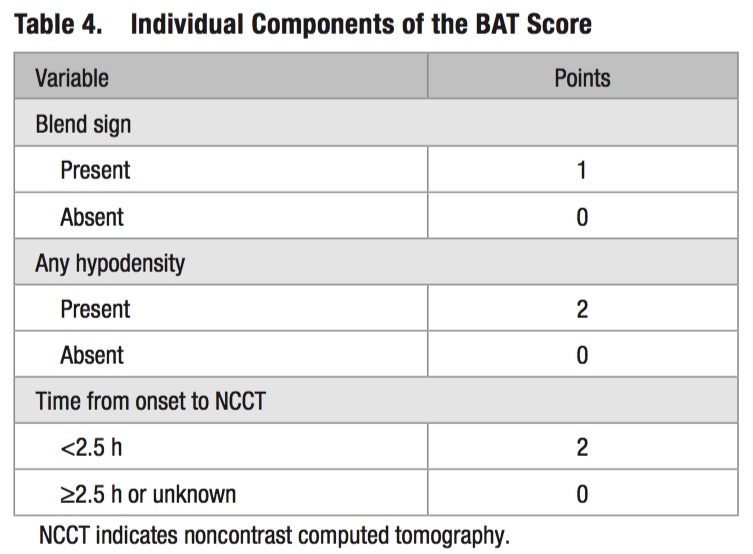
- Patients with a score ≥ 3 have a higher risk of hematoma expansion.
Show Additional Information
Show References
- Half of elderly patients presenting with pneumonia will manifest signs of delirium
- Tachypnea is the most reliable and earliest vital sign abnormality
- Classic symptoms are not often helpful at predicting severity of illness
- Symptoms are unreliable
- Cough (63-84%)
- Dyspnea (58-74%)
- Fever by history (53-60%)
- Fever at arrival (12-32%)
- Pleuritic chest pain (8-32%)
- Sputum (30-65%)
Show References
Nursemaid’s elbow is a common pediatric injury with peak incidence occurring between two and three years of age. It is a condition that typically arises from a sudden upward pull of the arm as an axial traction is placed on the forearm, and the radius is pulled through the annular ligament, resulting in subluxation of the radial head. Over the years, various maneuvers have been attempted, but the two most common are supination with flexion and hyperpronation. A 2017 Cochrane meta-analysis analyzed 8 trials specifically comparing supination with flexion versus hyperpronation. Data from those trials suggested that hyperpronation resulted in less failures at ?rst attempt than the supination-?exion, and although there was limited data, there was no obvious difference in adverse events or pain between the two techniques.
Bottom Line: There is likely a lower risk of failure with first attempt reduction with hyperpronation than with supination-flexion for nursemaid’s elbow.
Show Additional Information
Show References
Despite initial excitement for the use of intravenous lipid emulsion (ILE) therapy as an antidote for serious poisonings due to lipohphilic drugs there remains an absence of evidence combined with an incomplete understanding of its efficacy, mechanisms of action, safety, and analytical interferences to recommend its use except in a few clinical scenarios.
The lipid emulsion workgroup performed a comprehensive analysis of four systematic reviews and based recommendations from consensus of expert panelists from the American Academy of Clinical Toxicology, the European Association of Poison Centres and Clinical Toxicologists, the American College of Medical Toxicology, the Asia Pacific Association of Medical Toxicology, the American Association of Poison Control Centers, and the Canadian Association of Poison Control Centers. Toxins evaluated had to have a minimum of three human cases reported in the literature.They concluded that ILE could be indicated for the following clinical situations:
- In Bupivacaine poisoning resulting in cardiac arrest or life threatening toxicity (dysrhythmias, VTach with compromised organ perfusion, VFib, status epilepticus, and/or hypotension with organ compromise defined as increased lactate concentration, acute kidney injury, increased troponin, altered mental status, or decreased capillary refill) ILE is recommended after standard ACLS is started and if other therapies fail or as last resort.
- In life-threatening toxicity due to other local anesthetics, ILE recommended if other therapies fail/in last resort
- In cardiac arrest due to toxicity from Amitriptyline (or other tricyclic antidepressants), lipid soluble and non-lipid soluble Beta-receptor antagonists, Bupropion, Calcium channel blockers (diltiazem, verapamil and dfihydropyridines), Cocaine, Diphenhydramine, Lamotrigine, Baclofen, Ivermectin and other Insecticides, Malathion and other Pesticides, Olanzapine and other Antipsychotics, and SSRIs.
- Most common regimen of ILE was a bolus of 1.5 mL/kg of ILE 20% followed by infusion of 0.25 mL/kg/min
- The use of ILE with extracorpeal membrane oxygenation may cause fat deposition in the circuit and increase blood clot formation causing malfunction and limitation of use of this potentially life saving modality. This should be considered if VA-ECMO is a treatment option.
The Bottom Line:
The use of Intravenous Lipid Emulsion in severe poisoning is recommended only for a few poisoning scenarios and was based on very low quality of evidence, and consideration of risks and benefits, adverse effects, laboratory interferences as well as related costs and resources.
Show References
DOACs and the Critically Ill
- The use of DOACs for the prevention of stroke and venous thromboembolism is increasing.
- Though DOACs may be non-inferior to warfarin for these indications, it is important to consider the following pearls on DOACs in the critically ill patient:
- Acute kidney injury can double the half-life of dabigatran to more than 30 hours
- Hepatic failure can markedly increase the half-life of the factor Xa inhibitors
- PT, aPTT, and INR may not accurately assess the risk of bleeding. Use dilute thrombin time (TT), ecarin clotting time (ECT), or TEG/ROTEM to assess coagulopathy
- Can consider PCC (25 to 50 IU/kg) for life-threatening hemorrhage. The evidence supporting this recommendation is not robust.
Show References
Exercise talking points for the pregnant patient
(from ACSM 2017 Consesnsus statement)
Exercise throughout pregnancy is generally safe but should be monitored
No evidence of higher rates of preterm or prolonged labor, or deliveries that require induction or episiotomy
No evidence of negative effect on APGAR scores
Other benefits:
Avoidance of excessive weight gain, improved balance, and decreased back pain
Improved well-being, energy levels, and sleep patterns
Improved labor symptoms and facilitation of post-partum recovery
Lower risk of C-section
Reduced risk of having a large for gestational age (LGA) or small for gestational age (SGA) infant
Risks include environmental exposure, dehydration, hypoxia, and uterine trauma:
High impact or high-strain physical activity during the fetal implantation phase may lead to slightly higher risk of miscarriage
Sports with high risk of trauma last in pregnancy could result in placental abruption
Scuba diving is contraindicated because the fetus is not protected from decompression problems
Limit use of sauna or hot tub to fewer than ten minutes or omit altogether
Show References
Non-pharmaceutical fentanyl (NPF) is a major contributor to opioid overdoses and overdose fatality. In certain urban areas such as Vancouver, over 80% of heroin samples contain NPF. For isolated heroin overdose ED patients, they can be safely discharged after brief observation period (~2 hours). However, “safe” observation time for fentanyl is unknown.
Recently, a retrospective study evaluating the safe observation period in 1009 suspected (uncomplicated) fentanyl overdose ED visits (827 unique patients).
Results:
In the field:
- 476 (47.1%) received bystander naloxone
- 422 (44.1%) had field GCS of 15
- 547 (57.2%) had pulse oximetry of >= 95%.
- EMS administered naloxone to 546 (57.1%) patients (mean dose 0.4 mg IV)
In the ED:
- 16 patients received additional naloxone in the ED
- Mean length of stay: 173 minutes (IQR: 101 to 267 minutes)
- 90% of the patients were discharged within 380 minute.
- One patient was admitted and one patient died after discharge within 24 hours.
Conclusion:
- Majority of the patients were safely discharged after 3 - 4 hours after receiving naloxone and if able to maintain GCS 15 with oxygen level 95% while able to ambulate normally.
- However, some patient may require up to 6 hours of observation.
Show References
ED physicians frequently utilize modailities such as noninvasive positive pressure ventilation (NIV) and high flow nasal cannula (HFNC) to support and potentially avoid intubation in patients presenting with acute hypoxic respiratory failure. Unfortunately, failure of these measures, resulting in "delayed" intubation, has been associated with increased mortality.1,2
A recent post-hoc analysis of data from a multicenter randomized controlled trial evaluated 310 patients with acute hypoxic respiratory failure managed with supplemental O2 by regular nasal cannula, HFNC, or NIV.3
The following factors were predictive of eventual intubation in the different groups:
- For nasal cannula patients, RR > 30 at 1 hour
- For HFNC patients, tachycardia at 1 hour (No respiratory variables were found to predict intubation).
- For NIV patients, tidal volume > 9ml/kg predicted body weight or PaO2:FiO2 ratio < 200 at 1 hour
Of note, 45% of the 310 patients eventually required intubation, and these patients in general had a higher initial respiratory rate and lower PaO2 at presentation, and were more likely to have bilateral infiltrates on CXR.
Bottom Line: Reevaluate your patients frequently. If RR remains high, P:F ratio remains low, or patient respiratory effort/work of breathing is not alleviated by noninvasive measures, consider pulling the trigger on intubation earlier.
Show References
Unsuccessful lumbar punctures (LP) may lead to epidural hematoma (EH) formation at the site of needle insertion which may affect subsequent attempts and lead to no success or a grossly bloody sample. There is no standard definition of a traumatic LP based on CSF red blood cell counts. Gross blood may also be obtained by interrupting the vascular structures outside the spinal canal which would not result in EH formation.
This was a prospective study of children younger than 6 months who had an LP at a single children’s hospital. Post LP ultrasounds were completed by the investigating team and interpreted by a pediatric radiologist. 74 patients were included in the study. 31% of the patients had evidence of a post LP EH. 17% fully effaced the thecal sac which would likely preclude future success at that anatomic site. 25% of patients where the clinician did not feel there was a traumatic attempt had evidence of an EH.The study was not powered to determine the risk factors for EH formation. The study also did not look at any other consequences to EH.
Key points: Point of care ultrasound to evaluate EH and bleeding at the failed LP site my provide useful information for a location of subsequent attempts. Also US to evaluate for bleeding in the spinal canal may help with interpretation of the CSF when a large number of red blood cells are present.
Show References
Bradycardias caused by poisoning are due to the toxin's effects on cardiovascular receptors and cellular channels and transport mechanisms and are often refractory to standard ACLS drugs. The most common drug classes responsible for bradycardias are calcium channel and beta blockers and digoxin (cardiac glycosides). Sodium channel blockers, clonidine, and opiates also can cause bradycardias. Antidotes are as follows:
- Glucagon 5-10mg IV bolus followed by 1-5 mg/hr (Always pretreat with antiemetic) - Beta Blockers
- Calcium infusion 1-3 grams IV Bolus - Calcium Channel Blockers
- High Dose Insulin Euglycemic therapy of reg insulin 0.5-2 unit/kg Bolus (ie. 100 Units) with D50 IV bolus followed by reg insulin 0.5-1 units/kg/hr and dextrose 0.5 grams/kg/hr - Calcium channel and Beta Blockers
- **Intravenous Lipid Emulsion therapy bolus 1.5 mL/kg of ILE 20% followed by an infusion of 0.25 mL/kg/min- Very small subset of toxins. See below.
- Atropine 2mg IV - Acetylcholinestrase inhibitors (Organophosphates)
- Sodium Bicarbonate 1-3 amps IV - Sodium Channel Blockers
- Digibind for acute toxicity10 vials IV (20 Vials in cardiac arrest) and for chronic toxicity 2 vials and repeat as needed - Cardiac gylcosides
- Narcan 2 mg IV repeat boluses up to 10 mg- Opiates and Clonidine
** ILE is recommended only in life threatening poisonings where other accepted therapies have been use first or in cardiac arrest clinical scenarios.
Show References
Linezolid, an antimicrobial agent in the oxazolidinone class, often used to cover MRSA and/or VRE, is a reversible MAOI that increases the risk of serotonin syndrome, particularly when administered with other serotonergic agents.
In 2011, the US FDA issued a warning against concomitant use of Linezolid and other serotonergic agents, particularly SSRIs and SNRIs. When use of linezolid is absolutely indicated, an appropriate washout period prior to initiation was recommended.
Based on published reports and retrospective reviews, the incidence of linezolid-associated serotonin toxicity is between 0.54% and 18.2%.
A study published in the Journal of Clinical Psychopharmacology in Oct 2017 examined the incidence of serotonin syndrome with combined use of linezolid and SSRIs/SNRIs compared with linezolid alone and though there was a trend toward increased incidence in patients on SSRI/SNRIs, the authors were unable to find a statistically significant difference.
Several flaws:
-Study was retrospective
-Incidence of serotonin syndrome in both groups was very low: 1/87 (1.1%) in Linezolid + SSRI/SNRI group compared to 1/261 (0.4%) in Linezolid alone group.
-Patients in “Linezolid alone” group were not on SSRIs or SNRIs, but were allowed to be on other serotonergic medications.
Despite this study, there are many (>30) case reports of Linezolid-associated serotonin syndrome in patients taking other serotonergic agents.
Cyproheptadine (the “antidote”) is an H1 antagonist and nonspecific serotonin antagonist. A single case study published in 2016, reported successful use of cyproheptadine for prophylaxis against serotonin toxicity in a patient with schizophrenia, depression, and severe osteomyelitis requiring treatment with linezolid while on fluoxetine.
Bottom Line:
Risk of linezolid-associated serotonin syndrome may be lower than previously thought, however, it is still not recommended for use in patients taking concomitant serotonergic agents without an appropriate washout period.
In case of resistant infection with no other antibiotic treatment options, the risks and benefits of concomitant administration must be weighed seriously and providers must familiarize themselves with and be vigilant in watching for signs/symptoms of serotonin toxicity.
In situations where use of linezolid is unavoidable in patients on concomitant serotonergic agents, prophylactic cyproheptadine may be considered.
Show References
Female Athlete Triad
- Low energy availability
- With or without eating disorders
- Menstrual dysfunction
- Low bone mineral density (BMD)
Energy availability considers the amount of remaining energy for metabolic processes based on calories takin in with eating and calories burned through exercise or both.
Menstrual dysfunction occurs as a result of low energy availability causing decreased GnRH inhibition and ovarian suppression and decreased estrogen.
Low bone mineral density occurs due to amenorrhea and decreased energy availability. Estrogen limits bone resorption (stimulates calcitonin and renal calcium retention).
This is very important for young girls as by age 12 they have 83% of their total BMD & 95% two years after menarche.
If you see an athlete in the ED with one component of the triad, inquire about the other two. A 15yo athlete with a stress fracture may not realize that her disordered eating, excessive exercise or amenorrhea may by contributing factors and may benefit from follow up with PCP, dietitian, Gyn, etc.
Clonidine, (central alpha-2 receptor agonist) can produce opioid-like toxidrome in addition to its cardiac effects (bradycardia and hypotension). Previous studies have shown that naloxone has variable (~40%) success in reversing CNS/respiratory depression and cardiac effect.
A recent retrospective study (n=51) of pediatric poisoning showed that administration of 5 to 10 mg had improved reversal of clonidine toxicity.
Total of 51 somnolent patients: 5- 10 mg of naloxone reversed 40 patients
- 22 patients awoke with 6 mg or less
- Bradycardia reversed in 17 of 44 patients
- Hypotension reversed in 7 of 11 patients
There was no adverse effect from naloxone administration.
Repeat administration of naloxone was required in some patients.
Bottom line
- For pediatric clonidine toxicity, consider initial naloxone dose of 5 mg IV.