
Does using a combination of aspirin and clopidogrel decrease your patient’s risk of recurrent stroke after a minor ischemic stroke or high risk TIA event?
- The recent international Platelet-Oriented Inhibition in New TIA and Minor Stroke (POINT) trial compared 4881 patients receiving aspirin/clopidogrel vs. aspirin/placebo within 12 hours of symptom onset.
- Patients who received DAPT had a lower rate of major ischemic events at 90 days compared to aspirin/placebo (5.0% vs. 6.5%, p=0.02).
- However, patients who received DAPT had a higher rate of major hemorrhage compared to aspirin/placebo (0.9% vs. 0.4%, p=0.02).
- A similar Chinese study, the Clopidogrel in High-Risk Patients with Acute Nondisabling Cerebrovascular Events (CHANCE) trial, compared 5170 patients receiving DAPT vs. aspirin/placebo within 24 hours also found lower rate of stroke (8.2% vs. 11.7%, p<0.001) but similar rates of moderate/severe hemorrhage (0.3% vs. 0.3%, p=0.73).
- Major differences between these two trials are the population studied and the duration of DAPT, as POINT utilized DAPT for 90 days while CHANCE utilized DAPT for 21 days.
Bottom Line: The use of DAPT in minor ischemic stroke and high risk TIA reduces the risk of recurrent stroke. However, the duration of DAPT may affect the risk of major hemorrhage.
Show Additional Information
Show References
We know that high flow nasal cannula is an option in the management of acute hypoxic respiratory failure without hypercapnea. A newer iteration of high flow, "high velocity nasal insufflation" (HVNI), may be up-and-coming.
According to its makers (Vapotherm), it is reported to work mainly by using smaller bore nasal cannulae that deliver the same flows at higher velocities, thereby more rapidly and repeatedly clearing dead space, facilitating gas exchange and potentially offering ventilatory support.
In an industry-sponsored non-inferiority study published earlier this year:
- 204 adult patients in 5 EDs
- Any acute respiratory failure deemed by the treating physician to require non-invasive positive pressure ventilation (NPPV)
- Patients randomized to either NPPV (bilevel positive airway pressure) or HVNI
- Rate of HVNI treatment failure (26%) and intubation @ 72 hours (7%) fell within predefined noninferiority margins
- Rates of PCO2 clearance were similar between HVNI and NPPV groups
- The study was not powered to detect differences between different etiologies for respiratory failure
- Authors concluded that HVNI is noninferior to NPPV for all-comer respiratory failure.
Bottom Line:
The availability of a nasal cannula that helps with CO2 clearance would be great, and an option for patients who can't tolerate the face-mask of NPPV would be even better.
HVNI requires more investigation with better studies and external validation before it can really be considered noninferior to NPPV, but it certainly is interesting.
Show References
Clonidine is an alpha-2 agonist commonly used to treat hypertension. Clonidine can also be used to mitigate symptoms of opioid withdrawal as it easily crosses the blood brain barrier and reduces sympathetic effects.
When using clonidine for acute withdrawal or blood pressure control, oral tablets are the preferred route. Clonidine transdermal patches have slow absorption and take 2-3 days for the effect to be seen. Once removed, clonidine patches can provide therapeutic levels for up to 20 hours.
Bottom Line: If clonidine is needed acutely for your patient, select oral tablets and titrate to effect.
Show References
Question
33 y/o M with PMH of ETOH induced pancreatitis presents with epigastic/RUQ pain & N/V after drinking last night, per patient his usual “pancreas pain”. The nurse shows you his blood tubes because they look “milky”. Lipase 1200, Ca 6.8.
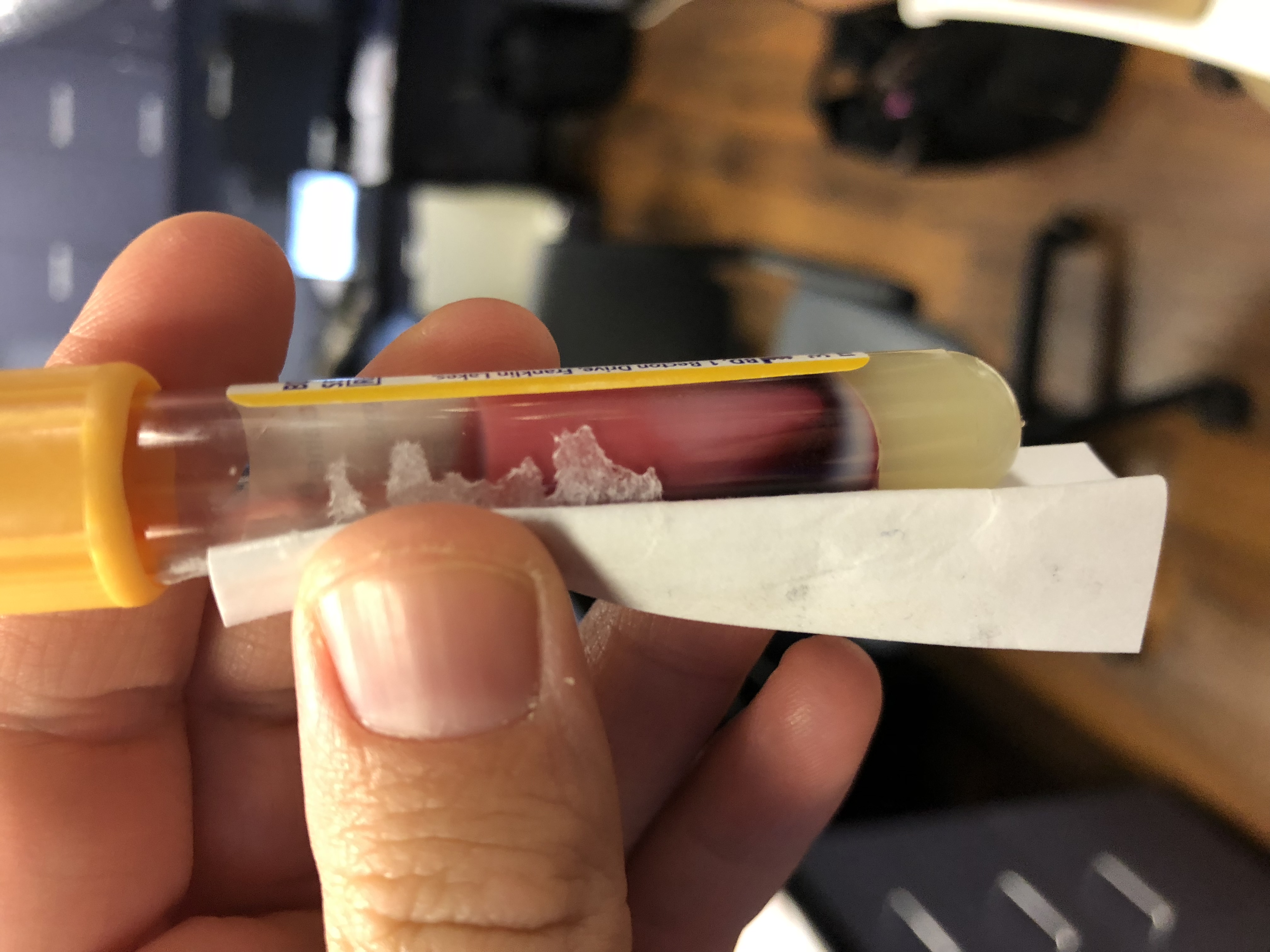
What lab test would you add?
Show Answer
Show References
25yo baseball pitcher presents with medial elbow pain. He felt a painful “pop” and could not continue to throw (due to loss of speed and control). Mild paresethesias in 4th and 5th digits.
What physical examination maneuvers can you do at the bedside to assist in the diagnosis?
Exam opposite elbow first to establish baseline and to assist patient relaxation and understanding.
Flexing elbow to 20 to 30 degrees unlocks the olecranon
- Valgus stress test – flex elbow with forearm/hand supinated. Apply valgus stress test and note for laxity/firm endpoint.
https://www.youtube.com/watch?v=KXQxH0UTn-8
- Milking maneuver – Here the valgus stress is created by pulling on the patient’s thumb with the forearm supinated and elbow flexed to 90°. Note instability, pain, or apprehension.
https://www.youtube.com/watch?v=4sa9goJ4afs
or
https://www.youtube.com/watch?v=SwigwaZxBXE
- Moving valgus stress test – Similar to the milking maneuver, the valgus stress test is applied while the elbow is ranged through full flexion and extension. Note instability, pain, or apprehension in mid range (between 70 and 120 degrees)
https://www.youtube.com/watch?v=OnkkHpG3Dqg
Originally described a Dr. West in 1841 – it is a rare (~1200 cases annually) seizure disorder in young kids, generally less than 1 year old. Very subtle appearance, often with only bending forward or ‘jerking’ of the extremities as opposed to Brief Resolved Unexplained Event (BRUE) or tonic-clonic in description. The spasms can be thought of as a syndrome, where 70% of those have an undiagnosed rare metabolic/genetic disease.
A prompt evaluation, including labs, EEG, MRI, metabolic and genetic studies is vital in helping to establish a diagnosis which can have a profound impact on the patients prognosis. Examples might include Tuberous Sclerosis, Pyridoxine Dependent Seizures among over 50 others.
Bottom line: In pediatric patients less than 1 year old who present to the Emergency Department with a description of spasm-like episodes, consider Infantile Spasms on the differential, and consult your friendly neighborhood Pediatric Neurologist for help in determining a proper disposition.
Show References
Show References
Question
A 19 year old male presents confused and very agitated complaining of seeing things and stomach pain. His friends report he ingested a naturally occurring plant to get high a few hours ago but is having a "bad trip". His physical exam :
Temp 100.3, HR 120, RR 14, BP 130/88. Pulse Ox 98%.
Skin: Dry, hot , flushed
HEENT: Marked mydriasis 6mm
Lungs: Clear
Heart: Tachycardic
Abdomen: Distended tender suprapubic with absent bowel sounds,
Neuro: Extremely agitated pacing, no muscular rigidity.
What has he ingested and what is the treatment?
Show Answer

Show References
Sedating Mechanically Ventilated Patients
- Providing appropriate analgesia and sedation to mechanically ventilated patients is of paramount importance.
- In a recent systematic review and meta-analysis, Stephens et al. assessed the impact of deep sedation within the first 48 hours of initiation of mechanical ventilation.
- In 9 studies that included over 4,500 patients, deep sedation within the first 48 hours of initiation of mechanical ventilation was associated with increased mortality, increased ICU LOS, and increased frequency of delirium.
- Take Home Points
- When possible, target lighter levels of sedation in mechanically ventiilated patients.
- Though no universally accepted definition of light sedation exists, most studies use a RASS of -2 to +1
Show References
The Centers for Disease Control and Prevention recently released guidelines on the diagnosis and management of mild traumatic brain injury (mTBI**) among children. From 2005-2009, children made almost 3 million ED visits for mTBI. Based on a systemic review of the literature, the guideline includes 19 sets of recommendations on the diagnosis, prognosis, and management/treatment of pediatric mTBI.
Key Recommendations:
1. Do not routinely image patients to diagnose mTBI (utilize clinical decision rules to identify children at low risk and high risk for intracranial injury (ICI), e.g. PECARN)
2. Use validated, age-appropriate symptoms scales to diagnose mTBI
3. Assess evidence-based risk factors for prolonged recovery. No single factor is strongly predictive of outcome.
4. Provide patients with instructions on return to activity customized with their symptoms (see CDC Resources below)
5. Counsel patients to return gradually to non-sports activities after no more than 2-3 days of rest.
A wealth for information and tools for provder and families can be found at:
www.cdc.gov/HEADSUP (including evaluation forms and care plans for providers)
www.cdc.gov/traumaticbraininjury/PediatricmTBIGuideline.html
Show Additional Information
Show References
Analphylatoid reaction is caused by non-IgE mediated histamine released. Intravenous N-acetylcysteine (NAC) infusion is well known to cause analphylatoid reaction. However, it’s incidence is unknown.
Recently, a large retrospective study of all patients who received 21-hour IV NAC in 34 Canadian hospitals (1980 to 2005) was performed.
Anaphylactoid reaction was documented in 528 (8.2%) of 6455 treatment courses
- Cutaneous reaction (urticarial, pruritus and angioedema) occurred in 398 (75.4%)
- Systemic reaction (respiratory symptoms or hypotension): 34 (6.4%)
- Both reactions: 96 (18.2%)
Over 90% patients developed analphylatoid reaction within 5 hours.
Onset of reaction:
- 1stNAC dosing (150 mg/kg over 1 hour): 133/528
- 2ndNAC dosing (50 mg/kg over 4 hours): 371/528
- 3rdNAC dosing (100 mg/kg over 16 hours): 24/528
Administered medication for treatment
- Antihistamine: 371
- Beta-2 agonist: 15
- Epinephrine: 10
- Corticosteroids: 7
Patient characteristics that were associated with higher incidence of Anaphylactoid reaction includes
- Female
- Single acute ingestion
- Low serum acetaminophen level.
Bottom line
- Anaphylactoid reaction to NAC is uncommon
- Cutaneous symptoms are most common
- Female, single acute ingestion and low serum acetaminophen levels are associated with incidence of anaphylactoid reaction.
Show References
The recently published BICAR-ICU study looked at the use of bicarb in critically ill patients with severe metabolic acidemia...
- Multicenter, open-label, RCT, 26 French ICUs
- Adult patients with pH < 7.2 not secondary to hypercapnia, serum bicarb < 20 not due to bicarb wasting process
- SOFA score > 4 or lactate > 2
- No bicarb versus 4.2% sodium bicarb infusion titrated to pH >7.3
- Primary outcome: Composite measure of 28-mortality and presence of any organ failure at 7 days post-randomization
- Secondary outcomes: Need for/length of life support measures (renal-replacement, vasopressors, mechanical ventilation), SOFA score after enrollment, electrolyte effects, occurrence of ICU-acquired infections, and ICU length of stay
- Major findings:
- No difference in primary outcome overall
- No difference in pressor-free days, days off RRT, dialysis dependence at ICU discharge, ICU LOS
- Bicarb group had less need for RRT during ICU stay (35 vs 52%, p=0.0009)
- In patients with AKI and AKIN score 2-3*, the bicarbonate group had a decrease in both 28-day mortality (46 vs 63%, p=0.0166) and presence of any organ failure at day 7 (66 vs 82%, p=0.0142)
- Limitations:
- Unblinded
- A quarter of the control group actually received bicarb
- No data regarding vent settings, ABGs to r/o ventilation effects on pH
- 4.2% is not a standard concentration of bicarb used in the U.S.
Bottom Line:
Consider administration of sodium bicarbonate for your critically ill ED patients with severe metabolic acidosis and AKI, especially if acidosis &/or renal function is not improved with usual initial measures (such as IVF, etc).
*Acute Kidney Injury Network Staging Criteria

Show References
Froment’s Sign
Tests for motor weakness of the Ulnar nerve
Patient asked to hold piece of paper in both hands, grasping with the thumb and radial side of index finger of both hands
Examiner then pulls on the paper
Test is positive if patient flexes the thumb IP join in an attempt to hold onto paper
https://handlab.com/resources/wp-content/uploads/2014/04/June-2013-No25.jpg

Does Lactated Ringer's Raise Serum Lactate?
- Intravenous fluid administration is a cornerstone of resuscitation and the treatment of many critically ill ED patients.
- Recent publications have suggested that balanced crystalloid solutions may be better than 0.9% normal saline (NS) for select conditions.
- Lactated Ringer's (LR) is a common balanced crystalloid solution often used for fluid resuscitation in critically ill patients.
- AS LR contains approximately 28 mmol/L of sodium lactate, the question of whether LR elevates serum lacate is frequently asked.
- In a recent small, randomized, double-blind, controlled trial, investigators randomized healthy volunteers to receive 30 ml/kg of either 0.9% NS or LR. The authors report no statistical difference in the mean serum lactate when comparing LR to 0.9% NS.
Show References
Many elderly patients have thin skin making suture repair of lacerations difficult. Consider using Steri-Strips™ in combination with sutures to close fragile skin tears.
1. Apply Steri-Strips™ perpendicular to the wound in order to approximate skin edges.
2. Place sutures through both the applied Steri-Strips™ and skin and knot the suture.
This technique will help prevent the suture from tearing the skin as the tension of the suture will be distributed across the surface area of the Steri-Strips™.
Show References
The Centers for Medicare and Medicaid Services (CMS) require broad spectrum antibiotics to be administered within 3 hours of presentation of sepsis to be in compliance with the sepsis measure.
Not only do the antibiotics that are chosen determine compliance with this measure, but the order in which antibiotics are given can also significantly affect compliance.
According to CMS, for combination antibiotic therapy, both antibiotics must be started within the three hours following presentation; however, they do not need to be completely infused within this time frame.
Combination therapy typically includes a monotherapy antibiotic (see list in detailed information below) plus vancomycin (daptomycin or linezolid could also be used).
So which antibiotic should be given first?
If a monotherapy antibiotic is given first within the 3 hours of presentation, then compliance for the sepsis measure is met. These antibiotics cover a broader range of bacteria and are typically infused over ~30 minutes, which allows plenty of time for your second antibiotic to be initiated.
If vancomycin is given first, compliance with this measure can become difficult. First, vancomycin has a narrower spectrum of activity and is not a monotherapy antibiotic. Second, vancomycin infusion rates range from 1 to 2 hours. Given that antibiotics are usually given after sepsis is flagged, this infusion rate only gives a short period of time for the second antibiotic to be initiated. Thus, vancomycin should almost always be the second antibiotic infused.
In addition, patients may also have limited intravenous access or antibiotics may not be compatible with resuscitation fluids. All of these factors together must be considered when trying to gain compliance with this measure.
Take-Home Point:
Administer monotherapy antibiotics (e.g. piperacillin/tazobactam and cefepime) prior to administering vancomycin in your septic patients to improve compliance with the sepsis measure.
Show Additional Information
Show References
- Migraine diagnosis should only be made after other serious intracranial diagnoses have been ruled out.
- Pediatric migraine is a difficult diagnosis to make before the age of 7 years, due to communication difficulties
- Avoid opiates and barbiturates. They have not proven to be effective, and have been shown to decrease the effectiveness of future triptan treatments.
- First line treatment for mild to moderate migraines is acetaminophen and/or NSAID's. The addition of caffeine, has been shown to potentiate the analgesic effects of both.
- First line treatment for moderate to severe migraines is triptans.
- Most pediatric migraines presenting to the ED, are severe migraines that have failed the above abortive home treatments and have persisted for 24+ hours. These patients often require intravenous therapy.
- Dopamine receptor antagonist, specifically Prochlorperazine, 0.15mg/kg, 10mg max, has demonstrated the greatest effectiveness. Consider administration with diphenhydramine, 1mg/kg, 50mg max to prevent dystonic reactions.
- Concomitant dexamethasone, 0.6mg/kg, 20mg max administration has been shown to decrease acute recurrence.
- If prochlorperazine fails, other alternatives include Sumatriptan, 5-20mg IN, 50-100mg PO and lidocaine, 0.5mL of 4% solution IN.
- IVF hydration, and reduction of light and sound stimuli may be helpful.
Show References
A 68 year old male presents to the ED complaining of weakness to his legs. He states today his yard chores took him over 2 hours to complete instead of the usual 15-20 minutes due need to take frequent breaks for rest due to leg pain. He denied any chest pain or shortness of breath. Past medical history included hypercholesteremia, HTN, and CAD. He is taking aspirin and recently started on rosuvastatin.
His physical exam was unremarkable.
Results showed normal EKG and CBC. Bun was 70, Creatinine was 3.4, and CPK of 1025.
This patient has statin induced rhabdomyolysis and acute renal failure.
Take Home Points:
- Rhabdomyolysis is characterized by muscle necrosis which causes the release of myoglobin into the bloodstream.
- Clinical manifestations can range from asymptomatic elevation of CPK to life-threatening cases with extremely high CPK levels, electrolyte imbalance, and acute renal failure.
- Classic triad is: muscle aches and pains, weakness, and tea-colored urine.
- Numerous recreational drugs, pharmaceuticals, and toxins can alter myocyte function. Ethanol, statins, and cocaine in particular have high risk to cause rhabdomyolysis.
- 50% of cases of statin-induced-rhabdomyolysis were due to drug interactions.
Show Additional Information
Show References
Kohler’s disease
Osteonecrosis of the tarsal navicular bone
Affects children ages 4 to 7
4x more likely in males
Can be painless or present with arch/midfoot pain and a limp (usually activity related)
Usually unilateral but can be bilateral (in up to 25%)
PE: Tenderness to palpation over the length of the arch esp the medial navicular
Swelling, warmth, redness
-Can be misdiagnosed as an infection
X-ray: Sclerosis, collapse/flattening or fragmentation of navicular
Treatment: Walking boot or short leg cast
http://www.texasfootdoctor.org/images/kohlers%20xray.jpg
