
- Focal seizures, such as those due to frontal lobe epilepsy (FLE), are not always easy to recognize and may be erroneously attributed to peripheral or psychiatric sources.
- FLE seizures may present as abnormal body posturing, sensorimotor tics, and/or other abnormal motor skills, and rarely may be associated with uncontrollable laughing and/or crying.
- Post-seizure confusion >may occur, but typically does not last as long as the post-ictal states associated with other types of epilepsy.
Show References
Primary Intracranial hemorrhage is associated with the following risk factors:
- hypertension, smoking, alcohol, hypocholesterolemia, genetic factors, warfarin, phenylpropylamine, cocaine and methamphetamine.
Common causes of secondary ICH are as follows:
- vascular malformations, arteriovenous malformations, cavernous angiomas, small arterial telangiectasia, and primary and secondary brain tumors.
The question of how to address elevated blood pressure in spontaneous intracranial hemorrhage has been debated. High blood pressure may cause hematoma expansion, but this has not been proven. Lowering blood pressure may help reduce neurologic deterioration, but this has also not been proven in the literature.
The AHA recommended guidelines for blood pressure management in spontaneous ICH are as follows:
If SBP>200 or MAP>150, consider aggressive reduction of BP with continuous IV infusion, monitoring BP every 5 minutes
If SBP>180 or MAP>130, with evidence or suspicion of elevated ICP, consider monitoring ICP and reducing BP using intermittent or continuous IV medications to keep CPP>60 to 80
If SBP>180 or MAP>130 without evidence or suspicion of elevated ICP, then consider a modest reduction of BP (MAP of 110 or targeted SBP 160/90) using intermittent or continuous IV medications, monitoring BP every 15 minutes
Show References
Splenic Artery Aneurysm (SAA)
Ever scanned someone and the report says "incidental note of a splenic artery aneurysm"? Well, if it hasn't happened yet, it will sooner or later. This type of aneurysm isn't that rare and with the number of abdominal CTs we order we are bound to see this in clinical practice.
Some important points to remember about SAA:
- 3rd most common location of intra-abdominal aneurysm, 1st-aortic aneurysm, 2nd-iliac artery aneurysm
- Most common complication is sudden rupture and occurs in as many as 3-10% of cases
- 80% pf patients with SAA are asymptomatic
- Symptomatic aneurysms may present with left upper quadrant pain, nausea, and vomiting
- Splenic infarct is a rare complication
- Most important is followup: patients will need close followup for asymptomatic splenic artery aneurysms. Consultation with a surgeon will need to be arranged if it is thought that the patient has symptoms due to the aneurysm
Major and minor clinical prognostic predictors for pericarditis have been described as follows:
Major: fever > 38 degrees C, subacute onset, large effusion, tamponade, lack of response to aspirin or NSAIDs after at least 1 week of therapy
Minor: myopericarditis, immunodepression, trauma, oral anticoagulant therapy
Patients with any of these criteria [major or minor] should strongly be considered for admission. In the absence of these factors, studies show that patients managed as outpatients do well.
[Imazio M, Spodick DH, Brucato A, et al. Controversial issues in the management of pericardial diseases. Circulation 2010;121:916-928.]
Pelligrini-Stieda Lesion:
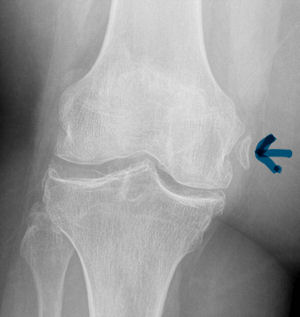
A Pelligrini-Stieda lesion is shown in the radiograph below. This lesion was originally described in 1905, and is associated with a tear of the Medial Collateral Ligament. Heterotrophic calcification forms causing chronic pain, which typically needs to be surgically excised.
So for the students out there, it is possible to diagnosis an MCL tear on plain radiographs. Just not very often.
| Cutting Edge | Old School |
| Gastric Lavage | |
| Hyperinsulinemia and Euglycemia | Supportive care, glucagon for beta blocker overdoses |
| Intralipid administration | Supportive care for anesthetic overdoses, TCAs, and other lipid soluble agents |
| Low dose or NO narcan | High dose narcan for opoid overdoses |
| Checking salicylates and tylenol levels for overdose | Tox screens for everyone |
- Frontal Lobe Epilepsy (FLE) is characterized by recurrent, brief, focal seizures arising from the frontal lobe of the brain, often occuring during sleep.
- FLE is the second most common form of epilepsy, behind Temporal Lobe Epilepsy (TLE).
- FLE presents in 2 forms: (1) simple partial (focal) seizures (no affect on awareness or memory), or (2) complex partial (focal) seizures (affects awareness and memory before, during, and/or after the seizure).
- FLE seizures are often misdiagnosed as psychiatric disorders, non-epileptic convulsions, or sleep disorders, due to the unusual symptoms that they often produce.
Ventilating the Patient with Traumatic Brain Injury
- Many patients with acute TBI will require intubation and mechanical ventilation for a variety of reasons.
- Ventilating the patient with TBI becomes a balancing act between maintaining adequate cerebral perfusion and minimizing lung injury.
- Some pearls to consider:
- Avoid hypoxia: although guidelines recommend a PaO2 > 60 mm Hg, most suggest a higher PaO2 (> 80 mm Hg) be initially targeted.
- Avoid hypercapnia: many patients will develop hypercapnia when ventilated using the low tidal volume strategy (6 ml/kg) of the ARDSnet trial; titrate TVs to maintain a PaCO2 between 32-35 mm Hg.
- PEEP: the application of PEEP remains controversial in patients with TBI given the theoretical risk of increasing ICP through reductions in venous return; if PEEP is applied pay close attention to the cerebral perfusion pressure to ensure it remains > 60 mm Hg.
Show References
- a collection of blood UNDER the periosteum of the outer surface of the skull
- occurs in 2.5% of live births
- most commonly occurs ove the parietal bones
- because the blood is below the periosteum, it will NOT cross suture lines
- usually enlarge during the first few days of life, then slowly resolve over weeks or months
- significant bleeding is a risk
- when the blood resorbs, it can aggravate neonatal jaundice
- aspiration and xrays are not routinely indicated
The Segond Fracture:
An benign appearing avulsion fracture of the lateral tibeal plateau that is marker for more significant injuries such as:
- Anterior Cruciate Ligament (ACL) tear associated with this fracture 75-100% of the time
- Injury to the Medial Meniscus occurs with a Segond fracture 66-75% of the time.
If this avulsion fracture is seen consider immobilzing the patients knee until they can follow up with Orthopedics and/or get an MRI to determine if additional injuries are present.

Precedex (Dexmedetomidine) - Great for pediatric imaging procedures
Alpha-2 agonist with sedative properties
No analgesic effect alone, but shown to decrease the amount of opioids required for a painful procedure
Benefits pts go to sleep and awake in a more natural state. Caregivers tend to prefer this as opposed to other sedatives. Short recovery time- about 30 minutes
Adverse effects include bradycardia and hypotension. Not recommended in any child with cardiac abnormalities. Paradoxical hypertension with loading dose has also been observed
Effective for MRI or CT scans at loading doses of 2mcg/kg over ten minutes, then maintenance of 1mcg/kg/hr
Residents can gain experience with Precedex with Peds sedation on M,W,F mornings with sedation team, contact me to arrange a time for you to participate.
- The 7-day risk of completed ischemic stroke after TIA is 5%.
- The use of reliable stroke prediction tools are potentially invaluable in guiding the degree of urgency that one applies to the management of TIA patients.
- Accuracy of the ABCD2 Score, considered to be the most-refined tool of its kind, was recently again evaluated.
- This 7-point scale assigns risk based on 5 factors: Age > 60 (1 pt.), BP > = 140/90 (1 pt), Clinical features - weakness (2 pts), speech impairment w/o weakness (1 pt); Duration >=60 min (2 pts), 59 to 10 min (1 pt); Diabetes (1 pt).
- The study found that the discriminatory power of the ABCD2 Score may best be applied when used in patients at low risk for an early, disabling ischemic stroke.
Show References
There have been several attempts to try to quantify the best target glucose levels in critically ill patients. This is still a moving target, but a recent study sheds some light on the effect of different levels of hyperglycemia and the types of patients who are particularly vulnerable.
This is a retrospective cohort study whic reviewed 259,000 ICU admissions over a three year period at 173 separate sites. Their findings were as follows:
Compared with normoglycemic patients, the adjusted odds for mean glucose 111-145, 146-199, 200-300, and >300 was 1.31, 1.82, 2.13 and 2.85 respectively.
There is a clear association between the adjusted odds of mortality related to hyperglycemia in patients with AMI, arrhythmia, unstable angina, pulmonary embolism, pneumonia and gastrointestinal bleed.
Hyperglycemia associated with increased mortality was independent of type of ICU, length of stay and/or pre-existing diabetes.
So, even though we have not come to solid conclusions about how far down to keep the glucose levels down, it makes sense to pay particular attention and be more vigilant of the blood glucose levels, especially in the higher-risk patients listed above.
Show References
Suspect your patient has an aortic dissection? Don't wait to lower the blood pressure.
A few considerations for the patient with suspected aortic dissection:
- If the patient is hypertensive AND you really think they could have the disease, start the drip then. Don't wait until the CT is done. Every second that goes by with extremely elevated BP may increase the dissection length.
- If you are really worried about a patient having a proximal aortic dissection, don't wait for the creatinine to come back...scan them without it. If you are really suspicious this is justified in many cases.
- There is very little (to no) role in performing a dry CT (because the patient's creatinine comes back elevated). Dry CT is very insensitive. Instead get a transesophageal echo or an MRI.
Many cardiac patients take warfarin...no surprise.
Many patients use herbal supplements...no surprise.
Many herbal supplements can produce increased bleeding risk with warfarin, and some produce decreased effects of warfarin...that may be a bit of a surprise. Here's a few that are worth knowing:
Herbals that increase the bleeding risk of warfarin: alfalfa, angelica (dong quai), bilberry, fenugreek, garlic, ginger, and ginkgo
Herbals that decrease the effect of warfarin: ginseng, green tea
In addition to asking your patients about their prescription medications, specifically ask your patients if they take herbal supplements, over-the-counter products, or green tea (since many patients don't consider green tea to be either an herbal supplement)...especially if the patient takes warfarin. You just might diagnose or prevent a disastrous bleeding complication.
[Tachjian A, Maria V, Jahangir A. Use of herbal products and potential interactions in patients with cardiovascular diseases. J Am Coll Cardiol 2010;55:515-525.]
A recent study by Smith et al showed that the general abdomen/pelvic CT scan in trauma patients obtained with 5mm slices is a better screening test for spine fractures than plain films. They also showed that when compared to dedicated reconstructed thoracolumbar CT scan (2mm slices focused on the spine) it did not miss any clinically significant fractures.
The statistic for plain radiographs and the nonreconstructive CT scan are shown below.
| | Plain Radiographs | Nonreconstructive CT Scan | ||
| | Lumbar | Thoracic | Lumbar | Thoracic |
| Sensitivity % [95% CI] | 47 [33 to 62] | 13 [3 to 32] | 94 [83 to 99] | 73 [50 to 89] |
| Specificity % [95% CI] | 91 [78 to 97] | 71 [54 to 85] | 95 [85 to 99] | 94 [79 to 99] |
| Positive Predictive Value % [95% CI] | 85 [66 to 96] | 15 [2 to 45] | 95 [86 to 99] | 89 [67 to 99] |
| Negative Predictive Value % [95% CI] | 61 [48 to 72] | 56 [41 to 71] | 93 [82 to 99] | 83 [66 to 93] |
The take home point is that dedicated Spine CT scans are probably not needed unless they are going to be used to guide surgical or non-surgical management, and plain films should probably be abandoned in patients that are undergoing CT scans of the chest/abdomen/pelvis.
Show References
When a child is reported to be exposed to a rat poison it is commonly a long acting coumarin like brodifacoum. The rat usually eats the poison then during its traumatic little life will cause its own death by jumping and squeezing through a crack. When a human is exposed, this is the typical sequence of events:
- Exposure (and when you usually see them in the ED)
- 24-72 hrs later you will actually see an INR rise if actually ingested
Treatment is the same as for coumadin, vitamin K. However, do not start empirically since the patient will be committed to high doses of vitamin K for several months. Let the patient prove they have been poisoned which means they will require recheck of their INR 2-3 days later though they can be sent home with specific warning signs of anticoagulation.
- For many years the recommendations for managing new-onset seizure (NOS) in the emergency department did not include any specific instruction for such patients with HIV/AIDS.
- A study done by Pesola and colleagues found that, infact, AIDS patients with NOS require additional vigilence in terms of their management.
- This study found that over 15% of AIDS patients with NOS would have erroneously been sent home without appropriate treatment had the standard recommendation for NOS management been followed; these patients were found to have intracranial lesions related to toxoplosmosis and lymphoma, and did not necessarily have focal neurologic deficits.
- It is therefore recommended that all AIDS patients with NOS undergo neuroimaging with lumbar puncture, as indicated.
Show References
Bleeding Dialysis Fistula?
Ever see a patient in the ED c/o "my fistula won't stop bleeding"? If you haven't, you probably will in the future.
Here are some helpful tips on getting these bad boys to stop oozing:
- Local pressure for 10 minutes will stop many of these bleeders
- Can also try locally applied gel foam/thrombin
- Pharmacologic adjuncts may be required, especially if the patient has missed dialysis-DDAVP can be given (makes platelets stickier by causing endothelial cells to release von Willibrand Factor). You can also give platelets, since platelets don't work well in a uremic state. Many dialysis patients are on coumadin because of chronic line clots, so don't forget to reverse this if present
- Probably as a last resort you can tie a superficial circular suture at the puncture site. This works quite well.
Impingement Syndrome and the Diagnostic Accuracy of 5 Common Tests
It is also reported that subacromial impingement syndrome (SAIS) is the more frequent cause of shoulder pain.
The authors of this study attempted to determine the diagnostic accuracy of the following 5 tests for SAIS:
- Hawkins-Kennedy
- Neer
- Empty Can
- Painful Arc
- External Resistance
The study demonstrated that any 3 positive tests out of the 5 has a sensitivity of 0.75 (0.54-0.96) , specificity of 0.74 (0.61-0.88), positive likelihood ratio of 2.93 (1.60-5.36) and negative likelihood ratio of 0.34 (0.14-0.80). See the table below for the individual test characteristics. No single test was deemed accurate enough to make the diagnosis by itself.
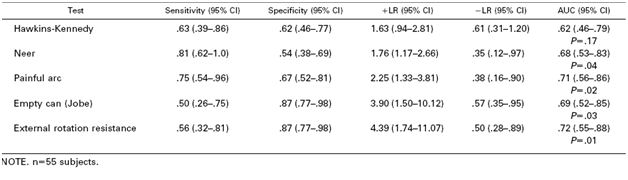
So in the end you should be familiar with most of these tests in order to use a combination of them to make the diagnosis of impingement syndrome. Future pearls will review how to perform these tests.