
In the second half of pregancy, we've traditionally learned that the gravid uterus compresses the inferior vena cava and therefore decreases cardiac output when patient is in a supine position. Therefore, we've learned that patients in the second half of pregnancy the patient should be placed in a left lateral tilt position.
However, it is difficult to perform good quality chest compressions when the patient is in a titled position.
Therefore, the optimal position for chest compressions on the patient in cardiac arrest in the second half of pregnancy is to have the patient in a supine position; and have another rescuer manually deflect the uterus to the patient's left side. This provides optimal compressions + optimal venous return.
Show References
Chief complaint: “Posterior heel pain”
http://www.aidmybursa.com/_img/ankle-retrocalcaneal-subcutaneous-bursitis.jpg
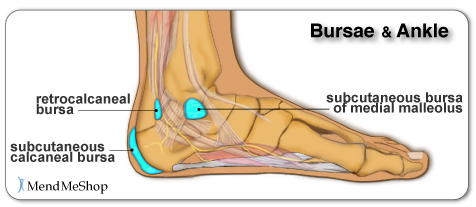
Retrocalcaneal bursitis
The retrocalcaneal bursa is located between the Achilles tendon and the posterior superior border of the calcaneus.
H&P: Inflammation and pain may follow repetitive dorsi/plantar flexion of the ankle (excessive running, jumping activities). Tenderness anterior and superior to the Achilles insertion on the heel.
Treatment: Minimize weight bearing. ½ inch elevation. NSAIDs.
Posterior calcaneal bursitis
This bursa is subcutaneous, just superficial to the insertion of the Achilles tendon.
H&P: Inflammation and pain may follow irritation from the upper border of the heel counter of a shoe. Posterior heel pain. Tender “bump” (the inflamed and swollen bursa) on the back of the heel.
http://podiatry.files.wordpress.com/2006/12/patient2.jpg

Treatment: Opened-heeled shoes, sandals, or placement of a “U-shaped” pad between the heel and the counter. NSAIDs. Advance to shoes with soft or less convex heel counters.
Show References
- occurs in 1/1000 live births, but found in 15% of neonatal autopsies
- usually weigh <2500 grams at birth with prematurity the most common risk factor
- present with bleeding from the nose and mouth with severe respiratory distress
- immediate treatment with tracheal suctioning, oxygen, and positive-pressure ventilation
- ventilation goal is to maintain a high, positive expiratory pressure of at least 6-10cm H20
- also check for and correct any underlying bleeding disorders
- extremely high mortality, but no long-term pulmonary deficits if the infant survives
Show References
As we eat our turkey today and the myth that we are tired because of the tryptophan content is propagated further - nothing to do with the 2000kcals that we just ate - I would like to share an interesting and controversial study.
Use of stimulants and and sedatives by EM residents. Incidence is as follows:
In a study of 485 residents with 47% response rate:
Prescription Stimulants: 3.1%
Sleep Aids (all): 89%
Use of Nonbenzodiazepines (zolpidem): 14%
Use of Melatonin: 10%
Benzodiazepines: 9%
Difficult job with difficult hours. What is the appropriate medication or is there a medication that truly assists with performance? Are they doing harm to themselves? to patients?
Disrupted circadian rhythm, addiction tendencies and the hardship of a stressful nightshifts are the price we pay for this specialty. Awareness and education are needed for the residents as well as the attendings.
Show References
- Any patient presenting with an acute onset of dizziness described as a spinning sensation should be thoroughly assessed for cerebellar stroke, as these often present in such a manner, prior to assuming that the source is simple vertigo.
- Cerebellar strokes, whether due to infarct or hemorrhage, typically present with ataxic gait, abnormal Rhomberg, dysmetria with finger-to-nose and heel-to-shin testing, and nystagmus.
- In addition, the dizziness associated with cerebellar strokes should be less reproducible and extinguishable than that due to simple vertigo.
- In terms of imaging, remember that CT scanning is not the preferred radiologic modality for evaluating the cerebellum and posterior aspects of the brain; the thickness of the posterior skull tends to create significant artifact and distortion. If suspicion warrants, MRI should therefore be pursued.
Show References
Non-Convulsive Status Epilepticus (NCSE) is generally under reported. An ICU study found 10% admissions for altered mental status (AMS) were eventually diagnosed as NCSE.
Pearls:
- Include NCSE in the AMS differential
- NCSE may occur with or without convulsive seizures
- Difficult to distinguish from a post-ictal state (14% of convulsive seizures convert to
NCSE)
- Reported mortality is up to 44%
Consider NCSE when:
- Seizure history / recent seizures
- Post-ictal period >1 hour
- Odd behaviors (e.g., chewing, blinking, personality change) and abnormal eye
movements (86% specific)
- AMS without structural, metabolic or traumatic etiology
- Patient intubated for status epilepticus
If you are unsure but suspicious of NCSE order a STAT EEG. Treat NCSE like a convulsive status.
Show References
We mentioned atropine's elimination from the cardiac arrest (asystole, PEA) protocols last week. Atropine (0.5 mg) is still indicated in unstable bradycardias that appear to be vagally-mediated, such as sinus bradycardia and Mobitz I bradycardia.
Beware, however, that atropine is not recommended in patients with transplanted hearts. These hearts lack vagal innervation, and in fact there's one small study suggesting that atropine may be associated with paradoxical slowing of the heart rate and worsening AV block. Go straight to pacing with these patients.
Show References
Evaluation of Potential Intra-Articular Joint Lacerations
Skin and soft tissue injuries in proximity to a joint often prompt concern of whether the injury violated the joint space. Joint Space involvement is important to exclude as it can lead to septic joints and long term disability.
One easy way to determine if the joint capsule has been violated is to inject methylene blue into the joint and watch to see if any of the methylene blue extravasates through the soft tissue.
Indications for a methylene blue injection include:
- Periarticular fracture
- Visible joint capsule
- Proximity to a joint
There are no absolute contraindications. Though clearly the procedure does not need to be done when the injury highly suggests an open joint injury and the patient will require operative debridement and exploration.
To watch a video of a injection head to eMedicine by clicking http://emedicine.medscape.com/article/114453-overview
Show References
In the setting of a patient suffering from an anticholinergic overdose with hallucinations/agitation, it may be beneficial to administer the antidote: Physostigmine. Many hesitate simply because they have never administered before or there may be doubt in the diagnosis. Here is the skinny:
1) Anticholinergic OD seen in following meds: diphenhydramine (Benadryl), dimenhydrinate (Dramamine), scopolamine, benztropine (Cogentin), some plants like datura stromonium (thorn apple)
2) Physostigmine 1mg IV slowly over a REAL 5 min. Administer to fast and patient may seize. Maximum dose of 2mg IV.
3) Contraindications: suspicion of TCA OD (anectdotal and from old case report) - screening EKG should be done prior to administration of physostigmine. Also glaucoma, closed angle, obstructive uropathy.
Remember your clinical endpoint needs to be measurable, thus hallucinations and agitation should be reversed. No indication if the patient is only experiencing dry mouth or other more mild anticholinergic symptoms.
- Idiopathic Intracranial Hypertension, previously known as pseudotumor cerebri, can be treated with medications such as carbonic anhydrase inhibitors (i.e. acetazolamide), corticosteroids, indomethicin, loop diuretics, and analgesics used to treat migraine headaches.
- While removing excess cerebrospinal fluid (CSF) via lumbar puncture (LP) is sometimes considered to be an appropriate therapeutic intervention for IIH in the emergency department, it is generally not recommended for the following reasons:
-- CSF reforms within 6 hours, making its removal short-term, unless there is a CSF leak.
-- LP can be challenging in obese patients and uncomfortable for patients, in general.
-- LP complications such as low pressure headaches, CSF leak, CSF infection, and intraspinal epidermoid tumors.
Show References
Positioning for Ventilated, Critically Ill Obese Patients
- Up to one-quarter of patients in the ICU are obese, as defined by a BMI > 35 kg/m2
- Obesity can significantly alter pulmonary physiology causing
- reduced lung volumes
- decreased compliance
- abnormal ventilation to perfusion relationships
- respiratory muscle inefficiency
- For intubated obese patients, body position can affect ventilatory management
- In the supine position, obese patients can have collapse of lung segments along with increased impedance of the diaphragm
- Elevating the head of the bed to 30-45 degrees in intubated obese patients has been shown to improve tidal volumes and lower respiratory rates.
Show References
Dose of Epinephrine for Patients with Anaphylaxis
Many of us are familiar with 0.3-0.5 mg IM of 1:1,000. Important to give IM and not SC.
In severe cases, consider IV Epinephrine:
- Take 1 mg of crash cart Epinephrine (1:10,000) and inject into 1 liter of normal saline
- Start drip at 1 cc/min which is 1 microgram/min
- "Titrate to life" (i.e. titrate up or down according to severity)
Show References
The new 2010 AHA Guidelines no longer recommend the use of atropine in caring for patients with cardiac arrest. While it may be useful in vagally-mediated bradycardias, the evidence does NOT support the use of atropine in patients with asystole or PEA; therefore, it has been removed from the cardiac arrest algorithm.
Show References
Transverse Myelitis
A group of inflammatory disorders characterized by acute or subacute motor weakness, sensory abnormalities and autonomic (bowel, bladder, sexual) cord dysfunction.
Symptoms are usually bilateral but both unilateral and asymmetric presentations can occur.
Look for a well-defined truncal sensory level
-below which sensation of pain and temperature is altered or lost.
Causes: Autoimmune after infection or vaccination (60% of cases in children), direct infection, or a demyelinating disease such as MS. No cause is found in 15 – 30% of cases.
Incidence: Bimodal peak at 10-19 years and at 30-39 years.
Diagnostic testing: MRI of the ENTIRE spine to both rule out structural lesions and rule in an intrinsic cord lesion. If MRI is normal reconsider the original diagnosis.
Treatment: Steroids are first-line therapy. Dosing is controversial but generally involves high IV doses for 3-5 days (1000 mg methylprednisolone). Plasma exchange is second line for those who don’t respond to steroids.
Show References
- Ingestion of concentrated hydrogen peroxide (H2O2) has been associated with venous and arterial gas embolic events, hemorrhagic gastritis, gastrointestinal bleeding, shock, and death.
- Although H2O2 is generally considered a benign ingestion in low concentrations (OTC is 3%), case reports have described serious toxicity following high concentration exposures.
- Hyperbaric oxygen (HBO) has been used with success in managing patients suffering from gas embolism with and without manifestations of ischemia.
- A recent poison center case record review confirmed previous findings.
- It identified 11 cases of portal gas embolism. In 10 cases 35% H2O2 was ingested and in 1 case 12% H2O2 was ingested. All abdominal CT scans demonstrated portal venous gas embolism in all cases. Hyperbaric treatment was successful in completely resolving all portal venous gas bubbles in nine patients (80%) and nearly resolving them in two others. Ten patients were able to be discharged home within 1 day, and one patient had a 3.5-day length of stay.
- Bottom Line: In a patient with a history of hydrogen peroxide ingestion, have a low threshold for CT scan. HBO therapy is an effective treatment modality.
French LK, et al. Hydrogen peroxide ingestion associated with portal venous gas and treatment with hyperbaric oxygen: a case series and review of the literature. Clinical Toxicology 2010;48:533–38.
Show References
- Many neurologic conditions present with motor dysfunction. It is often helpful to distinguish these movement abnormalities in order to properly recognize and manage the disorder.
- Chorea >>> Sudden, ballistic movements.
- Athetosis >>> Writhing, repetitive movements.
- Fasiculations >>> Fine twitching of individual muscle bundles, most easily noted on the tongue.
- Dystonia >>> Sudden, tonic contractions of muscles of the tongue, neck (torticollis), back (opisthotonos), mouth, or eyes (oculogyric crisis).
- Tardive dyskinesia >>> lip smacking, chewing, and teeth grinding (early signs).
Ocular sonography is a fast, simple, and non-invasive tool to detect elevated intracranial pressure (ICP) by measuring the optic nerve sheath diameter (ONSD). Several studies have shown a positive correlation between increased ONSD (>5.7mm) and elevated ICP (>20mmHg). Although ultrasound may not replace CT or MRI to diagnose the cause of the increased ICP, its use as a triage tool can expedite these tests.
The technique:
- Use linear probe on closed eyelid.
- Identify the optic nerve sheath.
- Measure the optic nerve sheath, 3mm behind globe.
- Rotate probe 90 degrees and measure again.
- Average both diameters.
Please see the references below for more information and, as with any new technique please consult local experts prior to making clinical decisions.
Show References
The new 2010 AHA guidelines have provided greater focus on airway issues in patients suffering from cardiac arrest. Amongst the important areas of new emphasis are: (1) Cricoid pressure is no longer routinely recommended during intubation, and in fact it has been given a Class III rating ("harmful"); and (2) there is now a very strong push to use quantitative end-tidal CO2 monitoring (rather than just qualitative confirmation) of the airway after endotracheal intubation.
Show References
Dabigatran
- the first new ORAL anticoagulant in over 50 years
- is a direct thrombin inhibitor
- Indicated for reducing strokes and systemic embolism in patients with a fib
- DOES NOT need monitoring and frequent dose adjustments
- Has fewer drug and food interactions than warfarin
- Costs about $8/day (more than the cost of warfarin PLUS monitoring)
- Both warfarin and dabigatran have a similar OVERALL bleeding risk, but warfarin causes more intracranial bleeding and dabigatran more GI bleeding
Show References
Optimal management of subarachnoid hemorrhage requires prognostic understanding and effective communication with neurology and neurosurgical consultants, as well as the patient and their family members.
It is therefore often helpful to utilize and reference the widely recognized Hunt and Hess Scale in grading symptoms of ruptured cerebral aneurysm and subarachnoid hemorrhage severity:
- Grade 1: Asymptomatic; or minimal headache with slight nuchal rigidity. Approximate survival rate (ASR) 70%.
- Grade 2: Moderate to severe headache; nuchal rigidity; no neurologic deficit except cranial nerve palsy. ASR 60%.
- Grade 3: Drowsy; minimal neurologic deficit. ASR 50%.
- Grade 4: Stuporous; moderate to severe hemiparesis; possible early decerebrate rigidity and vegetative abnormality. ASR 20%.
- Grade 5: Deep coma; decerebrate rigidity; moribund. ASR 10%.
- Grade 6: Death; brain dead.
For your convenience, an online Hunt and Hess Scale calculating tool can be found at:
http://www.mdcalc.com/hunt-and-hess-classification-of-subarachnoid-hemorrhage-sah