
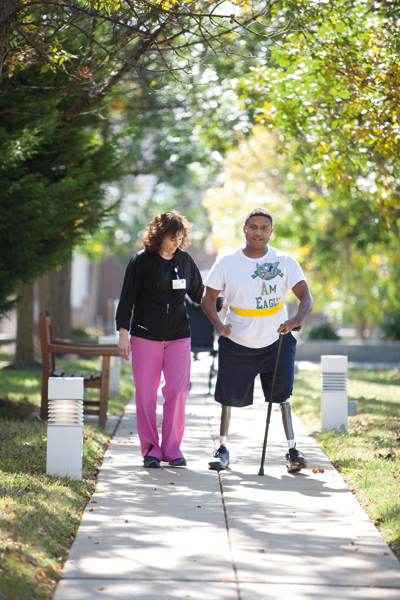
 Motion capture suits are sometimes worn by actors on a movie set to enhance special effects and animation, but the suits may also be worn by certain stroke patients at the University of Maryland as part of their rehabilitation program. The Department of Physical Therapy and Rehabilitation Science is using motion capture suits to spotlight physical strengths and weaknesses and help doctors design therapies to improve motor function. It’s but one example of the cutting edge clinical research being conducted by the department to help patients.
PTRS research focuses predominantly on older individuals. The staff is trying to understand and correct common physical mobility problems in this population, such as falling, movement and balance issues after stroke, Parkinson’s disease, and diabetic nerve damage in the feet and hands. Faculty members work collaboratively toward these overarching goals, but explore different problems in their research. Some of the studies use healthy older people as subjects and some use people with specific physical problems.
Most patients are seen at the University of Maryland Medical Center, but the PTRS staff also provides care and conducts research at the R. Adams Cowley Shock Trauma Center, the University of Maryland Rehabilitation & Orthopaedic Institute, and the Baltimore VA Medical Center.
 Professor and Chair Mark Rogers, PT., PhD., uses motion capture to explore how protective movements of the limbs, like stepping and reaching, can stabilize balance and stop falls; and he also looks at how falls are affected by the brain slowdown and other changes that accompany aging. He and his colleagues, including Rob Creath, PhD, are particularly interested in why older adults often fall sideways instead of straight forward or backward and are conducting a randomized clinical trial on this phenomenon supported by the National Institute on Aging. Other studies look at whether sensory cues – such as light-flashes, skin vibrations, or sound bursts – can speed up delayed neurological responses and improve posture problems and gait delays in people with Parkinson’s disease.
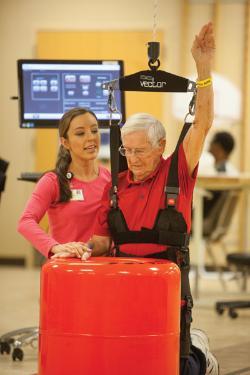
Douglas Savin, MPT, PhD, shares Dr. Rogers’ concerns and is training senior citizens to stay on their feet when they encounter terrain changes and startling environmental events, like unexpected loud sounds. Patients in safety harnesses work on a treadmill that goes forwards and backwards unpredictably until they can maintain their balance no matter which way the belt moves.
Kelly Westlake, PhD, is looking at ways to improve arm movements to brace the impact of a fall and reduce the risk of hip fracture in older adults. She is specifically interested in whether attention and anxiety affect how people react when they feel themselves losing their balance. Dr. Westlake is also studying the best way for people recovering from strokes to relearn hand coordination and improve everyday function. Mary Rodgers, PT, PhD, looks at how different exercise programs affect how well the body moves.
 Stroke Recovery
Many of the researchers focus on individuals recovering from strokes. Jill Whitall, PhD, and Sandy McCombe Waller, PT, PhD, discovered that, after a brain injury that affects the arms, training both arms together and combining that training with specific sound signals improves arm function faster than working with one arm and then the other.
Dr. McCombe-Waller also works with engineers at the University of Maryland, Baltimore to develop assistive devices, including sensors that operate electronic equipment from a wheelchair. She helps engineers understand what recovering patients can actually do and reminds them that their products must be affordable, easy to use, and washable.
Gad Alon, PT, PhD, studies the effect of electrical stimulation on peripheral artery disease (PAD) and the muscle loss that accompanies aging.
The researchers use cutting edge technology in their work, including a device called the BATRAC that exercises both arms at once, the robotic leg assist devices and motion capture suits, and magnetic and electrical stimulation machines that increase the activity of different parts of the brain through the skull.
The studies use healthy volunteers in the 50+ age range as well as disabled individuals. Study recruitment is done through the Veterans Administration and the Claude D. Pepper Older American Independence Center.