
Get To Know
Cecelia L. Bergeria, PhD: Measuring Craving to Address Addiction
October 16, 2026

Cecelia L. Bergeria, PhD, last year joined the UMSOM faculty as an Associate Professor of Psychiatry and as an addiction researcher at Kahlert Institute for Addiction Medicine where she is developing an assessment tool to measure opioid cravings.
In an edited interview, Dr. Bergeria discussed her approach to researching addiction and future lines of research she hopes to pursue at the Kahlert Institute.
Q: Tell us a bit about your research career, the work you did at Hopkins, and what drew you to study addiction medicine.
I joined Hopkins initially as a post-doc to study opioid addiction and work with my mentor, Dr. Kelly Dunn, who is now the director of the Kahlert Institute. I wanted to study opioid withdrawal to better understand how to remove barriers to getting people into treatment, and that work led to my interest in studying opioid craving. Although craving is a fundamental component of the addiction experience, it has been neglected by researchers because it can be seen as so subjective. But understanding craving and how to measure it could really help us develop new and better therapies—and help gain FDA approval for those therapies with validated measurement tools.
Q: Can you tell us about the strategy behind your research into repurposing existing, FDA-approved medications for use in addiction medicine?
Developing new medications from scratch takes so much time and millions of dollars, so if we find evidence that already approved medications can help some aspect of addiction, it potentially means new therapies becoming available much sooner and more cheaply than developing new drugs.
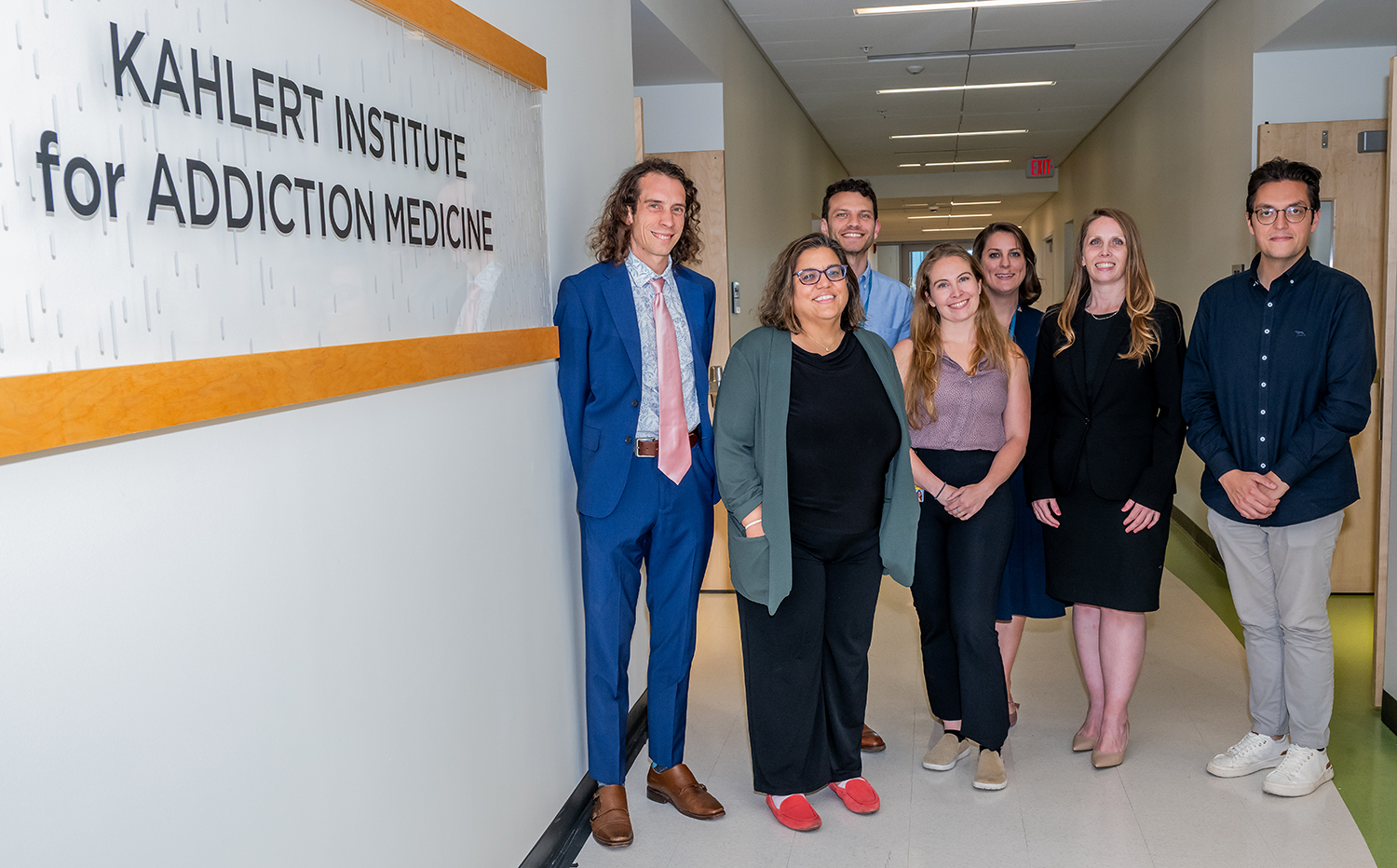 Kahlert Institute faculty (from left to right) Justin Strickland, PhD, Mary Kay Lobo, PhD, Peter Manza, PhD,
Summer Thompson, PhD, Cecilia Bergeria, PhD, Kahlert Director Kelly Dunn, PhD, MBA, and Marco Venniro, PhD.
For instance, I’m currently studying buspirone, also known as Buspar, which is an approved anti-anxiety medication. Buspirone may help address opioid withdrawal and cravings for opioids because it addresses a mechanism that has been shown to influence these outcomes in preclinical research. I’m currently halfway through a five-year study with R01 grant funding to see if it can help patients in treatment for fentanyl addiction. If we find sufficient evidence that buspirone or some other candidate medication can help in addiction medicine, we can disseminate the science to providers so they can utilize the medication off-label. Alternatively, we can submit an application to the FDA to label a medication for use in treating opioid use disorder, which is a lengthier process.
 Q: How are you working on developing an assessment of opioid craving?
Addiction experts in the field understand that if we can measure and define the variables that make up cravings for opioids, we can potentially learn to intervene in that space before people in treatment relapse and misuse opioids.
I’ve been working since 2020 to create an opioid craving assessment following the FDA requirements or qualification program. When the FDA qualifies an assessment, it can be used to support medication labeling and developing treatments to address each symptom of craving specifically. This is qualitative work, where I’ve been interviewing people with opioid use disorder to understand how they experience what we define as a “craving”, which appears to have six dimensions including: some form of anxiety or stress associated with close proximity to opioids; anticipation of positive reinforcement like the feeling of getting high, anticipation of negative reinforcement like avoiding pain or withdrawal, obsessive thoughts about the drug; motivation to seek it out; loss of control when around the drug.
We’ve formulated the assessment and are now are testing it at multiple clinics around the US to see how well it predicts treatment outcomes. We’re about five years off from our final data collection, which we plan to submit to the FDA for review. The addition of craving as a medication target will open up new treatment strategies and move beyond abstinence as the only treatment endpoint.
 Q: Are there other studies you plan to undertake in the near future?
I’m interested in studying behavioral and pharmacological strategies that could address hypertension among patients with opioid use disorder since poor cardiovascular health is a common co-morbidity in these patients.
In terms of the components of craving, we haven’t fully teased those apart to learn how different candidate medications could address each of them, so that’s another area. I’m hoping to investigate.
Q: What kinds of collaborators would you like to work with at Kahlert, UMSOM, and potentially across the University of Maryland?
I really value collaborators on basic research. A lot of medication development starts with precise behavioral presentations in preclinical modeling, and that can lead to translational models to really start advancing potential therapies toward clinical trials. Now that we have described craving in more detail, we can look at what assays exist in preclinical literature to replicate those dimensions and probe new medication targets. We are also working with my Kahlert colleague Peter Manza, PhD, who has fMRI expertise, to drill down on the neural mechanisms of craving.
Watch the Video