
U.S. Deputy Surgeon General Paul Jung Returns to UMSOM to Discuss Public Health Communication and Service
November 19, 2026 | Jake Shindel
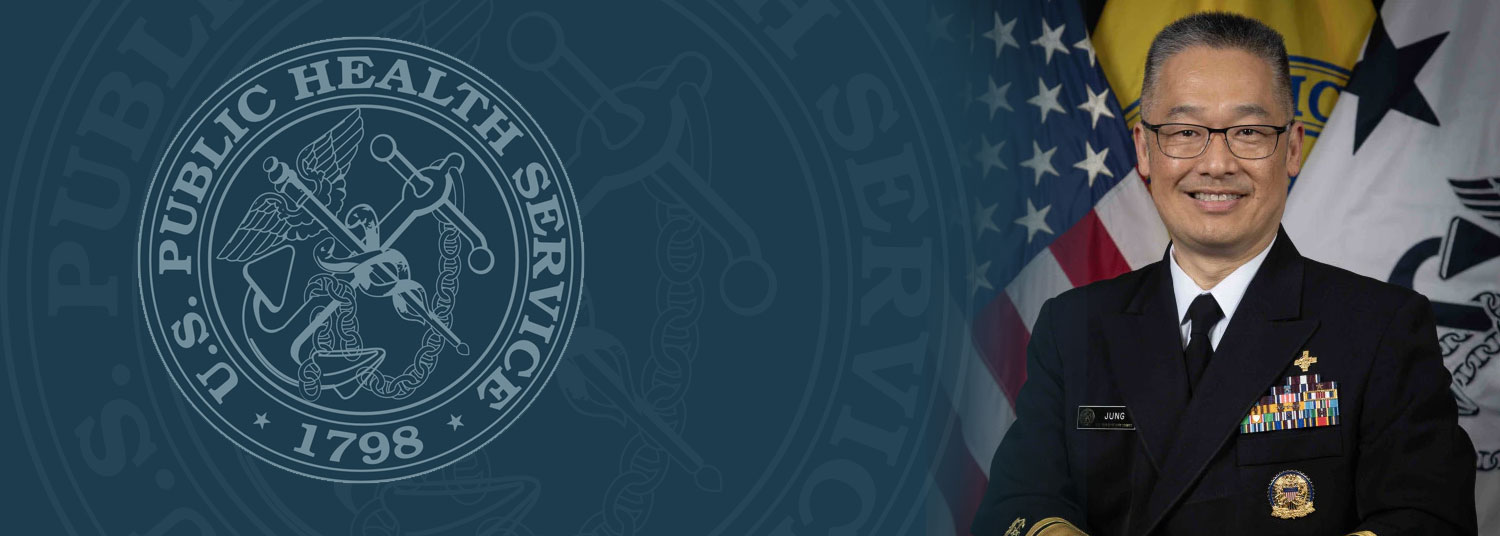
Rear Adm. Paul Jung, MD, Deputy Surgeon General of the United States, and an alumnus of the University of Maryland School of Medicine (UMSOM) who graduated in 1996, visited campus to speak with medical students about the mission of the U.S. Public Health Service and the importance of communicating reliable health information to the American public.
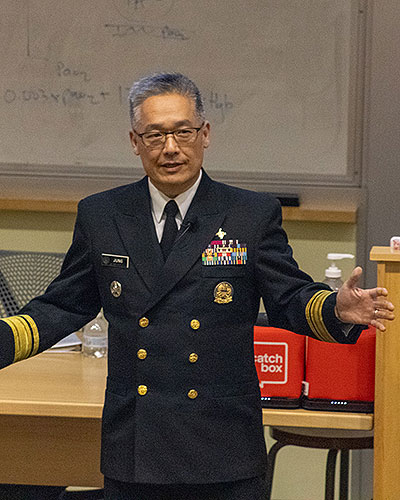 Organized by UMSOM’s Preventive Medicine Residency Program, the visit gave students an opportunity to hear from a physician and federal public health leader whose work centers on advancing the health of the nation. Dr. Jung’s return to his alma mater also highlighted the diverse career paths available to physicians seeking to make an impact beyond individual patient care.
During his presentation, Dr. Jung discussed the history of the surgeon general’s office, including landmark public health communications on smoking and HIV/AIDS. He emphasized that the office’s ability to inform the public depends on credibility, clear communication, and public trust.
“The Surgeon General's primary role is to be a communicator to the American public about health issues,” Dr. Jung said.
Dr. Jung explained that, unlike regulatory agencies, the surgeon general’s office relies on communication to help Americans understand health risks and make informed decisions. Maintaining public confidence in that information is essential to the office’s mission.
“The only power that the Office of the Surgeon General has is communication. And if we lose that trust, we have nothing,” Dr. Jung said.
Dr. Jung also discussed the office’s broader efforts to address emerging public health concerns, including mental health, addiction, vaping, and screen time among children and adolescents. He highlighted the importance of making reliable, accessible health information available to the public as health challenges and communication technologies evolve.
“We want to be the trusted source for information for the American people,” Dr. Jung said.
Dr. Jung said his time at UMSOM highlighted the various opportunities available to medical students.
“We had leaders of national student organizations in my class, we had students taking advantage of all kinds of different programs – from research to early clinical opportunities,” Dr. Jung said.
He said faculty connections at UMSOM led him to spending a summer working at the Maryland Department of Health.
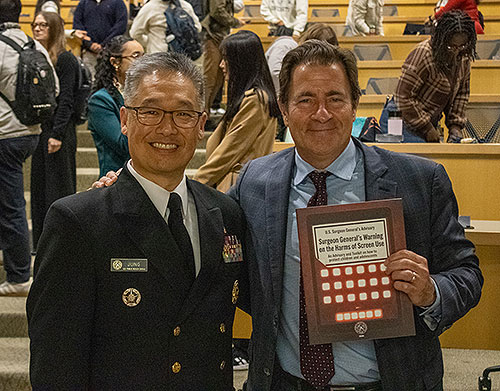 Beyond the classwork, Dr. Jung remembers great camaraderie among his classmates. He remembers the end-of-year Follies, where the students would create skits poking fun at faculty and administrators. He was even with UMSOM when Camden Yards opened, and said he remembers classes were canceled because of the expected traffic disruption.
Dr. Jung, who grew up outside Pittsburgh before moving to Laurel while he was in high school, was first commissioned as an officer after September 11, when he worked for the Food and Drug Administration. He believes living in Laurel had a significant impact on his career path — three students in his graduating class in high school became officers in the Commissioned Corps.
Dr. Jung made stops at the National Institutes of Health, the Indian Health Service, and even details to the Peace Corps and Capitol Hill on the Energy & Commerce Committee. Still, his current position shocked him.
“I never imagined that I would be Deputy Surgeon General,” Dr. Jung said.
For UMSOM students preparing to enter the medical profession, the discussion underscored how physicians can contribute to population health through education, prevention, leadership, and public service. Dr. Jung’s career offers an example of how medical training can provide a foundation for work that reaches beyond the clinical setting and influences health at a national level.
His visit reinforced UMSOM’s commitment to preparing future physicians to serve patients and communities while recognizing the important role that evidence-based communication plays in protecting public health.
Contact
Jake Shindel
Media, Communications, and Public Relations Specialist
jshindel@som.umaryland.edu
Telephone 443.286.9585