
Jacques Initiative Brings HIV Prevention Education Into Baltimore Beauty Shops Through Community-Designed Program
November 11, 2026 | Jennifer Gonzales

New study in the Journal of the International AIDS Society highlights how trusted community relationships can help address barriers to HIV prevention among Black women.
 What if a conversation about HIV prevention began not in a doctor's office, but in a neighborhood beauty shop?
A new study from the JACQUES Initiative at the University of Maryland School of Medicine highlights the potential of Tea Talk, a community-designed sexual health education initiative that brings HIV prevention information into Black-owned beauty shops across Baltimore. Published October 26 in the Journal of the International AIDS Society (JIAS), the study demonstrates how partnering with trusted community professionals can help make sexual health education more accessible, culturally responsive and relevant to the women it aims to reach.
In collaboration with six Baltimore-area beauty industry professionals, Tea Talk was designed to address barriers to HIV prevention among Black women by meeting them in familiar spaces where relationships, trust and open conversations already exist.
Black women continue to experience a disproportionate burden of HIV in the United States – accounting for half of HIV diagnoses in women, according to 2022 research, despite making up only 13% of the female population. Uptake of pre-exposure prophylaxis (PrEP)—medication that can prevent HIV acquisition—remains low among all women. Limited awareness, medical mistrust, stigma and the effects of gendered racism can all influence access to prevention services. Tea Talk offers a different approach: rather than expecting women to navigate these barriers on their own, the initiative brings prevention education into their communities.
“When we call Black women ‘hard to reach,’ we overlook how often our systems fail to show up in places where trust already lives. Beauty professionals are not simply a channel for health messages; they are community experts. Tea Talk was built with them, so prevention education could be relevant and connected to resources women can use,” said Stephen B. Thomas, PhD, professor of health policy and management and founder of Health Advocates In-Reach and Research (HAIR) Network at the University of Maryland School of Public Health.
Putting community expertise at the center
Rather than developing an intervention for the community from the outside, the JACQUES Initiative engaged six Black Baltimore-area beauty professionals in designing it from the ground up.
 Using a human-centered design process, the team worked with participants to explore clients' experiences, identify challenges surrounding HIV prevention and develop solutions suited to the realities of their shops and communities. The resulting intervention, Tea Talk, incorporated educational sessions, informational materials, connections to local resources, and tea and snacks to create a welcoming environment for conversation.
Participating beauty professionals also received education on sexually transmitted infections, sexual health, gender inclusivity and biomedical HIV prevention strategies. This training was designed to strengthen their confidence as community educators while helping them share accurate information and direct clients to appropriate resources.
The approach also recognized that how health information is presented matters. Participants recommended using visually engaging but discreet materials that could spark curiosity without explicitly displaying potentially stigmatizing references to HIV or PrEP. This allowed conversations to develop naturally through existing relationships between beauty professionals and their clients.
"As a medical community, we are sometimes quick to rush in and focus on what is of interest to us,” said Natalie Spicyn, MD, MHS, study PI and medical director of the JACQUES Initiative at the Institute of Human Virology, University of Maryland School of Medicine. "We learned a lot from the communication expertise of the beauty professionals, who had to tell the research team 'This poster looks good, but take HIV off of it, take PrEP off of it.' The importance of colorful but discreet materials, along with a welcoming tea set up which served as a conversation starter, were major contributors to the success of Tea Talk."
Early findings point to promise
 Tea Talk was piloted in six Baltimore-area beauty shops over three months, from March through June 2025. During the pilot, clients accessed the initiative's PrEP informational website 62 times through shop-specific QR codes. Participating beauty professionals reported strong interest among clients in sharing educational and prevention materials with others.
The study also documented a shift in participants' understanding of PrEP. Through the co-design process and educational training, beauty professionals broadened their perceptions of who could benefit from HIV prevention medication, recognizing its relevance to Black women as well as other populations.
Participants found the intervention feasible to implement and broadly acceptable to their clientele. Their recommendations for future development included expanding digital educational materials and incorporating mental health components.
While the pilot was not designed to measure changes in PrEP uptake or HIV incidence, its findings suggest that community-designed interventions may offer a valuable way to expand the reach of prevention education and address social and structural barriers to care.
Advancing community-centered HIV prevention
For the JACQUES Initiative, Tea Talk reflects the importance of developing public health strategies in partnership with the communities they serve. By recognizing beauty professionals as experts, collaborators and trusted sources of information, the initiative offers a model for engaging populations who may face barriers to traditional health care settings.
The findings also underscore the value of bringing prevention information directly into everyday environments, where conversations can happen without the formality or stigma some people associate with clinical settings.
As new HIV prevention options become available, approaches that connect people with accurate information and local resources will remain important to ensuring that advances in prevention reach the communities that need them.
The JACQUES Initiative is part of the Institute of Human Virology at the University of Maryland School of Medicine, which advances research, prevention, treatment and community engagement to address HIV and other infectious diseases.
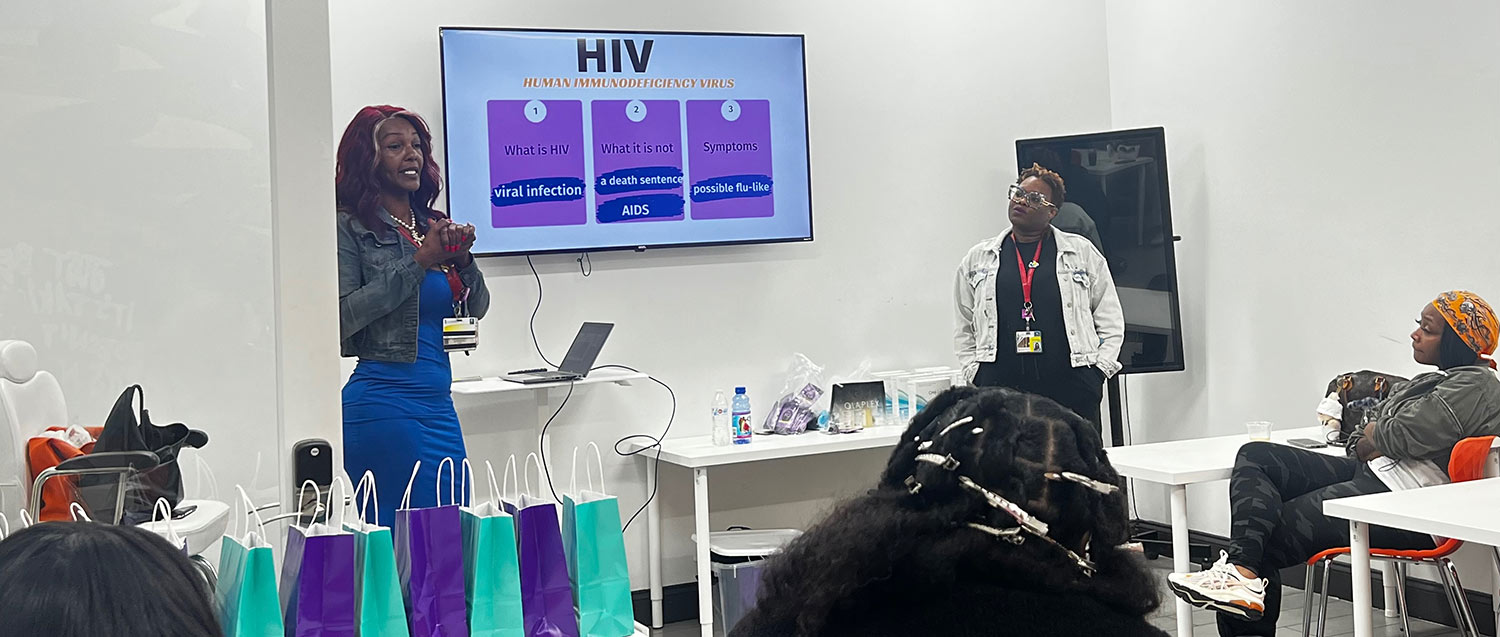
JACQUES Initiative’s Rhonda Carr, Community Program Coordinator, and Sierra Cary - Brown, BS, CHES Community Engagement Program Specialist leads education of Baltimore-area stylists for Tea Talks.
Contact
Jennifer Gonzales
Jennifer.Gonzales@ihv.umaryland.edu