
Ciguatera
- Heat resistant toxin found in fish, thus cooking doesn't protect you
- Found in over 400 species of fish but bioaccumulates in fish so predator tropical reef fish have higher concentration: grouper, barrucuda, snapper, parrotfish
- Found in tropical areas (See attached map for hot bed locations - in case you vacation there)
- Clinical Findings: Very neat hot-cold reversal where you place you hand in bucket of ice water and it feels like it is burning and visa versa, GI symptoms, paresthesias, ataxia and even hallucinations (very cool)
- Treatment: attempts with mannitol and gabapentin are reasonable and safe but completely unproven. Supportive care
Attachments
- During the emergency department management of all stroke patients, an NPO (nothing by mouth) status should be maintained until a formal swallow study can be performed to determine whether there is dysphagia.
- The best predictor of dysphagia (swallowing difficulty) in a stroke patient is the presence of dysarthria (motor speech abnormality).
- While the absence of a gag reflex, may suggest some degree of dysphagia, remember that about 10 to 15% of people lack a gag reflex.
Dexmedetomidine and the Critically Ill
- Dexmedetomidine is a newer sedative agent that is being used with increasing frequency in the critically ill
- A few pieces of information regarding dexmedetomidine:
- highly selective alpha-2 agonist
- produces dose-dependent sedation and anxiolysis while maintaining arousability at deep levels of sedation (hypercapnic arousal is preserved)
- onset of action is approximately 15 minutes with peak concentration achieved in about 1 hour
- metabolized via the liver
- no known active or toxic metabolites
- loading dose of 1 mcg/kg over 10 minutes followed by 0.2 - 0.7 mcg/kg/hr
- Primary side effect is bradycardia at excessive doses
- Cost is an issue when compared to propofol and midazolam
Show References
Jones fracture
- Fracture of proximal metaphyseal 5th metatarsal
- located w/in 1.5 cm distal to tuberosity of 5th metatarsal
- Prone to malunion
- Watershed area (poor blood supply)
- Under tension from multiple tendons
- Treatment
- Immobilize with posterior-mold splint
- Non-weight bearing - crutches
- Prompt orthopedic evaluation
- Some cases are managed with non-weight bearing casts
- Others are repaired operatively.
- Delayed jones fractures with malunion will require operative repair.
- Distinguish from pseudo-jones fracture (dancers fracture)
- metatarsal styloid avulsion fracture, generally does not require operative repair
- much more common than true Jones fracture.
Presented with persistant foot pain from
Jones fracture malunion.
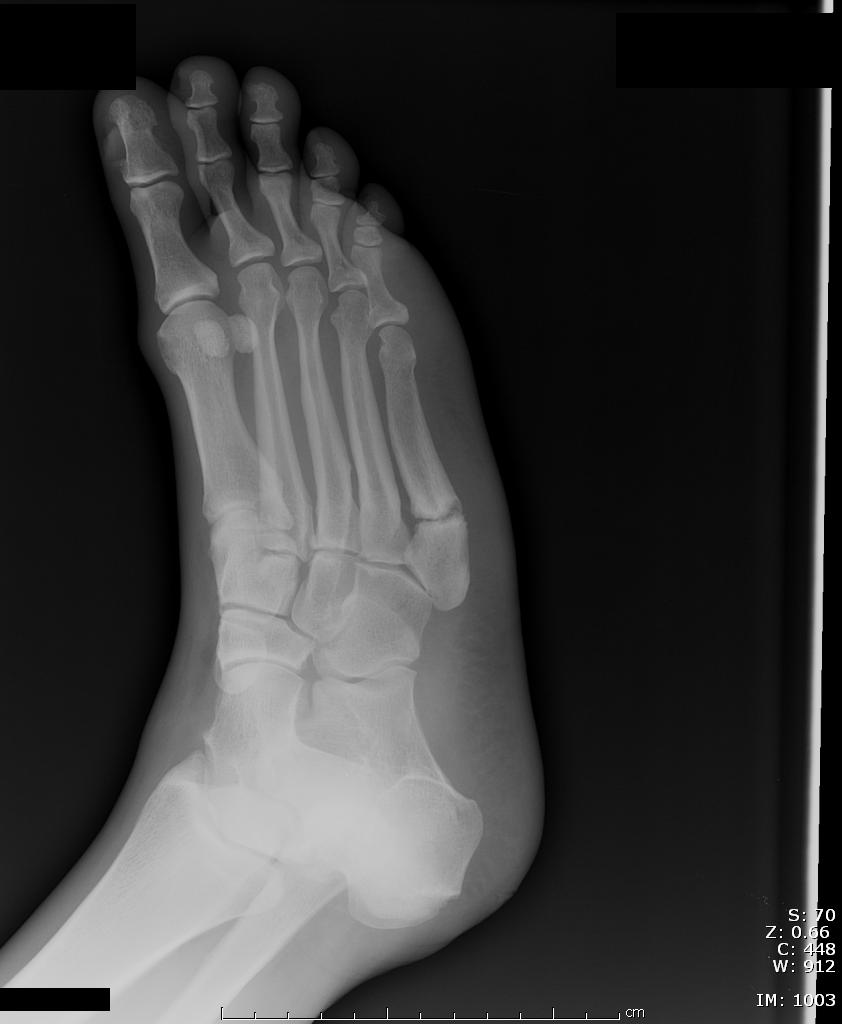
Show References
- results from failure of the upper femoral epiphysis, which allows displacement of the femoral head on the femoral neck
- onset may be sudden, but more often is gradual
- pain frequently is referred to the knee, but can also occur in the hip
- limp and out-toeing are common, with loss of medial hip rotation
- majority of patients are 7-15 years old, and are aboce the 95th percentile for weight
- AP or frog-leg lateral xrays of the hip are diagnostic
Show References
- Dysarthria is a motor speech abnormality that commonly results from stroke and is related to focal muscular deficits in the face.
- One of the most challenging aspects of recognizing dysarthria relates to distinguishing it from apraxia.
- Apraxia has nothing to do with a focal motor deficit, but rather a cortical deficit which results in an inability to optimally execute the function of the facial musculature.
- Isolated dysarthria without other neurologic deficit, termed pure dysarthria, is rare and thought to result from multiple lacunar infarcts causing hypoperfusion of the frontal cortex.
Show References
Lorazepam Infusions
- There is some literature that propofol may be better for sedation in the mechanically ventilated patient, yet many emergency physicians still do not have access to the medication
- Lorazepam infusions are frequently used in many EDs for sedation of the mechanically ventilated patient
- Patients receiving continuous infusions of lorazepam are at risk for propylene glycol toxicity
- Propylene glycol toxicity primarily causes a metabolic acidosis and acute tubular necrosis
- Critically ill patients with renal or hepatic dysfunction are at increased risk of toxicity
- Monitoring propylene glycol levels are impractical
- Rather, check the osmol gap: a gap > 10 - 15 reflects significany propylene glycol accumulation
- Hemodialysis effectively removes propylene glycol
Show References
Great case of bradycardia today in the ED-requiring transvenous pacemaker....cause?? K 7.6
Some bradycardia pearls:
- The dose of atropine is 0.5 mg IV. Can be repeated.
- Heart transplant patients will not respond to atropine as the transplant is denervated. Go right to pacing.
- Consider glucagon if suspected beta blocker toxicity....and be prepared...most patients vomit!
- DON"T FORGET THE K! A frequent cause of weird and insuspected bradycardia. I have had at least 3 cases of bradycardia (two requiring TV pacemaker insertion in the ED) due to hyperK in the last 3-4 weeks.
- Capture of the ventricle occurs when the complexes on the monitor become wide (assuming they weren't already wide)
- Search for the cause (MI, tox, metabolic, etc.)
A recent study from Mayo evaluated 238 patients with acute pericarditis and found that the "classic" features of acute pericarditis that we learned about are actually not as common as we think:
1. Only 50% of patients reported that their pain was positional and 70% reported that their pain was pleuritic. On the other hand, 12% reported pain that was typical anginal in nature.
2. Only 35-45% of patients reported a recent history of a viral illness.
3. Only 15-25% of patients had a friction rub.
4. Further complicating matters was the presence of positive troponin levels in 13% of the patients.
In this study, 17% of patients were sent for PCI because the treating physicians diagnosed the patients as having an acute MI. This study highlights the importance of maintaining pericarditis in the DDx of any patients with chest pain, even when it "sounds like an MI," and also maintaining vigilance for atypical features of pericarditis.
NG Tubes and Foleys:
Dovetailing off Dr. Hayes Lidocaine pearl on Thursday I thought we could provide an additional pearl on how to decrease pain with the insertion of Foleys and NG tubes.
Most providers use regular surgilube and coat the tip of the NG tube and foley with it prior to inserting it. Unfortunately this tends to only lubricate the first several centimeters of the passage you are trying to transverse, making the rest of the way a little uncomfortable.
Using a Uroget of viscious lidocaine allows you to actually inject the lubricant into the nares or urethral meatus. This will provide better lubrication of the entire passage and also provide some anesthesia.
Even if you do not want to use lidocaine most foley kits come with a syringe full of surgilube that can be injected into the urethral meatus helping to lubricate the passage.
One of the options in our armamentarium prior to inserting an NG tube or performing a non-emergent nasotracheal intubation is nebulized lidocaine. However, the total dose is always a concern with this anesthetic agent before we have to worry about toxicity such as lightheadedness, tremors, hallucinations, seizures, and cardiac arrest. Here are some points to remember:
- Maximum IV dose is 3 mg/kg when used as an antiarryhthmic in ACLS.
- Maximum subcutaneous/intradermal dose is 4.5 mg/kg. When used in combination with epinephrine, this value is increased to 7 mg/kg.
- One study evaluated lidocaine plasma levels after nebulized administration and found that a dose of 400 mg (5.7 mg/kg in a 70 kg patient) produced a peak of 1.1 mcg/ml, far below the 5 mcg/ml level associated with toxicity.
- Application to real-life: Using 4% topical lidocaine in a 5-mL nebulizer will give a total dose of 200 mg. This is within the range of safe, studied doses, and will provide the anesthetic effect you (and the patient) desires.
Show References
- While most typically only test and document that "cranial nerves II - XII are intact" when examining a patient, I would argue that cranial nerve I should also be tested in all head injury cases wherein there was significant facial/nasal trauma
- Direct blows to the face, by way of airbag deployment, dash board trauma, or assault, for example, can easily cause the ethmoid bone (see image below) to fracture leaving the olfactory nerve exposed to potential trauma as it crosses the cribiform plate.
- Shearing of this nerve can cause irreversible anosmia or hyposmia (inability or decreased ability to smell, respectively).
- The easiest, most effective way to test cranial nerve I is one nostril at a time (occlude the one not being tested), using items such as coffee, peppermint oil, or cloves. More annoying smells like that of an alcohol prep or benzoin, can also be used and would likely be more readily accessible in an emergency department.

The Cuff Leak Test
- As many of us have undoubtedly experienced, we are now extubating patients in the ED due to prolonged lengths of stay
- Critical to extubation is determining whether laryngeal edema may be present
- Laryngeal edema, resulting in airway obstruction, is one of the most common causes of respiratory distress following extubation
- Although shown to have moderate accuracy, many use the 'cuff leak test' to determine the iikelihood of laryngeal edema
- In most studies, performance of the cuff leak test is as follows:
- take the average of 6 serial measurements of expired tidal volume with the ETT cuff inflated
- take the average of 6 serial measurements of expired tidal volume with the ETT cuff deflated
- a difference of < 110 ml between averages strongly suggests the presence of laryngeal edema
- Take Home Point: patients with a cuff leak test < 110 ml are likely to have laryngeal edema and are at high risk of airway obstruction post-extubation. It is best not to extubate these patients in the ED.
Show References
Hypertensive Encephalopathy
Hypertensive encephalopathy (HE) is one of the true hypertensive emergencies. Although usually seen with diastolic BPs greater than 120 mm Hg, it can occur in patients with lower numbers. And the diagnosis can be really tricky to make. Sometimes the diagnosis isn't clear until symptoms resolve from BP reduction .
The presentation is variable and includes:
- Seizures
- Altered mental status
- Coma
- Vomiting
The goal of treatment is to reduce the BP NO MORE THAN 25% (of the MAP) within the first few hours. In addition, drugs like Hydralazine (which may lead to a precipitous decline in BP) and Clonidine (which can alter mental status) should be avoided.
Medications to consider for treating HE include intravenous drips-Fenoldopam, Nicardipine, Labetalol. Drugs like Nipride are probably best avoided since cyanide toxicity may alter a patient's mental status further.
- CNSD, also known as toddler's diarrhea
- the most common cause of chronic diarrhea in childhood
- possibly a variant of irritable bowel syndrome, family history of IBS is common
- children are 6-58 months of age, most commonly 11-24 months old)
- otherwise in good health with normal weight gain, without signs of malabsorption syndrome or enteric infection
- morning stool is the most formed, with the stools becoming progressively looser through the day that are malodorous with food particles
- most often due to dietary factors causing altered gastrointestinal motility such as reduced fat intake or excessive fluid intake, especially sucrose-containing fruit juices
- treatment is based on modification of the contributing dietary factors
Show References
Blast Injuries:
In honor of the 4th of July holiday, here is a quick pearl about blast injuries.
- Blast injuries due to fireworks most often affect the hands.
- Other than the obvious superficial wounds that are seen on exam, the EP should be aware of significant cavitation and destruction of muscles that can occur in the forearm, thenar and hypothenar muscle groups which may be distal from the gross wound seen.
- The energy from the blast is often transmitted through the carpal tunnel leading to an acute carpal tunnel syndrome from contusion of the median nerve.
- Patients should also be monitored for compartment syndrome.
- These patients can have significant injruies that are not immediately apparent. Consider observing these patients for awhile, or have them seen by hand surgery in case complications develop later on.
Show References
The followings is a list of unique clinical findings related to a certain sedative-hypnotic overdose:
1) Hypothermia:Barbiturates, bromides, ethchlorvynol (others but these more pronounced)
2) Unique odors: chloral hydrate, ethchlorvynol (which is Placidyl)
3) Bradycardia: GHB (again others but pronounced in this OD)
4) Tachydysrhythmias: chloral hydrate
5) Muscular twitching: GHB, methaqualone, etomidate
6) Discolored urine: propofol (green/pink)
Show References
- Xanthochromia is the yellowish discoloration of the supernatant from centrifuged cerebrospinal fluid (CSF).
- Xanthochromia is an abnormal finding and results from the lysis of red blood cells.
- Xanthochromia is present is CSF in > 90% of patients within 12 hours of subarachnoid hemorrhage (SAH) onset.
Coagulopathy from Acute Liver Failure
- ALF is defined as
- absence of chronic liver disease
- acute elevation in AST/ALT accompanied by INR > 1.5
- any degree of mental status change (encephalopathy)
- illness less than 26 weeks duration
- The most common cause is acetaminophen toxicity
- Regarding the coagulopathy that develops with ALF:
- FFP transfusion is not encouraged, as the volume may exacerbate cerebral edema and it has been shown to be ineffective for improving INR elevations
- The prophylactic transfusion of platelets for extreme thrombocytopenia is also not recommended for similar reasons
Show References
Todays pearl pertains to a great new blog put together by Dr. Michelle Lin, entitled "Academic Life in Emergency Medicine." The blog is superb and is a great resource for anyone interested in academic EM.
Today's posting is about teaching when time is limited and Michelle discusses a really good article written by Irby, et al. This article addresses a topic that is very pertinent to us in the ED, how to teach when it is busy. Isn't it always busy?
Tips from the article:
1. Identify the learner needs (can't be successful without this important step)
2. Teach rapidly (great tips for how to do this in the ED)
3. Provide feedback (students are starving for this)
Want more??? Gotta check out the article....
Here is the link to the site:
http://AcademicLifeinEM.blogspot.com/
Enjoy!