
Search
Subscribe to daily UMEM Pearls (FREE!) via:
421-440 of 889 results with category "Critical Care"
Dynamic LVOT Obstruction
- Recent literature has indicated that dynamic LVOT obstruction can occur in critically ill patients without hypertrophic cardiomyopathy. In fact, a recent study found that this condition may be present in many patients with septic shock.
- Risk factors for LVOT obstruction include any condition that decreases afterload, decreases preload, or increases heart rate.
- Consider LVOT obstruction when your ultrasound demonstrates close approximation of the lateral wall and septum plus systolic anterior motion of the anterior mitral leaflet.
- The treatment of patients with dynamic LVOT obstruction includes:
- Increasing preload with aggressive IVFs
- Increasing afterload (phenylephrine may be a good choice)
- Avoiding inotropes
- Decreasing heart rate (often with esmolol)
Show References
Recently Emergency Physicians have become far more aware of the importance of right ventricular (RV) function in our critically ill patient population. One of the methods that has been proposed to assess RV systolic function with bedside ultrasound (US) is the tricuspid annular plane systolic excursion (TAPSE). This simple bedside measurement utilizes M-mode to quantify the movement of the tricuspid annulus in systole. And while it has demonstrated reasonable accuracy at predicting RV dysfunction, adequate visualization of the lateral tricuspid annulus is not always obtainable in our critically ill patient population (1,2). In these circumstances an alternative measurement obtained in the subcostal window may be a viable option.
Similar to TAPSE, subcostal echocardiographic assessment of tricuspid annular kick (SEATAK) utilizes M-mode to assess the apical movement of the tricuspid annulus during systole. In a recent prospective observational study, Díaz-Gómez et al examined 45 ICU patients, 20 with known RV dysfunction and 25 with normal function. They compared the measurements obtained from TAPSE and SEATAK and found a strong correlation between the two measurement (Spearman’s ρ coefficient of .86, P=.03).
The small sample size and limited evaluation of RV function is far from ideal and more robust data sets are required before we cite SEATAK’s diagnostic accuracy with any confidence, but in the subset of patients where a TAPSE is unobtainable this may serve as an adequate surrogate until a more thorough echographic assessment can be obtained. 
Show References
--Massive PE is defined as PE with obstructive shock (hypotension [SBP <90] or end-organ malperfusion)
--Consider venoarterial (VA) ECMO in massive PE for hemodynamic support, particularly prior to intubation
--VA ECMO may prevent intubation/mechanical ventilation, surgical intervention, systemic and local thrombolysis
Show Additional Information
Show References
Oxygen-ICU Trial
- Recent observational trials have demonstrated an association between hyperoxia and worse outcomes in select critically ill patient populations.
- The Oxygen-ICU Trial was just published online in JAMA, and was an RCT to assess whether a conservative protocol for oxygen supplementation could improve outcomes in critically ill ICU patients compared with usual care.
- A total of 236 patients were randomized to the conservative oxgyen group (PaO2 target 70-100 mm Hg, SpO2 94-98%), whereas 244 were randomized to the usual care group (PaO2 up to 150 mm Hg, SpO2 97-100%).
- The results demonstrated that ICU mortality was lower in patients treated witih a conservative oxygen strategy, with an absolute risk reduction of 8.6%.
- Take Home Point: Be careful with the tiration of oxygen therapy and avoid hyperoxia in many of your critically ill patients.
Show Additional Information
Show References
The delta gap is a measurement intended to assess for mixed acid-base disorders. A straightforward alternative, the strong ion difference (SID), allows for a quick and simple assessment of any non-gap acidosis or alkalosis that may be present.
The SID is simply the difference between the strong cations (Na+, K+, Mg+, Ca+) and the strong anions (Cl-) present in the serum. The abbreviated SID is the difference between the serum sodium and serum chloride levels (approximately 138-102). Values typically range from 36-40 mg/dl. Values less than 36 denote the presence of some degree of hyperchloremic, non-gap, acidosis. While values greater than 40 demonstrate the presence of hypochloremic, non-gap, alkalosis. And while on rare occasions, variations in albumin or elevated levels of cations other than sodium can lead you astray, the SID is as accurate as a delta gap at identifying mixed acid-based disorders without the added mathematical complexity.
Show References
TAKE HOME POINTS:
-- High chloride load is associated with adverse outcomes in large-volume resuscitation (>60mL/kg in 24h), including increased risk of death [1]
-- Avoid supraphysiologic chloride solutions (i.e. normal saline) when resuscitation volumes are likely to exceed 60mL/kg (e.g. sepsis, DKA)
Show Additional Information
Show References
Pitfalls with PLR
- The passive leg raise (PLR) test has become a popular method to assess volume responsiveness in critically ill patients.
- PLR mobilizes a volume of approximately 150-300 mL and can be used in spontaneously breathing patients, those receiving positive pressure ventilation, or those with various arrhythmias.
- In order to properly perform the PLR, you must have a method to monitor cardiac output. (See previously pearl on 7/26/16).
- Pitfall: Simply monitoring arterial blood pressure alone is not a sufficient method to assess a positive PLR.
- Pitfalls:Risks of performing a PLR include increased intracranial pressure, reduced cerebral blood flow, and decreased pulmonary compliance.
Show References
Question
--Aggressive BP management (SBP <140) in atraumatic intracerebral hemorrhage (ICH) does NOT signifcantly improve mortality or disability compared with traditional goal (SBP <180) [1]
--However, a lower goal (SBP <140) has been shown to decrease hematoma size and be safe compared to a higher goal (SBP <180) [2]
Show Answer
Show References
Ketamine for RSE?
- Up to 43% of patients with status epilepticus may progress to refractory status epilepticus (RSE).
- Propofol, midazolam, and barbituates are often recommended for patients with RSE.
- Importantly, all of these medications may be limited by hypotension and respiratory depression.
- Ketamine is emerging as adjuvant therapy for patients with RSE.
- The loading dose of ketamine ranges from 0.5 to 3 mg/kg, followed by a maintenance infusion of 0.3 to 4 mg/kg/h.
Show References
Is it possible to have a patient present in diabetic ketoacidosis (DKA) with both negative serum and urinary ketone levels?
A case report published in American Journal of Emergency Medicine by Jehle et al provides a helpful reminder of this phenomenon (1). The degree of acidosis is directly related to the ratio of the various ketones/ketone metabolites: acetone, acetoacetate and beta-hydroxybutyrate present in the serum. The proportion of each respective substance is determined by the existing redox state in the blood. At any given time, acetoacetate and beta-hydroxybutyrate exist in an equilibrium dependent upon the ratio of NAD+ and NADH(fig.1). These substances freely convert with the assistance of the enzyme beta-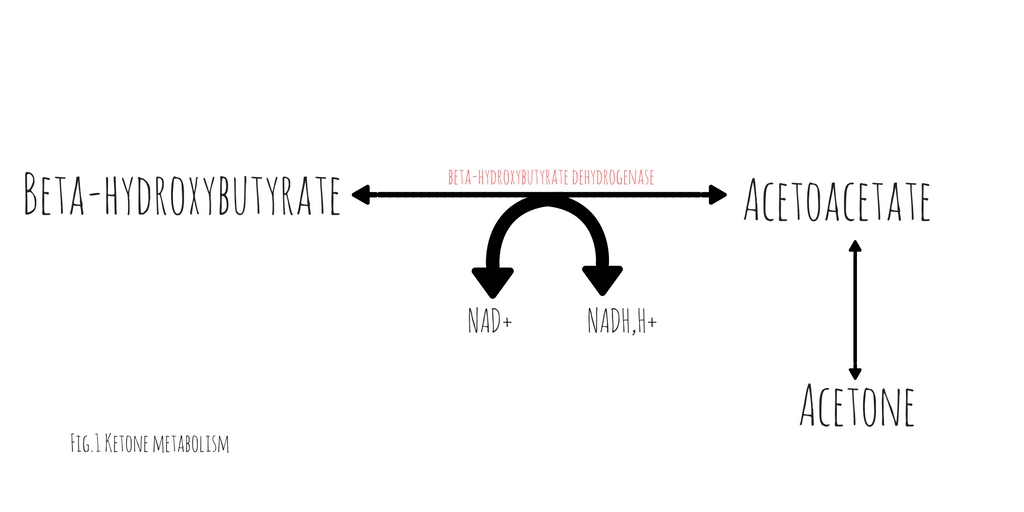 hydroxybutyrate dehydrogenase (2). This conversion requires the donation of a hydrogen atom from NADH. The balance between beta-hydroxybutyrate and acetoacetate, is determined by the ratio of NADH to NAD+. Acetoacetate will freely degrade into acetone through non-enzymatic decarboxylation. Early in DKA, acetoacetate is the most prevalent substance. As the disease progresses and the serum ratio of NADH to NAD+ increases, the proportion of beta-hydroxybutyrate rises, decreasing the quantity of acetoacetate and acetone.
Traditional serum and urinary ketone assays react strongly to acetoacetate but neither reliably react with beta-hydroxybutyrate. Patients in whom the majority of their anion gap is filled by beta-hydroxybutyrate, urinary or serum ketone levels may be negative. In such cases, serum beta-hydroxybutyrate assays would be positive but are not universally available.
It is important to note, with resuscitation and insulin therapy, the ratio of NADH/NAD+ will start to normalize causing an increase in the quantity of acetoacetate. As the patient improves and the anion gap clears, the degree of ketones detected in the serum and urine will paradoxically increase.
Show References
Zika Virus-associated GBS
- Zika virus has been shown to trigger Guillain-Barre Syndrome (GBS) at a rate similar to Campylobacter jejuni infections.
- In patients with Zika virus-associated GBS, neurologic deterioration has been rapid, with approximately 33% of patients developing respiratory distress.
- For patients who have required intubation, the duration of mechanical ventilation and length of ICU stay has been very long.
- Consider Zika virus-associated GBS in patients with muscle weakness, facial palsy, or paresthesias in the setting of a travel or exposure history to the virus.
Show References
Despite a lack of prospective data, end-tidal CO2 (ETCO2) is often proposed as a viable replacement for the traditional pulse check to identify return of spontaneous circulation (ROSC) in patients presenting to the Emergency Department in Cardiac Arrest. A recent study by Tat et al examined this very question. The authors prospectively enrolled 178 patients suffering out-of-hospital cardiac arrest (OHCA) and examined the accuracy of a rise in ETCO2 at predicting ROSC. The authors examined both a rise of 10 and 20 mm Hg in ETCO2. Of the 178 patients included in this cohort, 60 (34%) experienced ROSC. The sensitivity and specificity of ETCO2 to predict ROSC at a threshold of 10 mm Hg was 33% and 97% respectively. At a threshold of 20 mm Hg ETCO2 performed no better with a sensitivity and specificity of 20% and 99% respectively.
What this data suggests is while a rise of ETCO2 of greater than 10 is highly suggestive of ROSC, the contrary cannot be said. The absence of a spike in ETCO2 does not rule out ROSC, as the large majority of patients experiencing ROSC in this cohort did so without demonstrating a significant rise in ETCO2. This evidence suggests that ETCO2 is a poor surrogate for a pulse check.
Show References
Predicting Fluid Responsiveness with ETCO2
- It is well known that almost 50% of critically ill patients do not respond to fluid resuscitaiton. For those that do not respond, indiscriminate fluid administration may be harmful.
- There is increasing emphasis on the use of dynamic markers of fluid responsiveness, namely passive leg raise (PLR), pulse pressure variation, respirophasic changes in the IVC, and many others.
- ETCO2 can also be used to assess fluid responsiveness in mechanically ventilated patients with no spontaneous respiratory effort.
- An increase in ETCO2 of at least 5% with a PLR has been shown to outperform arterial pulse pressure as a measure of fluid responsiveness.
Show References
- Emergency providers routinely care for neurologically injured patients, such as those with a SAH or TBI.
- Many of these patients will require airway management. In these patients, it is important to minimize any increase in ICP, as this can adversely effect cerebral perfusion pressure.
- When intubating the neurocritical care patient, consider a dose of fentanyl (2 to 5 mcg/kg) prior to intubation. This has been shown to decrease the sympathomimetic response to laryngoscopy.
Show References
LVADs and RV Failure
- Acute RV failure can be seen in up to 10% of patients after LVAD implantation.
- The treatment of RV failure in the LVAD patient consists of the following:
- Fluids: avoid aggressive fluid administration, as this can displace the septum and impair LVAD function
- Inotropes: consider early initiation of dobutamine, milrinone, or epinephrine to augment RV function
- Vasopressors: target a MAP higher than 60 to 70 mmHg to maintain RV perfusion pressure
- If intubated, avoid hypoxia, hypercarbia, high PEEP, and high ventilator pressures. These can increase pulmonary vascular resistance and further worsen RV function.
Show References
There are 4 types of respiratory failure that all providers should be familiar with
Type 1: Hypoxemic, PaO2 <50; this can include shunt , V/Q mismatch, or high altitude. Pulmonary edema, ARDS, pneumonia are common causes of this type of failure.
Type 2: Hypercapnic respiratory failure; decreased RR or tidal volume. This includes neuromuscular disorders including GBS or Myasthenia Gravis, in addition to medication overdose. COPD and asthma can lead to this type of respiratory failure as well.
Type 3: Peri-operative; atelectasis; decreased FRC from being supine or obese during the operative period.
Type 4: Shock or hypoperfusion leading to increased work of breathing and respiratory failure.
Heat Stroke
- Heat stroke is critical illness defined as a core body temperature greater than or equal to 40oC and altered level of consciousness.
- Mortality from heat stroke can be as high as 30%.
- Numerous methods exist to rapidly cool patients below 39oC.
- Of these methods, ice-water immersion cools patients the fastest and is highly effective in young patients with exertional heat stroke.
- There is currently insufficient evidence to routinely recommend antipyretic agents, intravascular cooling devices, body cavity lavage, or the use of ice packs in the groin/axilla/neck. In addition, dantrolene is not recommended in the treatment of heat stroke.
Show References
- Current guidelines recommend IV proton pump inhibitors in setting of acute upper GI hemorrhage as a bolus + infusion (e.g. 80 mg bolus + 8mg/hr infusion).
- Recent meta-analysis comparing bolus + infusion versus intermittent bolus (most commonly 40 mg BID) demonstrated non-inferiority of intermittent bolus dosing.
- In fact, there was a trend (though not significant) to superiority of intermittent bolus dosing, with decreases in rebleeding, mortality, repeat intervention.
- From a practical standpoint, pantoprazole requires a dedicated IV line, and is not compatible with other common ICU infusions (fentanyl, propofol, norepinephrine, octreotide).
Show References
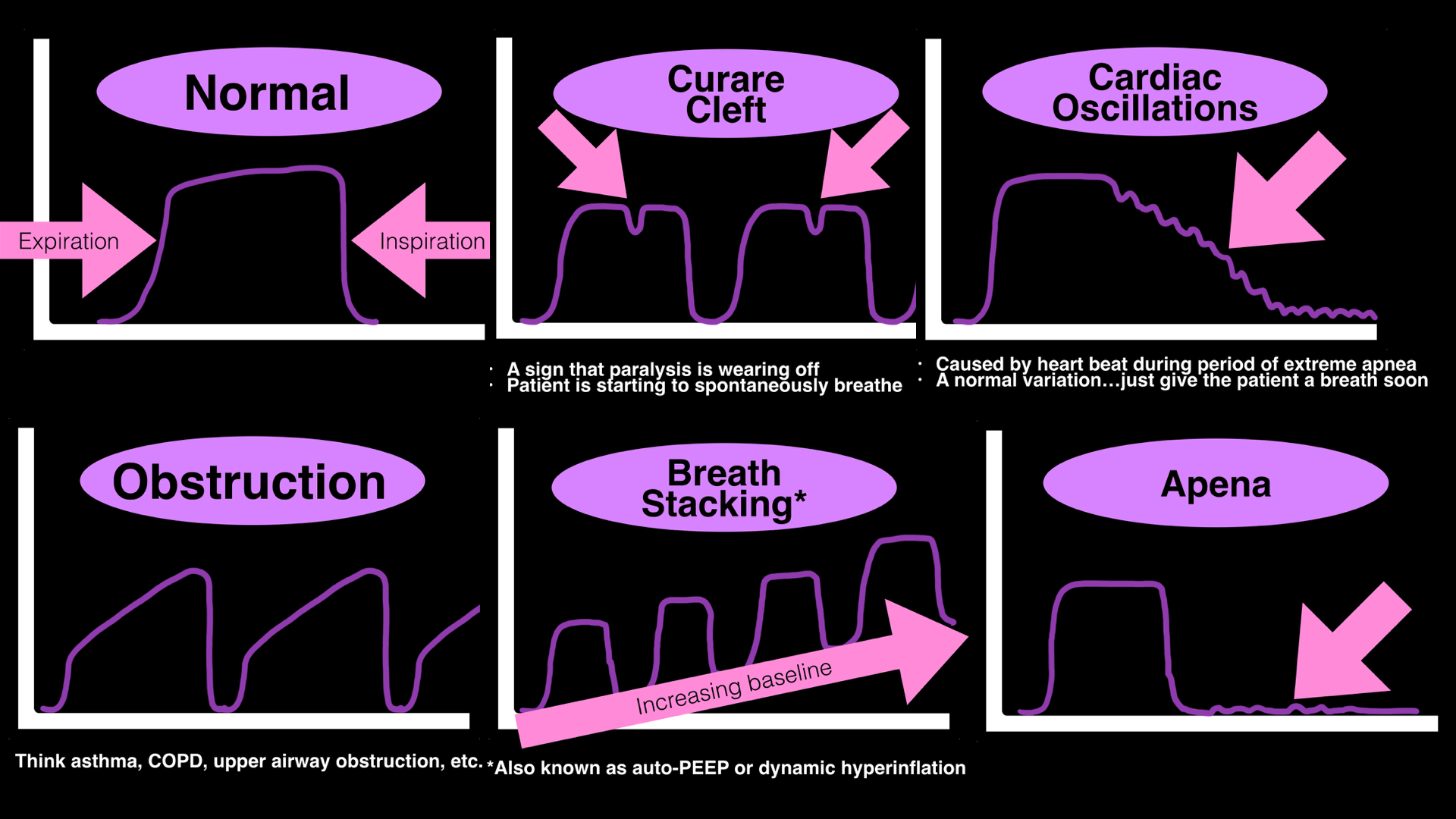
- Many clinicians use end-tidal CO2 to monitor respirations during procedural sedation or mechanical ventilation
- Typically either the presence (or absence) of a "normal" waveform or the quantitative value is used, however a lot more information can be gathered from the actual shape of the waveform; below are a few examples.
- For more examples of interpreting waveforms, click HERE.
Show References
American Thoracic Society (ATS) Conference Highlights
The ATS conference was last week in San Francisco and a few cool articles were presented. They are briefly summarized below:
1. Using a helmet vs face mask for ARDS: Non-invasive ventilation is not ideal for ARDS for a variety of reasons. At the same time, endotracheal intubation and ventilation carries some risks as well. Could a new design of a "helmet" device make a difference? This one center study from the Univ of Chicago suggests that it would: decreased rate of intubation, increase in ventilator free days, and decrease in 90 day mortality. http://jama.jamanetwork.com/article.aspx?articleid=2522693
2. Can aspirin prevent the development of ARDS in at risk patients in the emergency department? Unfortunately, it does not appear to help. http://jama.jamanetwork.com/article.aspx?articleid=2522739
3. Should you start renal-replacement therapy (HD, CRRT etc) in critically ill patients with AKI sooner or later? Seems to have no difference and may actually lead to patients not needing any dialysis. Really a great read if you have time. http://www.nejm.org/doi/full/10.1056/NEJMoa1603017?query=OF&
4. Should I extubate at night? Lastly, probably don’t extubate at night if you can avoid it. Or just be cautious. http://www.atsjournals.org/doi/abs/10.1164/ajrccmconference.2016.193.1_MeetingAbstracts.A6150