
Getting to Know: Elana Fertig, PhD, Director of the Institute for Genome Sciences at the University of Maryland School of Medicine
July 23, 2025

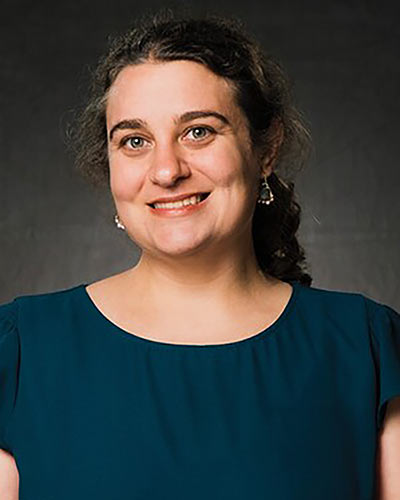 Elana J. Fertig, PhD, FAIMBE, joined the University of Maryland School of Medicine (UMSOM) in December 2024 as a Professor of Medicine and the new Director of the School’s Institute for Genome Sciences (IGS). She’s also the Associate Director for Quantitative Science in the Marlene and Stewart Greenebaum Comprehensive Cancer Center (UMGCCC). Previously a Professor of Oncology at Johns Hopkins University, Dr. Fertig is internationally recognized for her landmark research in integrating datasets in the multidisciplinary field of computational biology — including genomics, proteomics, and transcriptomics, specifically integrating those multi-omics technologies with mathematical models to develop a new predictive medicine paradigm in cancer. In a recent commentary in Nature Biotechnology, she argued that mathematical modeling has the potential to predict cellular changes resulting from therapeutic interventions to better prioritize treatment strategies for precision medicine.
In an edited interview, Dr. Fertig discussed her research in computational biology in the cancer space and why computational bioscience should be considered a distinct field rather than simply another method for analyzing data. She also described her vision for the types of collaborative research programs she hopes to cultivate at both IGS and UMGCCC.
Q: Can you tell us about your experience before joining UMSOM in December and how you are settling into your new roles?
As a mathematician and translational oncology researcher, my role as a professor at Johns Hopkins spanned both the medical school and the school of engineering. I also served in leadership roles as Co-Director of the Convergence Institute and Associate Cancer Center Director/Division Director for Quantitative Sciences at Johns Hopkins, which prepared me for the opportunity here at IGS.
Many of my goals, both at Hopkins and now at IGS, focus on technology development and applying new quantitative methods to unlock the molecular and cellular underpinnings of tissues as they apply to cancer. It's exciting coming to IGS and thinking about applying that approach across all diseases.
Q: What would you describe as your strategic vision for IGS going forward? And are there particular lines of inquiry you want to pursue?
We have a very rich group of faculty at IGS. While I plan on staying very deeply involved in cancer research, I’m interested in bringing everyone in the Institute together to work as a team to conduct research into aging, developmental biology, and different diseases. We have the rich shared computational infrastructure of IGS and the biomedical research environment across UMSOM and UMB as a whole. And beyond our campus, there is also the engineering environment at College Park and the computational resources of the Institute for Health Computing (IHC) in Bethesda. There’s an opportunity to start bridging and leveraging those resources to understand diseases more systematically.
Q: In addition to serving as director of IGS, you're also the Director for Quantitative Science in the Marlene and Stuart Greenebaum Comprehensive Cancer Center. Can you tell us about that role and how it overlaps with your work at IGS?
I view these dual roles as very synergistic, allowing us to design and build up programs in parallel.
I see two aspects to my roles.
One is expanding data science access to clinical investigators and basic biological investigators who have historically not worked with these techniques.
The other is advancing bidirectional, collaborative team science projects with data science researchers like myself and with clinical investigators and preclinical biologists developing systems-level understandings of diseases. My research will focus on developing the techniques to do that.
Q: What should people know about the differences, opportunities, and limitations of computational technologies such as AI, machine learning, and computational modeling?
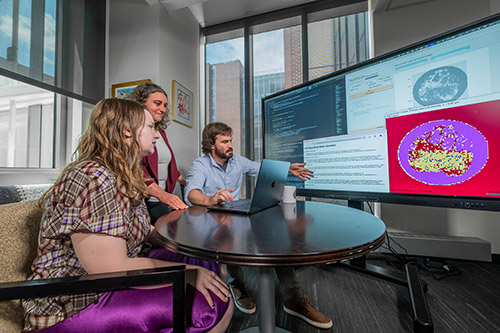 I think it's really important to recognize that quantitative sciences — AI, math modeling, statistics — are their own scientific disciplines, each one as distinct as biochemistry is from cell biology. You would never go to a biologist and say, “Hey, can you use one of those experimental systems and give me an answer to the biology of this?” We always prefer a collaborative approach, where you offer your experimental hypothesis, and I offer my computational hypothesis, and we think about whether it’s a good match.
If nothing else, I’d love people to understand that it's never too early to approach somebody about a collaboration. Come to us with your research question, and we can help with the experimental design and ensure we have the right tools for the question you’re asking. If we’re getting the data after somebody's designed their experiment, it's too late.
And if you do need help with data analysis rather than collaboration, we have amazing shared resources for bioinformatics and genomics profiling that researchers can utilize. Just know that because this is so new, there are lots of areas where I might not know how to analyze your data. Nobody might. It might require computational research programs that completely invent a new technique or technological enhancements to what's out there.
Q: Are there particular lines of inquiry within your field that you would like to pursue with researchers from across the university?
 Yes, a countless number. These include how systems work, from the microbial up to the population level. How do local tissue environments, or the larger natural environment, influence the etiology of disease? How do biological systems evolve, and how do genes evolve? I think those types of questions get people really pumped up.
A new area of my research is conducting more mechanistic mathematical modeling. The concept, and I’ve found it to be most baffling to my biology colleagues, is that you might not need any data at all: If you write down the equations for what cells do, then the computer can run a series of equations to simulate cells so you can make inferences as to what's going to happen next. That will be most useful in systems where you don't have a lot of data, but you want to do temporal thought experiments and hypothesis generation.
I like to think of it as a third experimental system on the computer, in addition to clinical trials and preclinical models.
For example, by replicating tumor and immune cell dynamics and adding in patient-specific omics data such as genomics of the tumor and/or patient or spatial transcriptomics of the tumor, we essentially build a “digital twin” — a virtual representation of the tumor that can respond to different drugs and dosing schedules within the program. This would allow us to run “virtual” clinical trials with many advantages over traditional clinical trials. It would reduce overall costs, tailor treatment to patients, thus reducing risks, identify new therapeutic targets, and accelerate drug discovery.
Watch the Video
Contact
Office of Public Affairs
655 West Baltimore Street
Bressler Research Building 14-002
Baltimore, Maryland 21201-1559
Contact Media Relations
(410) 706-5260