University of Maryland School of Medicine logo
Emergency Medicine
All Departments
UMSOM Assistant
UMEM Educational Pearls
  • Home
  • Departments
  • Emergency Medicine
  • CME
  • UMEM Educational Pearls
  • CME
  • Courses and Conferences
  • Free Open Access Medical Education
  • UMEM Educational Pearls

Search

81-100 of 382 results with category "Neurology"

Previous  |  1 |  2 |  3 |  4 |  5 |  6 |  7 |  8 |  9 |  10 |  ... |  20 |  Next

Title: Autoimmune Neurological Disease

Category: Neurology

Keywords: autoimmune, cancer, encephalopathy (PubMed Search)

Posted: 6/28/2017 by Danya Khoujah, MBBS

One of the differentials of a subacute neurological deficit (usually with a fluctuating course) is autoimmune neurologic disorders. This can encompass anything from neuropathic symptoms, to cerebellar pathology, to encephalitis-like picture. A personal or family history of autoimmune disease or malignancy should heighten suspicion, and the CSF is likely an inflammatory CSF profile as well (pleocytosis). Neural autoantibodies confirm the diagnosis, and are usually performed in both the serum and the CSF. Most laboratories perform a global screen for a number of potential antibodies that fit the concerning clinical picture, rather than one or two tests.
In addition, autoimmune CNS pathology is concerning for a paraneoplastic syndrome e.g. teratoma, lymphoma or small cell lung cancer.

Take Home Message: If suspecting an autoimmune pathology due to the risk factors and subacute nature of the disease, obtain some extra CSF to run the necessary tests after consulting with neurology. 

Show References

Tobin WO, Pittock SJ. Autoimmune Neurology of the Central Nervous System. Continuum 2017;23(3):627–653.


Title: What is the role of EEG for first-time seizures in the ED?

Category: Neurology

Keywords: seizure, electroencephalogram, EEG, epilepsy, antiepileptic (PubMed Search)

Posted: 6/14/2017 by WanTsu Wendy Chang, MD


What is the role of EEG for first-time seizures in the ED?

  • Wyman and colleagues performed a prospective trial on the use of 30-minute routine electroencephalogram (EEG) in the ED after a first-time seizure or recurrent seizure without performance of a previous EEG to guide decision making in the initiation of antiepileptic medication.
  • A diagnosis of epilepsy based on EEG findings was made for 21% of patients (n=15/71).
  • Antiepileptic medication was initiated in 24% of patients (n=17/71), including 2 patients with abnormal but not epileptic EEG findings.

Take Home Point:  A 30-minute routine EEG in the ED in adults with an uncomplicated first-time seizure revealed a substantial number of epilepsy diagnosis and can change ED management with immediate initiation of antiepileptic medication.

Show Additional Information

Background:

  • Seizures account for 1.2% of all ED visits with 24% representing first-time seizures.
  • The 2014 ACEP Clinical Policy on the evaluation and management of patients presenting to the ED with seizures recommend that antiepileptic medication not be initiated for uncomplicated first-time seizure.
  • Literature suggests that epileptiform activity on EEG predicts seizure recurrence while earlier EEG performance has a higher rate of finding epilepsy than delayed EEG performance.

Show References

  • Wyman AJ, Mayes BN, Hernandez-Nino J, Rozario N, Beverly SK, Asimos AW. The first-time seizure emergency department electroencephalogram study. Ann Emerg Med 2017;69(2):184-191.
  • Huff JS, Melnick ER, Tomaszewski CA, et al. Clinical policy: critical issues in the evaluation and management of adult patients presenting to the emergency department with seizures. Ann Emerg Med 2014;63(4):437-447.
  • Krumholz A, Wiebe S, Gronseth G, et al. Practice parameter: evaluating an apparent unprovoked first seizure in adults (an evidence-based review): report of the Quality Standards Subcommittee of the American Academy of Neurology and the American Epilepsy Society. Neurology 2007;69(21):1996-2007.


Follow me on Twitter @EM_NCC


Title: Neurally Mediated Syncope - Part 2

Category: Neurology

Keywords: syncope, vasovagal, orthostatic, blood pressure (PubMed Search)

Posted: 5/24/2017 by Danya Khoujah, MBBS


Vasovagal syncope is a subtype of neurally mediated syncope, and it is distinctly different from orthostatic hypotension. 

Patients with orthostatic syncope have severe orthostatic hypotension that results in transient loss of consciousness immediately or within moments of standing up. This is different from neurally mediated syncope, which develops gradually under conditions of prolonged orthostatic stress such as standing for several minutes. Tilt table testing is useful for true orthostatic syncope, but not for neurally mediated syncope. In addition, checking for “orthostatic hypotension” may not capture patient with orthostatic syncope, because the hypotension occurs so quickly after standing up. Of note, patients may still have orthostatic tachycardia or intolerance with neurally mediated syncope. 


Show References

Cheshire WP. Syncope. Continuum 2017;23(2):335–358.


Title: Neurally Mediated Syncope - Part 1

Category: Neurology

Keywords: syncope, vasovagal, seizures, orthostatic, blood pressure (PubMed Search)

Posted: 5/10/2017 by Danya Khoujah, MBBS

"Neurally mediated syncope" is the most common cause of syncope in all age groups, and includes various overlapping entities, such as neurocardiogenic syncope, vasovagal syncope, and vasodepressor syncope. These are distinctly different from orthostatic hypotension and seizures. 
A careful history is the most important “test” to diagnose neurally mediated syncope. It is frequently preceded by a characteristic prodrome with symptoms such as nausea, dizziness, feelings of warmth or coldness, visual dimming or blurring, clammy skin, facial pallor, general weakness, decreased hearing, or fecal urgency. Symptoms last 30 seconds to several minutes prior to syncope. 
Differentiating syncope from seizures:
Brief, multifocal,arrhythmic, myoclonic jerks are observed in up to 90% of patients at the time of syncope. These are caused by brainstem hypoperfusion and may be mistaken for seizures. The jerks follow the LOC (rather than immediate) and the eyes deviate upward (rather than lateral). If tongue biting occurs, it’s the tip (rather than the side, which is what occurs with seizures).
 

Show References

Cheshire WP. Syncope. Continuum 2017;23(2):335–358.


Title: Vasogenic Cerebral Edema

Category: Neurology

Keywords: vasogenic cerebral edema, white matter, blood-brain-barrier, steroids (PubMed Search)

Posted: 4/26/2017 by WanTsu Wendy Chang, MD

 
Vasogenic Cerebral Edema
  • Vasogenic cerebral edema is most commonly seen with brain tumors and cerebral abscesses.
  • It mainly involves the white matter.
  • Gray-white differentiation is maintained, so the edema has a finger-like pattern on CT (see Figure).
  • It is caused by disruption of the blood-brain-barrier, thus responds to treatment with steroids.


Show References

Case image courtesy of Dr David Cuete, Radiopaedia.org, rID: 23178

Follow me on Twitter @EM_NCC!

Attachments

  • 1704262312_20170426_Figure.jpg (60 Kb)


Title: Simplified GCS vs. Full GCS? Which One To Use?

Category: Neurology

Keywords: Glasgow Coma Scale, GCS, motor GCS, mGCS, Simplified Motor Scale, SMS (PubMed Search)

Posted: 4/12/2017 by WanTsu Wendy Chang, MD

 
Simplified GCS vs. Full GCS?  Which One To Use?

  • The Glasgow Coma Scale (GCS) is an instrument widely used to assess level of consciousness by EMS.
  • The motor GCS (mGCS) and Simplified Motor Scale (SMS) have been proposed to simplify EMS triage.
  • A number of retrospective studies have compared these scales.
  • Chou et al. performed a systematic review and meta-analysis of 18 studies with a total number of 1.7 million patients to compare the predictive utility of these scales for identification of patients with severe traumatic injury.
  • The total GCS was slightly better than the mGCS or SMS on predicting mortality, neurosurgical intervention, severe traumatic brain injury, and emergent intubation.

Bottom Line:  The motor GCS and Simplified Motor Scale (SMS) have similar discrimination when compared with the total GCS, and may be easier to use.

Show References

Chou R, Totten AM, Carney N, et al. Predictive Utility of the Total Glasgow Coma Scale Versus the Motor Component of the Glasgow Coma Scale for Identification of Patients with Serious Traumatic Injuries. Ann Emerg Med. 2017 Jan 11. [Epub ahead of print].


Follow me on Twitter @EM_NCC


Title: Stroke and Pregnancy: What's Different?

Category: Neurology

Keywords: CT, MRI, tPA, peripartum, PRES (PubMed Search)

Posted: 3/22/2017 by Danya Khoujah, MBBS (Updated: 7/21/2026)

  • The incidence of stroke (both ischemic and hemorrhagic) in pregnant and peripartum women is three times age-matched controls. This increased risk is mostly in the 3rd trimester and up to 16 weeks postpartum. 
  • Consider other causes of stroke:  posterior reversible encephalopathy syndrome (PRES), reversible cerebral vasoconstriction syndrome, cerebral venous sinus thrombosis and cardioembolic stroke from peripartum cardiomyopathy.
  • CTs carry some risk due to the ionizing radiation, but with abdominal and pelvic shielding the exposure to the fetus is very low. MRIs do not carry that risk, but Gadolinium is absolutely contraindicated in pregnancy as it deposits in fetal tissue. 
  • Pregnancy is a relative (not absolute) contraindication for tPA.

Show References

Majerisk JJ. Inherited and Uncommon Causes of Stroke. Continuum 2017;23(1):211–237.


Title: IV Fluids for Headache?

Category: Neurology

Keywords: headache, migraine, intravenous fluids, IVF (PubMed Search)

Posted: 3/8/2017 by WanTsu Wendy Chang, MD

 
IV Fluids for Headache?
  • Headache is the 4th most common ED visit in the US.
  • Clinical experience suggests that IV fluids (IVF) are commonly used as adjunctive treatment for headaches, however, the efficacy is unknown.
  • A retrospective study using the National Hospital Ambulatory Medical Care Survey (NHAMCS) found that ED length of stay was significantly greater in patients who received IVF than in those who did not (202 min vs. 131 min, p<0.001) even after adjusting for initial pain score, sex, age, and mode of arrival. 
  • A post-hoc analysis of data collected from 4 ED-based migraine trials found that IVF was not associated with improvement of pain score or sustained headache freedom.
  • There is no current evidence to suggest a direct analgesic effect of IVF in the treatment of headaches.


Show References

  • Jones CW, et al. Epidemiology of intravenous fluid use for headache treatment: Findings from the National Hospital Ambulatory Medical Care Survey. Am J Emerg Med. 2017. [Epub ahead of print]
  • Balbin JEB, et al. Intravenous fluids for migraine: a post hoc analysis of clinical trial data. Am J Emerg Med. 2016;34:713-6.

Follow me on Twitter @EM_NCC


Title: Strokes in Young Adults

Category: Neurology

Keywords: stroke, alcohol, substance abuse, mimics (PubMed Search)

Posted: 2/22/2017 by Danya Khoujah, MBBS (Updated: 7/21/2026)

  • 15% of all cases of ischemic strokes occur in patients less than 45 years old.
  • To put things into perspective, incidence of stroke in this age group is twice that of multiple sclerosis.
  • Delayed diagnosis is due to several factors:
    • The relative rarity of the diagnosis in comparison to stroke mimics at this age, the 3 most common being: migraines, seizures, and Bell's palsy. 
    • Atypical presentations, such as acute vestibular syndrome. 
    • Although “typical" risk factors (such as smoking, diabetes and hypertension) are present in young patients with strokes, other factors to be considered are high-risk alcohol consumption, cocaine use (especially smoked), physical inactivity, sleep 6 hours or less a night, and known thrombophilia. 


Show References

Lo DW, Kumar R. Arterial Ischemic Stroke in Children and Young Adults. Continuum 2017; 23(1):158-180.

Singhal AB, Biller J, Elkind MS, et al. Recognition and management of stroke in young adults and adolescents. Neurology 2013;81(12):1089-1097.


Title: Back to the Basics: Aphasia

Category: Neurology

Keywords: aphasia, fluency, comprehension, repetition, Broca's aphasia, Wernicke's aphasia, conduction aphasia (PubMed Search)

Posted: 2/8/2017 by WanTsu Wendy Chang, MD

 
Back to the Basics: Aphasia
  • Aphasia is an impairment of language
  • 3 important assessments in an aphasic patient are fluency, comprehension, and repetition (see attached figure)
  • Patients with fluent speech are able to generate speech spontaneously, though the content of their speech may have errors
  • Patients with non-fluent speech have difficulty initiating speech
  • Patients who have fluent speech but are unable to repeat have a problem with comprehension or a disconnect between the sensory and motor components of language
    • In Wernicke’s aphasia, patients cannot comprehend what they read and hear 
    • In conduction aphasia, patients can comprehend what they read and hear


Show References

Types of aphasia [Online image]. Retrieved February 8, 2017 from https://www.aphasia.org/

Follow me on Twitter @EM_NCC

Attachments

  • 1702082322_20170208_Figure.jpg (84 Kb)


Title: Diagnosing Myasthenia Gravis in the ED

Category: Neurology

Keywords: weakness, ptosis (PubMed Search)

Posted: 1/25/2017 by Danya Khoujah, MBBS

Patients may present to the ED with new onset weakness due to myasthenia gravis (MG). A group that is frequently missed is late-onset MG, which occurs after the age of 50. It is frequently misdiagnosed as a stroke or transient ischemic attach (TIA).

Two cardinal features:

  • fatiguability: must be distinguished from fatigue. 
  • fluctuation

Bonus pearl: Ocular symptoms are present in up to 85% of patients with MG, with unilateral ptosis or asymmetric bilateral ptosis being the most common presentations.

Show References

Nicolle MW. Myasthenia Gravis and Lambert-Eaton Myasthenic Syndrome. Continuum. 2016;22(6):1978–2005


Title: Driving after concussion: Is it safe to drive after symptoms resolve?

Category: Neurology

Keywords: concussion, driving performance, cognitive impairment (PubMed Search)

Posted: 1/11/2017 by WanTsu Wendy Chang, MD

 
Driving after concussion: Is it safe to drive after symptoms resolve?
  • Limited data is available to guide when individuals should return to driving after a concussion.
  • Cognitive impairments in reaction time, executive function, and attention can persist even after symptoms of a concussion resolve.
  • Schmidt et al. compared driving performance between individuals within 48 hours following symptom resolution after a concussion with matched controls using simulated driving.
  • They found that concussed individuals had poorer driving performance despite being asymptomatic.
  • This study is limited by a small sample size (n=28), however, it raises interesting questions regarding whether driving should be restricted following concussions and how should readiness to return to driving be determined.


Show References

Schmidt JD, Hoffman NL, Ranchet M, et al. Driving after concussion: Is it safe to drive after symptoms resolve? J Neurotrauma. 2016 Dec 13. [Epub ahead of print]

Follow me on Twitter @EM_NCC


Title: ED Pharmacist on Time to Thrombolysis

Category: Neurology

Keywords: pharmacist, thrombolysis, door-to-needle time, acute ischemic stroke (PubMed Search)

Posted: 12/14/2016 by WanTsu Wendy Chang, MD

Impact of an ED pharmacist on time to thrombolysis in acute ischemic stroke

  • Prior studies showed that incorporation of ED pharmacists within ED clinical teams lead to more rapid treatment of trauma, stroke, and STEMI.
  • A recent retrospective study conducted by Montgomery et al. showed that having an ED pharmacist on the stroke alert team increased the number of patients meeting goal door-to-needle time of 60 minutes.

Show Additional Information

  • This retrospective study compared the number of patients meeting goal door-to-needle (DTN) time of 60 minutes with and without an ED pharmacist participating on the stroke alert team.
  • A higher proportion of patients with an ED pharmacist met goal DTN time of 60 minutes (71% vs. 39%, p=0.002, 95% CI 0.10-0.50).
  • Patients with an ED pharmacist had an average 20-minute decrease in door-to-needle time (p=0.004, 95% CI 6.6-33.4).

Show References

Montgomery K, Hall AB, Keriazes G. Impact of an emergency medicine pharmacist on time to thrombolysis in acute ischemic stroke. Am J Emerg Med 2016;34:1997-9.

Follow me on Twitter @EM_NCC


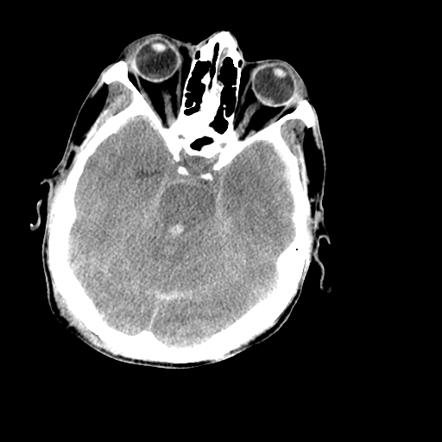
Title: Subarachnoid Hemorrhage -- Or Is It?

Category: Neurology

Keywords: subarachnoid hemorrhage, mimic, pseudosubarachnoid hemorrhage, cerebral edema (PubMed Search)

Posted: 11/9/2016 by WanTsu Wendy Chang, MD

Question

Patient found pulseless after submersion in water for 20 minutes.  After ROSC, patient’s GCS was 3 and pupils are dilated and nonreactive.

Show Answer

  • There is increased attenuation of the basal cisterns and subarachnoid space as well as diffuse cerebral edema.
  • At first glance, it appears to be a subarachnoid hemorrhage.
  • However, the Hounsfield unit of the density is lower than blood.
  • This is a pseudosubarachnoid hemorrhage sign.  
  • This can be seen in anoxic injury with cerebral edema, pyogenic meningitis, venous sinus thrombosis, bilateral large subdural hemorrhages.

Show References

Kim JM, Eom TH. The pseudosubarachnoid hemorrhage: clinical implications of subarachnoid hemorrhage misdiagnosis. Pediatr Emerg Care. 2016 May 12. [Epub ahead of print]

Follow me on Twitter @EM_NCC


Title: Spinal Cord Imaging 101

Category: Neurology

Keywords: contrast, epidural, multiple sclerosis (PubMed Search)

Posted: 10/26/2016 by Danya Khoujah, MBBS

Magnetic resonance imaging (MRI) is the method of choice for imaging the spine for the suspicion of non-traumatic disorder, such as multiple sclerosis (MS), transverse myelitis, epidural abscess, spinal cord infarcts, and spondylotic myelopathy (changes in the spinal cord due to disk herniation or osteophytes in degenerative joint disease).

If the differential diagnosis includes infection, neoplasm, demyelination or inflammation, then IV contrast should be administered.

Show References

Singh K, Mechtler LL and Klein JP. Imaging of Spinal Cord Disorders. Continuum 2016;22(5):1595 1612


Title: Updated Guidelines for Traumatic Brain Injury

Category: Neurology

Keywords: Brain Trauma Foundation, BTF, guideline, traumatic brain injury, TBI (PubMed Search)

Posted: 10/12/2016 by WanTsu Wendy Chang, MD

Updated Guidelines for Traumatic Brain Injury

The Brain Trauma Foundation (BTF) Guidelines for the Management of Severe Traumatic Brian Injury (TBI) was recently updated and published in September 2016.

Updated recommendations include:

  • Prophylactic hypothermia is not recommended (Level IIB).
  • Phenytoin is recommended for seizure prophylaxis (Level IIA).
    • There is insufficient evidence to recommend levetiracetam over phenytoin.
  • Maintain SBP 100 mmHg for patients 50-69 years old or 110 mmHg for patients 15-49 or >70 years old (Level III).
  • Treat intracranial pressure (ICP) > 22 mmHg (Level III)
  • Target cerebral perfusion pressure (CPP) between 60-70 mmHg (Level IIB).

For the executive summary and complete guidelines, go to https://braintrauma.org/guidelines/guidelines-for-the-management-of-severe-tbi-4th-ed#/


Title: PCC before LP in Patients on Anticoagulants?

Category: Neurology

Keywords: lumbar puncture, meningitis, INR, warfarin, spinal, bleeding (PubMed Search)

Posted: 9/28/2016 by Danya Khoujah, MBBS

You have a patient in whom you suspect meningitis, but he is on warfarin for a history of pulmonary embolism. You started empirical antibiotics. His INR is 2.6, and you want to do a lumbar puncture (LP) to confirm your diagnosis. Can you use Prothrombin Complex Concentrate to lower his INR and safely perform the LP?

Take Home Point:

Using PCC to lower INR to enable LP is relatively safe and effective in patients on vitamin K antagonists. The dose used was individually determined by the physician according to initial INR.

Limitation:

This is a retrospective study, with no control group. One patient (2.7%) had a myocardial infarction that was “possibly related” to the PCC administration. 

Show Additional Information

In Depth:

This is a retrospective study, with no control group.  However, it is the largest study to date that was specifically designed to answer this clinical question, including 37 patients over a 10-year period, with the following results:

- PCC was effective 90% of patients

- The median INR was 2.2 before, and 1.3 after (checked immediately after the infusion)

- The median time from starting the infusion and LP was 135 minutes.

- None of the patients had a spinal hemorrhage or allergic reaction.

- Some patients were started on vitamin K according to the physician’s discretion, with variable starting times of anticoagulation after the procedure (if at all).

Show References

Laible M, Beynon C, Sander P, et al. Treatment with Prothrombin Complex Concentrate to Enable Emergency Lumbar Puncture in Patients Receiving Vitamin K Antagonists. Ann Emerg Med. 2016 Sep;68(3):340-4


Title: My Patient Won't Open His/Her Eyes!

Category: Neurology

Keywords: eyelid apraxia, eye opening apraxia (PubMed Search)

Posted: 9/14/2016 by WanTsu Wendy Chang, MD

 
My patient won't open his/her eyes!
 
  • Beware of the patient who can't open his/her eyes but is otherwise awake!
  • This coma mimic is the result of eyelid apraxia, which is the inability to voluntarily open eyes despite intact frontalis muscle contraction and absent oculomotor dysfunction.
  • This can be seen in injuries of the nondominant hemisphere (e.g. R MCA stroke), medial frontal lobe, bilateral thalami (e.g. bilateral thalami stroke), and brainstem (e.g. progressive supranuclear palsy).
  • When asking these patients to open their eyes, they may use their forehead muscles to try and raise their eyelids.


Title: What is Ataxia?

Category: Neurology

Keywords: cerebellar disease, tremor, nystagmus (PubMed Search)

Posted: 8/24/2016 by Danya Khoujah, MBBS

Ataxia is an important clinical sign of cerebellar pathology, but how is it actually described?

Stance ataxia: inability to stand with feet together for more than 30 seconds

Gait ataxia

Sensory ataxia: the first 2 elements, in addition to a positive Romberg sign

Truncal ataxia: oscillation of body while sitting or standing

Limb ataxia: functional impairment in performing actions such as writing or buttoning and improves with slowing down the movement

Dysdiadokinesia: impairment of rapidly alternating movement

Intention tremor: tested by finger-to-nose and heel-to-shin.

Dysmetria: pastpointing or undershooting on finger-chasing or shin-tap.

Dysarthria: irregular and slow speech with unnecessary hesitation

Nystagmus and other ocular disturbances, such as ocular flutter and opsoclonus.

The first 3 are present in both cerebellar pathology and loss of proprioceptive input, the rest are usually due to cerebellar pathology or ataxic syndrome.

Show References

Ashizawa T and Xia G. Ataxia. Continuum 2016;22(4):1208-1226


Title: What's the cause of this patient's hemiplegia?

Category: Neurology

Keywords: Uncal herniation, ipsilateral hemiplegia, Kernohan's notch, Kernohan's sign (PubMed Search)

Posted: 8/10/2016 by WanTsu Wendy Chang, MD

Question

Patient presents after a fall confused, not moving his right side, but moving his left side spontaneously.  What's the diagnosis?
 

Show Answer

  • The patient has a right subdural hematoma (SDH) with midline shift and right uncal herniation. 
  • The classic presentation of a cerebral lesion with uncal herniation is ipsilateral mydriasis, contralateral hemiparesis, and abnormal extensor posturing.
  • In this patient’s case, there is compression of the contralateral cerebral peduncle of the midbrain by the edge of the tentorium cerebelli producing an ipsilateral hemiplegia (see attachment for Figure 2).
  • This false localizing sign is named Kernohan’s notch syndrome, Kernohan’s notch phenomenon, or Kernohan’s sign.

Show References

Diagram modified from "Localised Neurological Disease and Its Management A Intracranial". clinicalgate.com/localised-neurological-disease-and-its-management-a-intracranial/. Accessed 10 Aug 2016.


Follow me on Twitter @EM_NCC

Attachments

  • 1608101928_20160810_Figure_2.jpg (38 Kb)


Previous  |  1 |  2 |  3 |  4 |  5 |  6 |  7 |  8 |  9 |  10 |  ... |  20 |  Next
University of Maryland School of Medicine logo
  • Departments
  • Programs
  • Research Centers
  • Institutes
  • Graduate Education
  • CIBR Cores
  • Offices of the Dean
    • University of Maryland, Baltimore
    • University of Maryland Medical Center
    • Medical Alumni Association of the University of Maryland
    • Health Sciences and Human Services Library
University of Maryland School of Medicine
655 W. Baltimore Street
Baltimore, MD 21201
Contact Us

© University of Maryland School of Medicine

    • Webmaster
    • Web Accessibility
    • Site Index
    • UMB Hotline
    • Employment
    • Map