
Search
Subscribe to daily UMEM Pearls (FREE!) via:
41-60 of 84 results with category "Administration"
Ramadan is the holy month in the Islam faith, where observers will fast from sunrise to sunset. This includes food, water, some medications, smoking and sex. This can obviously have some impact on patients' health, especially when presenting to the ED. Here are some considerations to keep in mind:
- In general, there are exemptions to fasting for pregnant persons, children, breastfeeding persons, and people travelling.
- Bleeding is considered a contraindication to fasting, so menstruating women are exempt. Some people may interpret this to mean they cannot give blood or have lab work done, but there is an exemption for medical purposes
- Volume status is probably the main area to be concerned about. Always ask your patients if they are currently fasting and explain why IV fluids would be necessary
As with everything, maintaining cultural awareness and compassion will help to
Show References
Nurse Practitioners and Physician Assistants practice alongside Physicians in Emergency Departments. In 2021, an estimated 17,679 NPs and PAs worked in EDs.
How long do NPs and PAs continue in Emergency Medicine practice?
An analysis of Medicare data reports that over the eight years of the study, the annual attrition rate averaged 13.8%, or almost 1 in 7 leaving Emergency Medicine practice every year. At the time of attrition, the median age for women was 40.2 years (IQR 33.8 to 49.9) and for men was 45.9 (IQR 37.8 to 56.3).
For additional breakdown and discussion of these numbers, see Gettel CJ, Chosh R, Rothenberg, et al. Workforce Attrition Among Emergency Medicine Non-Physician Practitioners. Ann Emerg Med, in press, https://www.annemergmed.com/article/S0196-0644(24)01294-0/fulltext.
On March 18, 2022, Congress passed the Dr. Lorna Breen Health Care Provider Protection Act, named after an emergency medicine physician who died by suicide during the pandemic. This landmark legislation allocated $103 million across 45 organizations to introduce evidence-based measures to mitigate and prevent burnout.
As a result, the Impact Wellbeing Guide was developed, outlining the six key evidence-based action steps for organization leaders to address health care workers’ professional well-being listed below:
- Conduct a review of your hospital’s operations to determine how they support professional wellbeing.
- Build a dedicated team to support professional wellbeing at your hospital.
- Break down barriers to seeking help, such as updating and removing intrusive mental health questions on credentialing applications and offering confidential mental health support options.
- Develop a suite of communication tools that help you share updates with your workforce about your hospital’s journey to improve professional wellbeing.
- Integrate professional wellbeing into an existing quality improvement project at your hospital.
- Create a 12-month plan to continue to move your workforce’s professional wellbeing work forward.
The Guide is designed to help hospital leaders and executives accelerate or supplement professional wellbeing work in their hospitals at the operational level.
A PDF of the full guide is available from the CDC: https://www.cdc.gov/niosh/docs/2024-109/
Show References
Clinical practice in the world of the Electronic Medical Record has made many a clinician question the value of electronic reminders.
Banners warn of sepsis, the need for repeat evaluation, vital signs outside expected limits, wait times, and risks for readmission.
Can they instead help ED flow?
Sayan Dutta and colleagues suggest that they can. When clinicians chose to receive notice of a lab or imaging result, push notification reduced time between final result and ED disposition by 18 minutes (95% CI: 15-21 minutes).
The likely key here? Clinicians actively chose when and about what to be notified.
See: Result Push Notifications Improve Time to Emergency Department Disposition: A Pragmatic Observational Study, Annals of Emergency Medicine, 85(1), 53-62. https://www.annemergmed.com/article/S0196-0644(24)00404-9/abstract.
Show References
From all of us at UMEM, Happy Thanksgiving!!
We are incredibly Thankful for each of you and all that you do to care for patients and their families.
We are Thankful for those legends who have blazed the path in EM like Greg Henry who the EM community lost yesterday. Our thoughts are with his family. Thank you Dr. Henry for inspiring so many of us. Our pearls today are two of his famous quotes:
“Medicine is show business for ugly people.”
“You don’t go to Disney and see Mickey taking a smoke break. You have to be on when you are on shift”
Gooble, gooble,… gulp, some food for thought on the eve of Thanksgiving.
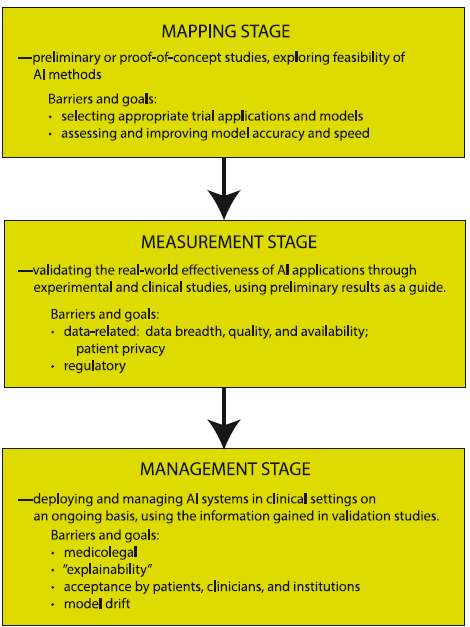
The development of artificial intelligence (AI) in emergency medicine is well under way. The schematic below and accompanying reference presents the anticipated stages in the process of AI development, including important features, considerations, and challenges as we move towards increased integration of AI in our practice of EM.
Show References
Does physician altruism influence quality metrics? This study suggests yes.
45 physicians were defined as “altruistic” based on their willingness to share a $250 cash prize with a stranger in an on-line version of the dictator game, something you might have played in an economics class.
Of 250 physicians drawn from primary care and cardiology, 45 met the definition of altruistic and 205 did not.
Overall, patients of altruistic physicians:
- Were less likely to experience ambulatory care sensitive admissions (absolute decrease of 1%, relative decrease of 38%, adjusted odds ratio 0.6 (0.38-0.97))
- Were less likely to experience ambulatory care sensitive emergency department visits (absolute decrease of 1.5%, relative decrease of 41%, adjusted odds ratio 0.64 (0.43-0.94)
- Had lower total spending (adjusted decrease of $800, relative change of -9.3% (16.2-2.3). [Note: the unadjusted results run in the other direction.]
The authors suggest that this difference may be on account of altruistic physicians being more willing to consider the appropriateness of tests or treatment or “devote more time and energy to their patients.”
They also note that while most physicians were categorized as not altruistic, at 18% this group of physicians exceeds the 5% of the general US population that would meet this definition.
Perhaps there is something quantitatively demonstrable to being a “good” doctor.
See https://jamanetwork.com/journals/jama-health-forum/fullarticle/2824419
Show References
- Did you know that emergency physicians spend nearly 1/3 of their handoff time responding to interruptions?
- EPs are interrupted around 7-11 times during handoffs, accounting for 11% of the total adverse events, a third of which are considered preventable.
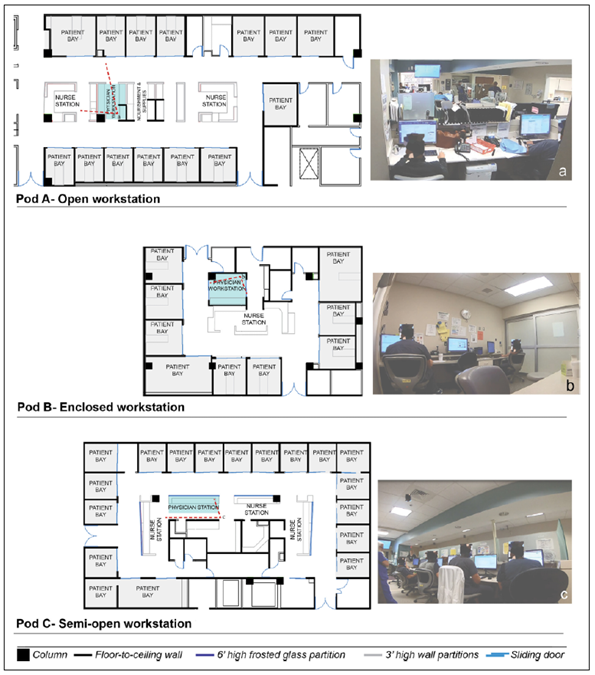
- This study examined the number of interruptions and perception of collaboration in three different physical spaces in the same ED: an open workstation, an enclosed workstation, and a semi-open workstation (see photos and blueprints below).
- Most EDs have open workstations as they are thought to optimize visibility and opportunities for collaboration among team members of all levels.
- EPs conducting handoffs in open workstations experienced more interruptions (patient care-related or not) as compared to those in the enclosed workstations.
- Investigators found that enclosure of the physicians’ workstation can decrease the number of times physicians are interrupted during critical tasks like handoffs, therefore decreasing the risk of errors and adverse events.
- EPs perceived a high degree of collaboration with colleagues in the enclosed workstation during handoff and felt less interrupted.
- While the number of documented handoff interruptions in the semi-open plan were lower than the open workstation, EPs still perceived interruptions as frequent.
- While there are clear benefits of the open workstation in the ED, it may be worth considering a different venue, specifically for handoffs, such as a “No Interruptions Zone” (NIZ) to decrease the perceived and actual frequency of interruptions, while also improving the sense of collaboration between team members during the handoff process.
Show References
Traditional Medicare now covers < 50% of Medicare beneficiaries. It reimburses on a fee-for-service basis. For beneficiaries, it includes deductibles and coinsurance requirements that yield average annual out-of-pocket expenses measured in the thousands of dollars.
Medicare Advantage, the new alternative, has grown quickly. Plans typically promise beneficiaries fewer co-pays and more services. It relies on private insurers (think United, Blue Cross, Kaiser Permanente) to coordinate care and rein in costs. Subsidies to Medicare Advantage have helped spur growth, subsidies that mean costs per beneficiary for Medicare Advantage exceed those for traditional Medicare.
Which means Medicare still needs to figure out how to save money and remain viable while the US population over 65 grows.
When listening to a lecture about Medicare or reading a study that uses Medicare data, take a moment to ask “Which Medicare? Fee-for-service? Or Advantage?”
For a take on the future of Medicare, see McWilliams JM, The Future of Medicare and the Role of Traditional Medicare as Competitor, NEJM, August 22/29, 763-769.
To understand why Medicare Advantage plans are popular, see https://www.kff.org/medicare/issue-brief/10-reasons-why-medicare-advantage-enrollment-is-growing-and-why-it-matters/.
Show References
“I’m not going to the hospital, my father died in a hospital.”
In planning a study it’s a good practice to consider what confounding variables you may need to look out for.
Confounding variables are associated with the predictor (independent) and outcome (dependent) variables, but they are not in the causal chain. In the above example, disease is likely the predictor variable, death is the outcome variable, and going to the hospital is a confounder. Of course, this assumes the death was not iatrogenic; then the hospital would be in the causal chain.
Patients may be selected for interventions based on severity of disease, functional status, education level, and other factors, and these may be confounders.
Confounding can be addressed at the design stage, by:
- Specification – excluding patients with the confounder (often not feasible)
- Matching – selecting cases and controls matched by confounding variable levels
- Randomization – randomly select patients for an intervention and hope confounding variables will balance out
It can be addressed in the analysis stage by:
- Stratification – analyzing data in strata defined by confounding variable levels
- Adjustment – mathematically adjusting for the confounding variable (usually by regression)
Show References
This retrospective study found that while overall rates of antibiotic prescriptions for viral URIs were low (that's good!), patients identified as non Hispanic white were prescribed antibiotics, despite guidelines advising against them, at a higher rate than non white patients (that's bad). It also found that in areas of socioeconomic deprivation, the prescribing rates were lower across all races than in more affluent areas (that's good and bad!)
Show References
Participation in meetings is an expected part of most (if not all) of our jobs. How many of these meetings are necessary? Could some of the “work” of meetings be accomplished with a few emails or other asynchronous forms of communication? Are meetings cluttering your schedule and making it impossible to get any real work done?
Some answers to these questions are offered in a Harvard Business Review article from March 2022.
Key points include:
- 70% of all meetings keep employees from working and completing all their tasks.
- Ineffective meetings that waste our time can negatively impact psychological, physical, and mental wellbeing.
Advantages to fewer meetings:
- Productivity was 71% higher when meetings were reduced by 40%.
- Employees feel empowered and more autonomous, increasing their job satisfaction by 52%.
- Removing 60% of meetings increased cooperation by 55%.
Authors recommend holding meetings only when “absolutely” necessary. That typically includes:
- To review work that’s occurred (what worked or didn’t and why)
- To clarify and validate something (policies, team goals, etc.)
- To distribute work appropriately among your team
Show References
Early administration of antibiotics for open fractures can reduce serious bone and soft tissue infections, with a common goal being antibiotic administration within one hour of injury.
In this study, there were 523 patients treated by EMS who had an open extremity fracture.
The median time from EMS dispatch until antibiotic administration was 31 minutes. 99% of the patients who received antibiotics received them within one hour of EMS dispatch. Prehospital times were on average 10 minutes longer for those patients who received antibiotics. The majority of these patients received cefazolin, followed by ceftriaxone, ampicillin, gentamicin and piperacillin/tazobactam. None of these patients required management for an allergic reaction or anaphylaxis. Five patients (1%) who received prehospital antibiotics and 159 patients who did not (1.4%) had a subsequent infection based on ICD codes.
Bottom line: In this small group, it was safe to administer antibiotics to a patient with an isolated open extremity fracture and the medication was able to be delivered earlier. Larger studies will be needed to see the impact of this practice on the development of osteomyelitis or soft tissue infections.
Show References
“Administrative harm” (defined as “the adverse consequences of administrative decisions within health care”) is a relatively new term for challenges that arise in complex health care work environments.
41 mostly hospitalists participating in interviews and focus groups found that the concept resonated, and that administrative harms could arise at all levels of leadership, negatively impacted both workforce and patients, were challenging to measure, and pointed to a lack of leadership responsibility and accountability. The group also suggested many approaches and solutions for prevention.
The article is here, https://jamanetwork.com/journals/jamainternalmedicine/fullarticle/2820266. If interested, take a look at the thematic tables 2 and 3.
There is a brief editorial comment here, https://jamanetwork.com/journals/jamainternalmedicine/article-abstract/2820275.
Author:
Gabriella Miller (She/Her)
Clinical Instructor
Department of Emergency Medicine
University of Maryland School of Medicine
Doxycycline PEP for the prevention of bacterial STIs.
The CDC now recommends “doxy PEP” for high-risk individuals. Doxycycline post-exposure prophylaxis (doxy PEP) is a prescription for patients to self-administer 200 mg doxycycline by mouth within 72 hours after anal, oral, or vaginal sex to prevent the transmission of chlamydia, gonorrhea, and syphilis. The CDC defines “high-risk” as men who have sex with men (MSM) and transgender women (TGW) who have been diagnosed with a bacterial STI within the past 12 months. They summarize the findings of the French IPERGAY and ANRS DOXYVAC studies, as well as the US DoxyPEP study, which all show promising reductions in risk ratios or hazard ratios of decreasing bacterial STI transmission on high-risk populations, including those who are taking PrEP for HIV. No significant adverse events related to doxy PEP have been reported.
Conclusion:
Counsel patients at high risk for bacterial STIs regarding the prescription of doxy-PEP for patient self-administration within 72 hours after sex.
Show References
This article shows us that even things we think of as objective measures in medicine may actually perpetuate systemic biases.
The study evaluated controlled hypoxemia in a group of volunteers. Traditional pulse ox devices measured falsely elevated pulse ox readings in participants with dark skin pigmentation and low tissue perfusion. It suggested different types of devices that may have improved accuracy in patients with darker skin pigmentation, but the underlying problem still exists.
Bottom line, this goes to prove what we have taught, never rely on a single value to reassure yourself of the patient's status, always take into account the bigger picture.
Show References
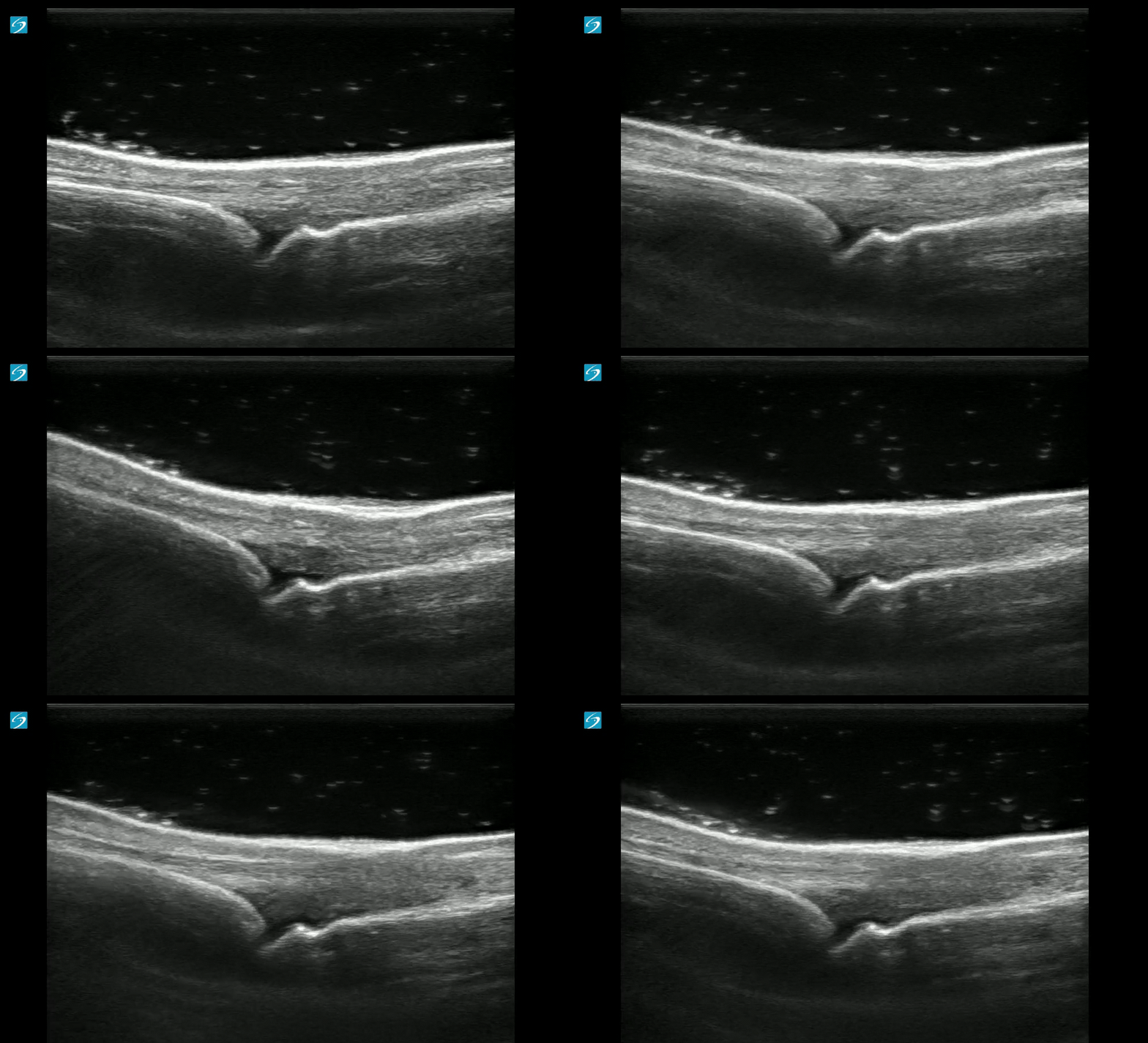
Do you have a patient with a finger injury or infection, or possibly a retained foreign body?
Try placing the hand in a water bath and use a linear ultrasound probe for evaluation. If there is an open wound, use a sterile ultrasound probe cover.
With ultrasound guidance, you can observe dynamic finger movements and identify areas that may require abscess drainage.
There is a growing trend toward the development of specialty-specific emergency services, such as Geriatric or Oncologic EDs.
- Supporters of this trend argue that:
- They provide better care at lower cost.
- They reduce the overall burden of patients in the general ED.
- They prevent hospitalizations and improve discharge rates due to specialty services and outpatient resources not otherwise available in the general ED (especially with complex patient populations like geriatrics or oncology).
- They streamline care for vulnerable populations and decrease ED LOS.
- On the other hand:
- Their establishment requires a substantial financial investment.
- Patients are less likely to use them because they don’t know that they exist.
- One of the largest studies of Geriatric EDs in the country did not show significantly different discharge rates or 72-hour revisit rates when compared with general EDs.
Will this trend continue? Is the segmentation of emergency care in our future? The author of this article opines that the answer depends on future outcomes research in this area.
Show References
This retrospective study looked at patients diagnosed with urinary tract infections receiving an IV dose of antibiotics prior to discharge and compared ED length of stay and return visit rate. They found:
“Parenteral antibiotic administration in the ED was associated with a 60-minute increase in ED LOS compared with those who received an oral antibiotic (P < 0.001) and a 30-minute increase in ED LOS compared with no antibiotic (P < 0.001). No differences were observed in revisits to the ED at 72 hours”
Appears no benefit to the practice of IV antibiotics prior to discharge in UTI patients.
Show References
BACKGROUND:
Prehospital administration of whole blood involves some areas of controversy. Though theoretical benefits are clear, concerns about logistics and timing of blood often dominates the discussion. This study was a retrospective analysis of prehospital blood administration within an urban EMS system from 2021-2023. Primary endpoints included: time to administration and in hospital mortality.
PATIENTS/METHODS:
The study population included patients presenting to the EMS system with signs and symptoms of hemorrhagic shock (SBP<70 or SBP<90 + HR> 100, n=61) and who received at least 1 unit of prehospital blood (PHB). The EMS system administered blood in conjunction with an advanced resuscitative bundle (calcium, TXA, blood). Isolated head injuries and blunt trauma patients were excluded from the analysis. The control group (n=82) was comprised of patients in the system's trauma registry presenting to EMS PRIOR to the initiation of whole blood and who exhibited similar clinical crtieria.
RESULTS:
- PHB patients had significantly higher BP upon arrival to hospital
- Following multivariate regression analysis, each minute delay to blood administration was linked to an independent increase in mortality of 11%
- PHB group demonstrated lower in hospital mortality
- PHB group linked to longer prehospital time interval (increased scene times)
BOTTOM LINE:
In this prospective study conducted within an urban EMS system, patients receiving prehospital whole blood demonstrated improved vital signs and reduced mortality when compared to a control group. Slightly extended prehospital time intervals for patients receiving PHB may be offset by the measured benefits of whole blood therapy.