
Search
Subscribe to daily UMEM Pearls (FREE!) via:
121-140 of 190 results with category "Pharmacology & Therapeutics"
Emergency Departments are increasingly searching for alternatives to opioids for acute pain management.
An urban trauma center in California retrospectively evaluated their use of low-dose ketamine for acute pain over a two-year period. [1]
- 530 patients
- Indications were separated in 7 broad categories such as abdominal pain, back pain, and musculoskeletal pain
- Ketamine dose: 10-15 mg (93% IV, 7% IM)
- No significant changes in heart rate or blood pressure
- 30 patients (6%) experienced adverse effects (psychomimetic/dysphoric reactions, transient hypoxia, emesis) - none were classified as severe based on authors' definitions
Application to Clinical Practice
There was no comparison group and there was no mention of what other pain medicines were given. Adverse events are often under-reported in retrospective studies. This study seems to demonstrate that low-dose ketamine administration for acute pain management in the ED is feasible with a low rate of adverse effects.
It's worth noting that a new review of 4 randomized controlled trials evaluating subdissociative-dose ketamine found no convincing evidence to support or refute its use in the ED. The 4 included trials had methodologic limitations. [2]
Show References
We know vancomycin should be dosed based on weight rather than the default 1 gm dose so many patients receive. A past Academic Life in EM post explores the nuances of proper vancomycin dosing. But do higher loading doses in the ED actually lead to more therapeutic trough levels?
New Data
A new randomized trial compared ED patients receiving 30 mg/kg initial doses vs. 15 mg/kg. [1] There was a significantly greater proportion of patients reaching target trough levels of 15 mg/L at 12 hours among the patients who received a 30 mg/kg loading dose as compared with a traditional 15 mg/kg dose (34% vs 3%, P < 0.01). This study did not use a max dose of 2 gm. They included patients up to 120 kg who received 3.6 gm loading doses! Patients with creatinine clearance < 50 mL/min were excluded. There was no difference in incidence of nephrotoxicity between the groups.
Application to Clinical Practice
- Advocate for change in your ED's order sets to weight-based dosing of vancomycin and remove 1 gm as a default option. [2, 3]
- While 34% attaininment of adequate trough levels still isn't great, properly loading vancomycin with up to 30 mg/kg is a step in the right direction. It also takes longer than one dose to reach steady-state levels.
- This study did not evaluate clinical cure rates, just trough levels.
Show References
Does IV magnesium have a role in the management of acute migraine headache in the ED? A new study says yes. [1]
Intervention
- 35 patients received IV magnesium 1 gm over 15 minutes.
- 35 patients received IV dexamethasone 8 mg + IV metoclopramide 10 mg over 15 minutes.
- Each group contained men and women.
- Initial pain score 8.2 in dexamethasone/metoclopramide group vs. 8.0 in magnesium group.
What They Found
Magnesium sulfate was more effective in decreasing pain severity at 20-min (pain scale 5.2 vs. 7.4) and 1-h (2.3 vs. 6.0) and 2-h (1.3 vs. 2.5) intervals after treatment (p < 0.0001) compared to treatment with dexamethasone/metoclopramide.
Show References
Many of the oral antibiotics prescribed in the ED have good bioavailability. So, a one-time IV dose before discharge generally won't provide much benefit.
In fact, a new prospective study found that a one-time IV antibiotic dose before ED discharge was associated with higher rates of antibiotic-associated diarrhea and Clostridium difficile infection. [1] One-time doses of vancomycin for SSTI before ED discharge are also not recommended (see Academic Life in EM post).
Bottom Line
Though there are a few exceptions, if a patient has a working gut, an IV dose of antibiotics before ED discharge is generally not recommended and may cause increased adverse effects. An oral dose is just fine.
Show References
The cross-reactivity between cephalosporins and penicillins is significantly lower than the 10% figure many of us learned. In fact, the beta-lactam ring is rarely involved. So, when the warning pops up next time you order ceftriaxone in a penicillin-allergic patient, what should you do?
In a patient with a documented penicillin allergy, here is a simple chart to help determine when a cephalosporin is ok to use:
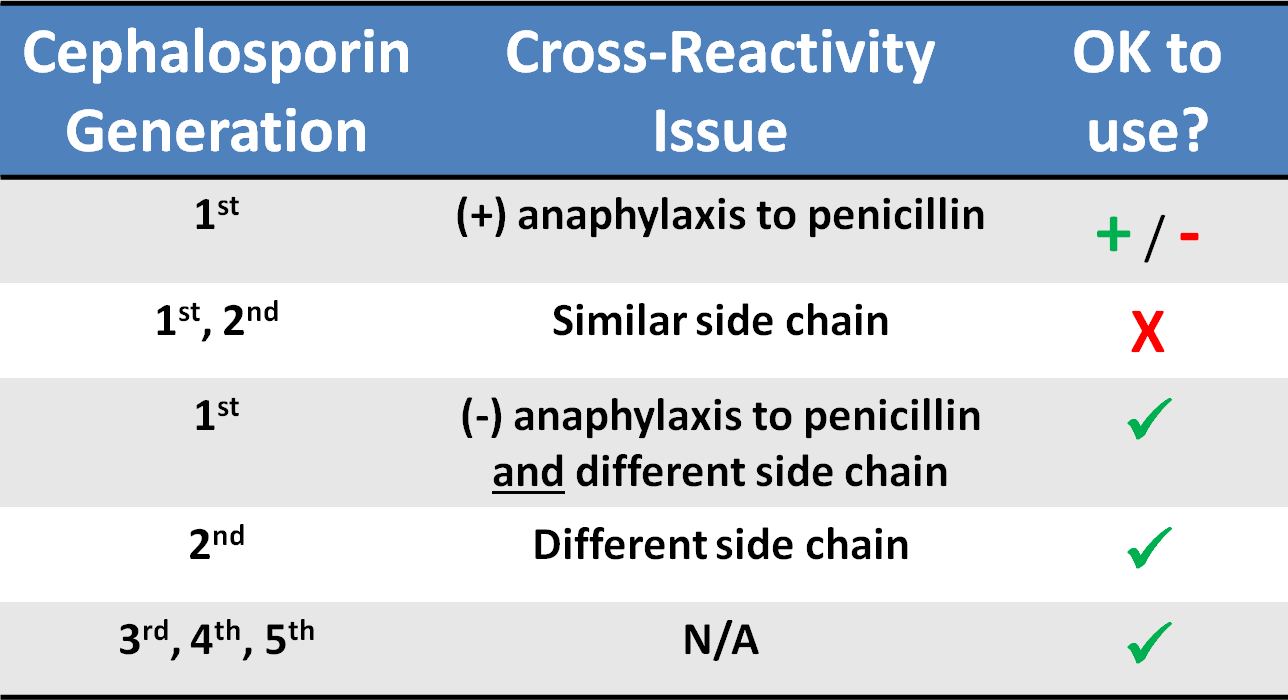
Common penicillins and cephalosporins with similar side chains include ampicillin/amoxicillin and cephalexin, cefaclor, cephadroxil, and cefprozil.
Show References
Beta-lactam antimicrobials (penicillins, cephalosporins, and carbapenems) are frequently used for empiric and targeted therapy in critically ill patients. They display time-dependent killing, meaning the time the antibiotic concentration is above the minimin inhibitory concentration (MIC) is associated with improved efficacy.
Two new pharmacodynamic/pharmacokinetic studies suggest that current beta-lactam antimicrobial dosing regimens may be inadequate.
- In patients from 68 ICUs across 10 countries, use of intermittent infusions (compared to extended and continuous infusions) and increasing creatinine clearance were risk factors for MIC target non-attainment. [1]
- A second group specifically investigated the pulmonary penetration of piperacillin/tazobactam in critically ill patients and found that intrapulmonary exposure is highly variable and unrelated to plasma exposure and pulmonary permeability. [2]
Antimicrobial dosing in critically ill patients is complex. Current dosing of beta-lactams may be inadequate and needs to be studied further with relation to clinical outcomes.
Show References
In May 2014, the U.S. Public Health Service released the first comprehensive clinical practice guidelines for PrEP.
Pre-Exposure Prophylaxis (PrEP) has been shown to decrease the risk of HIV infection in people who are at high risk by up to 92%, if taken consistently.
How this applies to the ED patient:
- You may start seeing more patients on only one HIV medication. The PrEP recommendation is once daily emtricitabine/tenofovir (Truvada) 200/300 mg.
- This is not a therapy that should generally be initiated in the ED as close outpatient monitioring and follow up is essential.
For more information, the CDC has a comprehensive website dedicated to PrEP.
Show References
Despite the lack of strong evidence to support the recommendation, the severity of the 2009 influenza pandemic prompted the World Health Organization (WHO) to advise that higher doses of oseltamivir (150 mg twice daily) and longer treatment regimens (> 5 days) should be considered when treating severe or progressive illness.
So, does the data support higher dosing in critically ill influenza patients?
A new systematic review concluded that "the small body of literature available in humans does not support routine use of high-dose oseltamivir in critically ill patients."
Show References
Clindamycin used to be a first-line agent for many SSTIs, particularly where MRSA was suspected. With growing resistance to staph species, the 2014 IDSA Guidelines recommend clindamycin as an option only in the following situations:
- Nonpurulent SSTI (primarily strep species)
- Mild - oral clindamycin
- Moderate - IV clindamcyin
- Severe, necrotizing infections - adjunctive clindamycin only with suspected or culture-confirmed strep pyogenes
- Purulent SSTI (primarily staph species)
- Clindamycin only recommended in moderate or severe cases if cultures yield MSSA
* Clindamycin may be used if clindamycin resistance is <10-15% at the institution.
Show References
In a prospective cohort of 598 ED patients, 5 risk factors were independently associated with uncomplicated cellulitis patients who fail initial antibiotic therapy as outpatients and require a change of antibiotics or admission to hospital:
- Fever (temperature > 38°C) at triage (OR = 4.3, 95% CI = 1.6 to 11.7)
- Chronic leg ulcers (OR = 2.5, 95% CI = 1.1 to 5.2)
- Chronic edema or lymphedema (OR = 2.5, 95% CI = 1.5 to 4.2)
- Prior cellulitis in the same area (OR = 2.1, 95% CI = 1.3 to 3.5)
- Cellulitis at a wound site (OR = 1.9, 95% CI = 1.2 to 3.0)
Patients presenting with uncomplicated cellulitis and any of these risk factors may need to be considered for observation +/- IV antibiotics.
Show References
Four small case series (one prospective, 3 retrospective) have concluded that dexmedetomidine (Precedex) may be a useful adjunct therapy to benzodiazepines for ethanol withdrawal in the ED or ICU. They are summarized on the Academic Life in EM blog.
A new randomized, double-blind trial evaluated 24 ICU patients with severe ethanol withdrawal.
Group 1: Lorazepam + placebo
Group 2: Lorazepam + dexmedetomidine (doses of 0.4 mcg/kg/hr and 1.2 mcg/kg/hr).
- 24-hour lorazepam requirements were reduced from 56 mg to 8 mg in the dexmedetomidine group (p=0.037).
- 7-day cumulative lorazepam requirements were similar.
- Clinical Institute Withdrawal Assessment or Riker sedation-agitation scale scores were similar within 24 hours.
- Bradycardia occurred more frequently in the dexmedetomidine group.
Take Home Points
- Dexmedetomidine reduced short-term benzodiazepine requirements, but not long-term when using symptom-triggered approach.
- Monitor for bradycardia when using dexmedetomidine.
Show References
Acetaminophen spent much of 2013 being chased by paparazzi and sharing magazine covers with Miley Cyrus. What a fall from stardom after becoming known as the pain reliever “hospitals use most,” and the one, “recommended by pediatricians.” Slogans we know well based on $100 million/year spent on advertising.
Approximately 150 patients a year die from unintentional acetaminophen poisoning averaged over the past 10 years. From 2001 to 2010, annual acetaminophen-related deaths amounted to about twice the number attributed to all other over-the-counter pain relievers combined,
The FDA sets the maximum recommended daily dose of acetaminophen at 4 grams, or eight extra strength acetaminophen tablets.
Ingestion of 150 mg/kg or approximately 10g for a 70 mg individual reaches the toxic threshold for a single ingestion. The toxic threshold decreases in cases of chronic ingestion.
Patients who “unintentionally” overdose have been found to take just over 8g per day (almost double the recommended maximum). This is unlikely due to taking one extra 325mg tablet once or twice.
Before we all go on a mad NSAID prescribing binge, let's all be aware of the dangers, educate our patients and allow Acetaminophen to walk the red carpet again.
Show References
A new study of almost 2 million prescriptions in VA patients compared the risk of cardiovascular death or dysrhythmia in patients receiving azithromcyin, levofloxacin, and amoxicillin.
What they found
Compared with amoxicillin, azithromycin was associated with a significant increase in mortality (HR = 1.48; 95% CI, 1.05-2.09) and dysrhythmia risk (HR = 1.77; 95% CI, 1.20-2.62) on days 1 to 5, but not 6 to 10.
Levofloxacin was associated with an increased risk throughout the 10-day period. Days 1-5 mortality (HR = 2.49, 95% CI, 1.7-3.64) and serious cardiac dysrhythmia (HR = 2.43, 95% CI, 1.56-3.79). Days 6-10 mortality (HR = 1.95, 95% CI, 1.32-2.88) and dysrhythmia (HR = 1.75; 95% CI, 1.09-2.82).
Important limitations
This study did not have a comparator group of patients getting no antibiotics. Previous data suggest patients on any antibiotic (eg, penicillin) have a higher risk of death or dysrhythmia.
The supplemental index shows that patients receiving azithromycin and levofloxacin had more serious infections (eg, PNA, COPD, etc.) which may have put them at higher risk for worse outcome irrespective of antibiotic choice.
What it means
It seems azithromycin and levofloxacin may contribute to a small increase in cardiovascular mortality and dysrhythmia during their use. A previous study found this is more likely in those with existing cardiovascular disease.
Show References
- Naloxone has technically always been able to be prescribed by physicians to individual patients.
- New laws however, make it acceptable for prescribers in many states to prescribe naloxone to “third parties,” e.g parents, friends, etc. of patients, with the assumption that the overdosed patient will not be capable of administering the antidote to themselves.
- Many states are offering short 10-20 minute training sessions on how bystanders can administer the reversal agent to the patient who has overdosed.
- If prescribed, it should be prescribed to the individual who completed the training, not the intended patient, and may be written for intranasal or intramuscular administration.
- Intranasal (IN) is “off label” and an approved intranasal preparation is not commercially available, but the intramuscular preparation can be prescribed along with an atomizer device. The usual IN dose is 1 mg per nostril which may be repeated in 3-5 minutes.
Show References
Aseptic meningitis is meningitis with negative bacterial cultures. Overall, viral infections are the most common etiology, however medications can also cause this illness.
Well known causes of aseptic meningitis include: antimicrobials (particularly sulfamethoxazole/trimethoprim), NSAIDS, antivirals (valacyclovir), and antiepileptics.
Recently an abstract was published that suggests that patients on levetiracetam have a higher risk of developing aseptic meningitis than those on topiramate and gabapentin. Lamotrigine has also been implicated, but appears to have a lower risk than levetiracetam, topiramate and gabapentin.
Show References
Background
The ACLS recommendation for epinephrine dosing in most cardiac arrest cases is 1 mg every 3-5 minutes. This dosing interval is largely based on expert opinion.
Primary Outcome
A new study reviewed 21,000 in-hospital cardiac arrest (IHCA) cases from the Get With the Guidelines-Resuscitation registry. The authors sought to examine the association between epinephrine dosing period and survival to hospital discharge in adults with an IHCA.
Methods
- For 6 to <7 min/dose, adjusted OR, 1.41 (95%CI: 1.12, 1.78)
- For 7 to <8 min/dose, adjusted OR, 1.30 (95%CI: 1.02, 1.65)
- For 8 to <9 min/dose, adjusted OR, 1.79 (95%CI: 1.38, 2.32)
- For 9 to<10 min/dose, adjusted OR, 2.17 (95%CI: 1.62, 2.92)
This pattern was consistent for both shockable and non-shockable cardiac arrest rhythms.
- This study only included in-hospital cardiac arrests.
- The data was retrospectively reviewed from a registry of prospectively collected data.
- This is certainly an interesting finding that needs to be explored further.
- Given that epinephrine in cardiac arrest has never been proven to work (and may cause harm), it's not too suprising that giving less of a potentially harmful drug portends better outcomes.
Show References
Tranexamic Acid (TXA) topically applied was compared to anterior nasal packing in 216 patients with acute anterior epistaxis. Cotton pledgets (15 cm) soaked in injectable TXA (500 mg/5 ml) were inserted into the bleeding nostril and removed after bleeding had arrested. This was compared to standard anterior packing.
RESULTS
| TXA Anterior packing |
| % pts bleeding stopped in 10 min: 71% 31.2% |
| Discharge after 2 hours 95.3% 6.4% |
| Rebleeding in 24 h hours 4.7% 11% |
| Satisfaction scores 8.5 4.4 |
Bottom line: topical tranexamic acid looks promising for control of uncomplicated anterior epistaxis.
Show References
In most situations (dependant on state laws and institutional policies), methadone-maintained patients enrolled in a drug abuse program are best managed by continuing methadone at the usual maintenance levels with once-a-day oral administration.
Pearl: In the event the methadone clinic is closed and/or the dose cannot be verified, 30-40 mg (10-20 mg IM) is generally enough to prevent withdrawal in most patients.
This is only a short-term measure and some patients may require additional methadone. Full doses of methadone should be reinstituted as soon as possible.
Show References
46 patients treated with high-dose droperidol (10-40 mg) were studied prospectively with continuous holter recording.
What they did
Patients initially received 10 mg droperidol as part of a standardized sedation protocol (for aggression). An additional 10 mg dose was given after 15 min if required and further doses at the clinical toxicologist's discretion.
Continuous 12-lead holter recordings were obtained for 2-24 hours. QTc > 500 msec was defined as abnormal (with heart rate correction - QTcF).
What they found
Only 4 patients had abnormal QT measurements, three given 10 mg and one 20 mg. All 4 had other reasons for QT prolongation. No patient given > 30 mg had a prolonged QT. There were no dysrhythmias.
What it means
There was little evidence supporting droperidol being the cause and QT prolongation was more likely due to pre-existing conditions or other drugs.
Show References
Tranexamic acid (TXA) is an antifibrinolytic that prevents clot breakdown by inhibiting plasminogen activation and plasmin activity
The CRASH-2 trial enrolled 20,211 adult trauma patients with significant hemorrhage (SBP <90 or HR 110) or at significant risk of hemorrhage
Patients were randomized to 1 gram TXA over 10 minutes followed by an infusion of 1 gm over 8 hours vs placebo
There was a significant reduction in the relative risk off all cause mortality of 9% (14.5% vs 16%, RR 0.91, CI 0.85-0.97, p = 0.0035)
The patients that benefited most were those most severely injured, and in those treated in less than 3 hours of injury.