
Search
Subscribe to daily UMEM Pearls (FREE!) via:
- Acute ischemic stroke patients are commonly admitted to an ICU after receiving IV tPA to be closely monitored for potential complications.
- Current post-tPA protocol requires frequent vital signs and neurological assessments up to every 15 minutes, thereby requiring 1:1 or 1:2 nurse-to-patient ratio.
- Studies have shown that stroke severity is a strong predictor of the need for critical care interventions for post-tPA patients, where patients with an NIHSS score ≥10 have an ~8x higher odds of requiring critical care interventions than those with NIHSS <10.
- A low-intensity post-tPA monitoring protocol (Figure 1) for patients with NIHSS <10 and no critical care needs has been found to be safe in a small single center study.
- These low risk patients were admitted with telemetry monitoring and 1:3 nurse-to-patient ratio after an initial period of q15 min standard monitoring.
- An international, multicenter, randomized controlled trial is being planned to study this further.
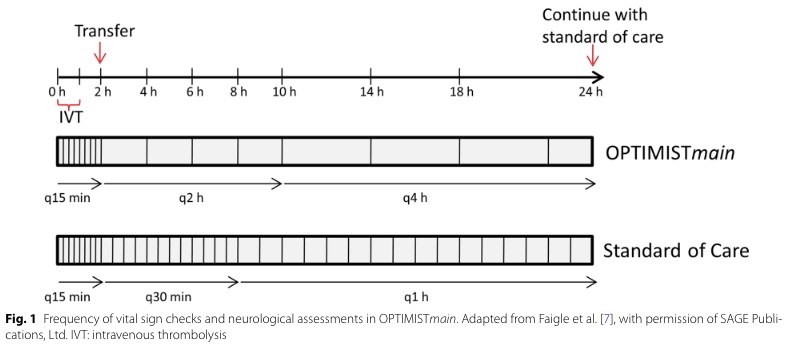
- This strategy may help streamline care and utilize hospital resources more efficiently in the COVID-19 pandemic and beyond.
Bottom Line: Patients with NIHSS <10 may be safe for low-intensity post-tPA monitoring if they do not require critical care after an initial period of q15 min standard monitoring for the first 2 hours.
References
- Faigle R, Butler J, Carhuapoma JR, et al. Safety trial of low-intensity monitoring after thrombolysis: Optimal Post Tpa-Iv Monitoring in Ischemic STroke (OPTIMIST). Neurohospitalist. 2020;10(1):11-15.
- Faigle R, Johnson B, Summers D, et al. Low-intensity monitoring after stroke thrombolysis during the COVID-19 pandemic. Neurocrit Care. 2020;33(2):333-337.
Follow me on Twitter @EM_NCC