
Search
Subscribe to daily UMEM Pearls (FREE!) via:
Question
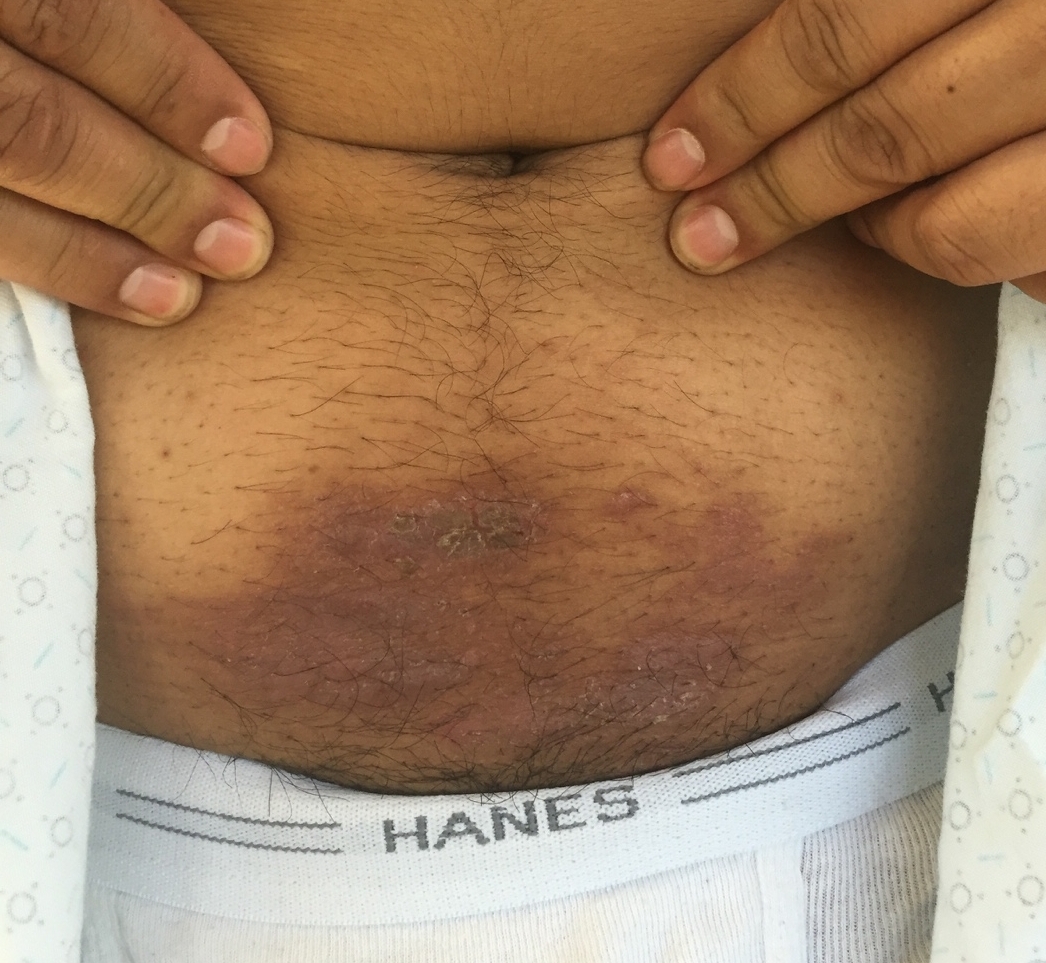
A 12 year old male who recently started middle school presents to the ED with a rash in the periumbilical region that has been developing over the last few weeks. The rash is scaly, somewhat itchy, but otherwise benign appearing. The patient has no known medical conditions other than eczema, and is otherwise well. What is the diagnosis?
Picture courtesy of Mara Haseltine, MD
Answer
-Nickel allergy dermatitis is a type of allergic contact dermatitis common in skin tests in 8-16% of the pediatric population. Unlike irritant dermatitises (such as exposure to poison ivy), it usually takes repeated exposure over time to develop. In this case, the back of the button on a pair of blue jeans was the offending agent, though belt buckles, earrings, watches, piercings, and any other metal that touches skin can also cause a similar reaction. -The process is a delayed type hypersensitivity reaction mediated by T cells. Topical steroids can help clear up the rash, but the best treatment is to remove contact with the offending agent. One simple method is to apply clear nail polish to the back of the metal button or otherwise cover it with a piece of cloth. -Between 10 and 16 percent of blue jean buttons may contain nickel according to two studies. -Commercial test kits are available to help determine what metal components contain nickel -Known metal allergies should be communicated and documented as it can complicate orthopedic appliances or cardiac stents
References
1. T. Suneja, K. Flanagan and D. Glaser, "Blue-jean button nickel; prevalence and prevention of its release from buttons," Dermatitis, vol. 18, no. 4, pp. 208-211, December 2007 .
2. T. Byer and D. Morrell, "Periumbilical Allergic Contact Dermatitis: Blue Jeans or Belt Buckles?," Pediatric Dermatology, vol. 21, no. 3, pp. 223-226, May-June 2004.
3. J. Brasch and J. Geier, "Patch Test REsults in Schoolchildren. Results from the Information Netowrk of Departments of Dermatology (IVDK) and the German Contact Dermatitis Group (DKG)," Contact Dermatitis, vol. 37, pp. 286-93, 1997.
4. W. Weston, J. Weston and J. Kinoshita, "Prevalence of Positive Epicutaneous Tests Among Infants, Children, and Adolescents," Pediatrics, vol. 78, pp. 1070-1074, 1986.