
Search
Subscribe to daily UMEM Pearls (FREE!) via:
Question
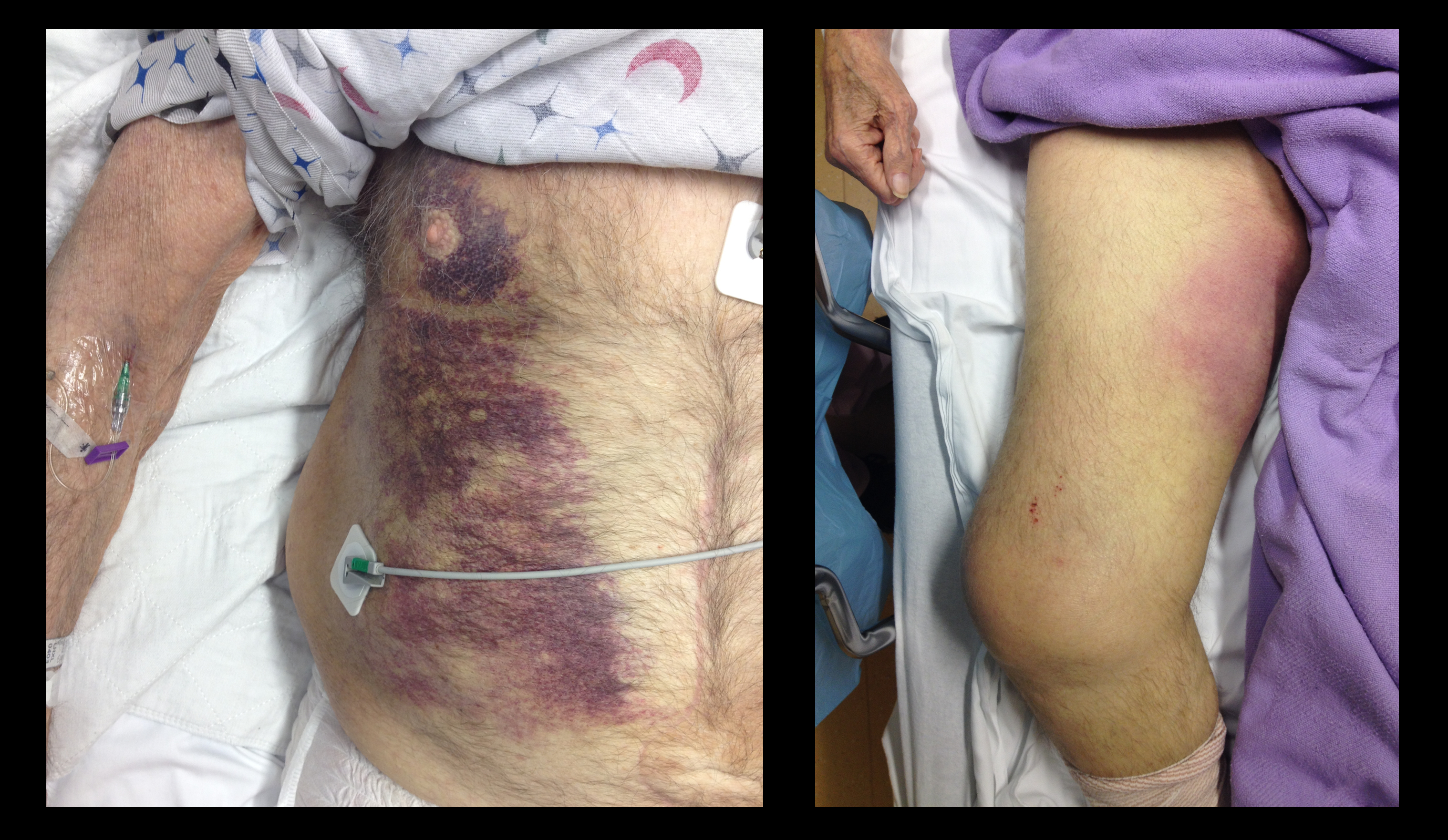
68 year-old male presents with weakness after surgical repair of his abdominal aorta. What’s the diagnosis and name at least one eponym for the signs displayed (there are five total)?
Answer
Grey-Turner and Fox's sign; these signs indicate retroperitoneal hemorrhage.
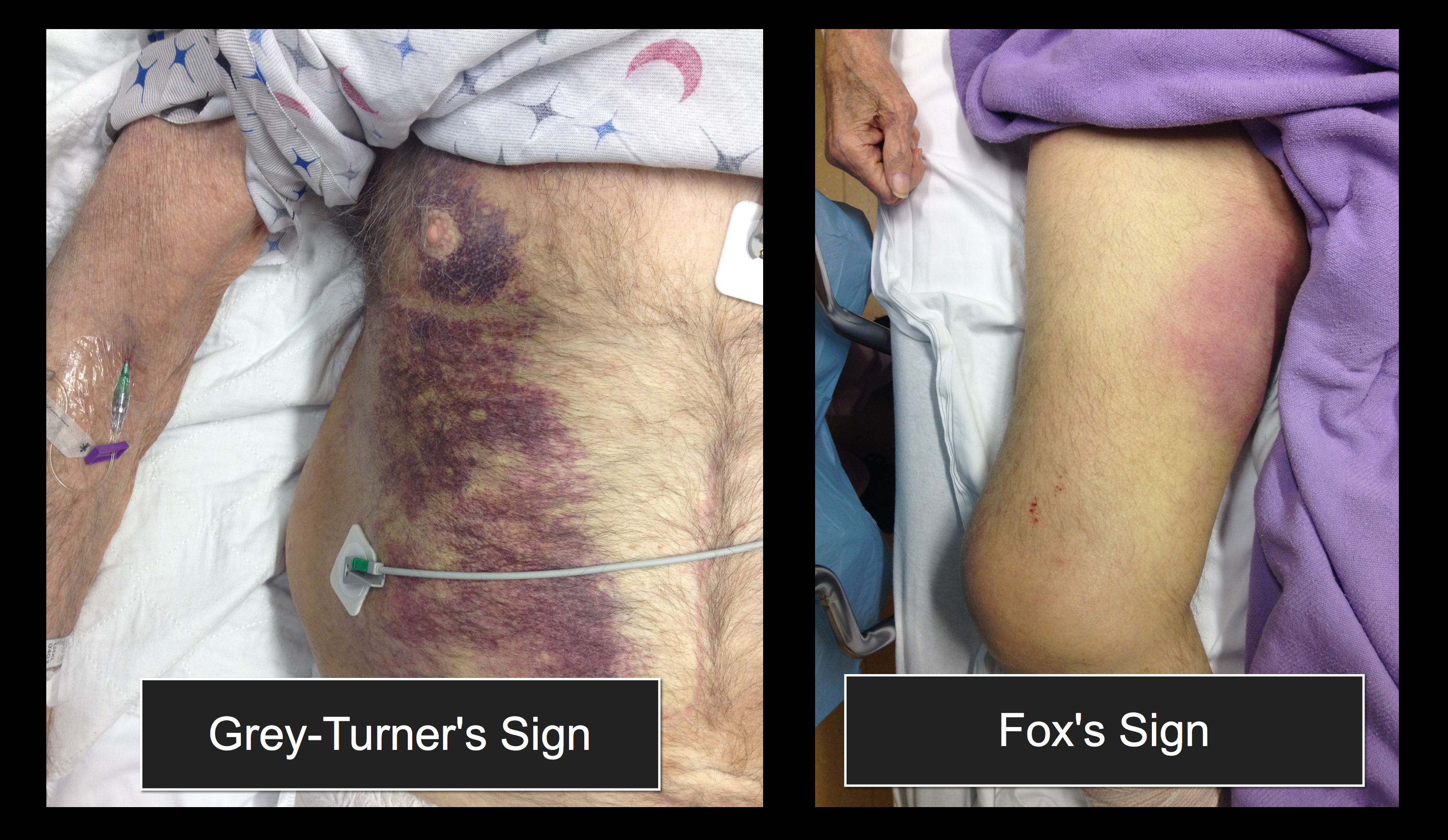
There are five signs suggesting retroperitoneal bleeding. They generally appear 24 hours after bleeding starts, occurring when blood extravasates along ligamentous connections between the retroperitoneal space and skin surface.
1. Grey-Turner Sign: Named for the surgeon who identified it in 1920; a bluish hematoma across the lateral abdominal wall when blood from the pararenal space leaks along the quadratus lumborum.
2. Fox’s Sign: Described by Dr. Fox in 1966 in two patients, (ruptured AAA and pancreatitis); ecchymosis over anteromedial thigh secondary to blood seeping along the fascia of psoas and iliacus.
3. Cullen’s Sign: Dr. Cullen (gynecologist), described this in 1918 as a sign of a ruptured ectopic pregnancy; bruise around the umbilicus from retroperitoneal blood tracking along falciform ligament.
4. Bryant’s Sign: Dr. Bryant initially described this sign; ecchymosis of the scrotum from blood tracking down the spermatic cord.
5. Stabler’s sign: Ecchymosis over the inguinal ligament
References
Follow me on Twitter (@criticalcarenow) or Google+ (+criticalcarenow)
- Turner GG. Local discoloration of the abdominal wall as a sign of acute pancreatitis. Br J Surg, 1920;7:394–395
- Fox JA. A diagnostic sign of extraperitoneal hemorrhage. Br J Surg 1966;53:193–195
- Cullen TS. A new Sign in Ruptured Extrauterine Pregnancy, Amer J Obstet, 1918,78:457
- James M. Dargin, Robert A. Lowenstein, Ruptured Abdominal Aortic Aneurysm Presenting as Painless Testicular Ecchymosis: The Scrotal Sign of Bryant Revisited, The Journal of Emergency Medicine, Volume 40, Issue 3, March 2011, Pages e45-e48
- Stijn, Heyman, and Vervloessem, Bryant's and Stabler's Signs after a Difficult Delivery,N Engl J Med 2011; 365:1824