
Search
Subscribe to daily UMEM Pearls (FREE!) via:
381-400 of 479 results with category "Orthopedics"
GOUT part 1
Gout is an inflammatory arthritis that classically affects the first metatarsal phalangeal joint
Gout prefers cool ambient temperature hence gouty tophi prefer the great toe (one of the coldest parts of the body) and avoids "warmer" joints such as the hip and shoulder.
Remember that gout can affect other joints as well (elbow, wrist, knee and ankle) and can cause painful bursitis and tendonitis
Multiple joints can be involved simultaneously (leading to confusing with RA and OA)
The involved joint will often be red, hot, swollen and very painful leading to easy confusion with cellulitis and or a septic arthritis
Diagnose gout by demonstrating monosodium urate crystals in the synovial fluid.
**Remember previous pearl by Dr. Bond regarding the coexistence of gout with septic joint**
Serum uric acid levels are commonly elevated but can be normal or even low
Use caution with this test because asymptomatic hyperuricemia is much more common than gout
Show References
Talar Neck Fractures
Have a high rate of avascular necrosis (AVN), nonunion, and arthritis. Almost all require ORIF
- Hawkins 1:
- 0- 13% AVN rate
- non-displaced fracture
- Hawkins 2:
- 20- 50% AVN rate
- Displaced fracture with subluxation or dislocation of the posterior facet of the subtler joint. Subtalar joint usually dislocated posteriory
- Hawkins 3:
- 20-100% AVN rate
- Displaced fracture of the talar neck with dislocation of the body of the talus from both the subtalar joint and the ankle joint


Show References
Cubital Tunnel Syndrome aka Radial Tunnel Syndrome
- The most common neuropathy of the elbow
- Entrapment of the ulnar nerve as it passes posterior to the medial epicondyle of the elbow
- HX: medial elbow and forearm pain occasionally associated with ulnar digit paresthesias.
- May be due to trauma, degenerative changes or throwing sports.
- PE: Pain with elbow flexion. Tenderness to palpation over the cubital tunnel. Positive Tinnel's sign.
- **Up to a quarter of normal asymptomatic patients will have a positive Tinnel's**
- DDx: Ulnar collateral ligament strain/tear and medial epicondylitis
- Tx: Ice, NSAIDs, activity modification, night splints with elbow in 45 degrees flexion and finally surgical decompression or nerve transposition
Show References
Sever's disease ,aka calcaneal apophysitis, is a common overuse injury in the pediatric and adolescent population.
Occurs secondary to traction of the calcaneus that most often occurs in young athletes (8-12 yo)
-Avg. age of presentation is 11 years 10 months in boys & 8 years 8 months in girls
-Repetitive traction to the weaker apophysis, induced by the pull of the Achilles on its insertion
Hx: Heel pain that increases with activity (running, jumping).
-May involve one (40%) or both (60%) feet
PE: Tenderness of the posterior heel at the Achilles tendon insertion and ankle dorsiflexor weakness
Imaging: Radiography is often normal. When positive, show fragmentation and sclerosis of the calcaneal apophsis. NOTE: These findings are nonspecific and also are observed in asymptomatic feet.
http://t0.gstatic.com/images?q=tbn:ANd9GcQ9R-fx1iyhbhNJpNL2W72bWdK72_mRBLNX5DUDtcMfnDli-x7Ong
DDx: Includes osteomyelitis and tarsal coalition.
Tx: Rest from aggravating activities, NSAIDs, ice (both pre and post sport). When pain free a program of stretching (gastrocnemius-soleus), strengthening (dorsiflexors) and shoe inserts (heel cups, lifts, pads, or orthotics) can provide significant pain relief.
Show References
Distal Radius Fractures
Typically distal radius fractures are treated with closed reduction and splinting in the ED, followed by operative repair. This is done because it is felt that patients will have the best functional outcomes if the bones are restored to their normal anatomic alignment. However, two studies published in 2010 suggest differently.
The study by Neidenbach showed that after one year there was no difference in functional outcomes between patients that were just splinted in the ED in the position the fracture was found versus those that had closed reduction with splinting.
The second study by Ego showed that there was no difference in outcomes between those that underwent conservative treatment with closed reduction and splinting versus those that underwent operative repair.
The take home point from these studies for the EM physician is that most distal radius fractures can be splinted in the position found with them following up with an orthopaedist. There is probably little advantage to performing a closed reduction in the ED knowing that this procedure can use a lot of valuable time and resources.
Show References
Iliotibial band syndrome (ITBS)
- Due to recurrent friction of the iliotibial band (ITB) sliding over the lateral femoral condyle.
http://footcarexpress.com/foot-orthotics/wp-content/uploads/2009/01/iliotibial-band-syndrome.jpg

Hx -
- Sharp or burning pain on the lateral aspect of the knee usually in runners.
- Rarely occurs at start of run, rather, occurs after reproducible time or distance
- (especially when running downhill)
PE-
- Typically negative other than local tenderness (approx. 2cm above lateral joint line) & occasional swelling over the distal ITB.
- Specialized tests: See also Ober's test and Noble's test
Tx
- Most patients respond to conservative treatment involving NSAIDs, stretching of the iliotibial band, strengthening of the gluteus medius, and altering training regimens.
Show References
FARES Method for Reduction of Anterior Shoulder Dislocations.
This method that was recently highlighted in a publication had a ~78% success rate with the authors able to reduce the shoulder in an average of 2.36 ±1.24 minutes without having to give the patients any analgesics or sedatives. The technique is done by:
- Placing the patient in the supine position.
- Hold the hand of the affected arm while the arm is at the patient’s side with the elbow extended and the forearm in neutral position.
- Apply gentle longitudinal traction and slowly move the arm into abduction while oscillating the forearm with continuous, brief (two to three full cycles per second) and short range (approximately 5 cm above and beneath the horizontal plane) vertical movements of the arm. These oscillations should be done during all all stages of the reduction as it helps that patient relax their muscles.
- Once the arm is abducted past 90º, gently externally rotate the arm while continuing to abduct it. Continue the oscillations.
- Reduction is usually achieved at ~ 120º of abduction.
- Once reduction is achieved, move the arm gently until it is internally rotated and resting on the patients chest.
Consider trying this with your next shoulder dislocation. No single method of reduciton is 100% successful, but methods like this that only require a single provider and do not require analgesics are extremely helpful in improving patient flow as they do not utilize a lot of ED resources..
Show References
Involves an avulsion of the flexor digitorum profundus (FDP) tendon from its insertion on the distal phalanx.
Ring finger is most commonly involved.
Usually occurs from a grabbing attempt (resulting in forced DIP extension during maximal FDP contraction) as would occur while attempting to grab someone’s jersey such as in football or rugby.
Clinically, there is normal passive DIP ROM with loss of active flexion. Examine this by asking the patient to flex the fingertip at the DIP while the PIP joint is held in extension.
*Remember that patients with a 90% full-thickness tendon laceration may still have normal (albeit painful) range of motion. The examiner must evaluation the strength of the tendon against resistance. This injury is commonly missed as it is diagnosed as a “jammed” finger.
Plain films may show a bony avulsion, but are often negative.
Treatment is primary repair especially with large bony fragments. Partial ruptures can be treated nonoperatively at the discretion of the hand surgeon.
Show References
Peroneal Tendon Subluxation: The Other Ankle Sprain
- Peroneal tendon subluxation is an uncommon cause of lateral ankle pain that is often misdiagnosed as a simple ankle sprain.
- It is commonly associated with sports that require cutting such as skiing, basketball, soccer, and football.
- The subluxation occurs when there is a forceful contraction of the peroneal tendon while the foot is dorsiflexed and inverted.
- Patients will often complain of pain at the posterolateral ankle that started as a forceful pop. They may also complain of snapping or popping around the lateral malleolus as it continues to sublux.
- On clinical exam, the patient will often have pain along the retrofibular groove. The peroneal tendon can be tested by actively dorsiflexing and everting the ankle from a plantar-flexed and inverted position. You should be able to see or feel the subluxation. Passive circumduction of the ankle may also recreate the subluxation.
- Conservative management (i.e.: ankle brace, cast or walking boot) is associated with a low success rate; therefore, these patients should be referred to sports medicine or orthopaedics for possible operative repair.

Show References
Commotio Cordis
Emergency medicine & sports medicine physicians often cover sporting events where athletes are at risk of commotio cordis
- 2nd most common cause of sudden cardiac death in young athletes in the US (HCM #1)
- Young males between 4 and 18 years old are at greatest risk
- 50% of all cases occur during competitive sports (baseball #1)
- Nonpenetrating, blunt trauma to the chest resulting to cardiac arrhythmia and, often, sudden cardiac death.
- Ventricular fibrillation (VF) is the most common arrhythmia.
- Thought to occur secondary to a precordial impact during an electrically vulnerable portion of ventricular repolarization (10-30 msec before the T-wave peak)
- Treatment: Immediate chest compressions and early use of an automated external defibrillator (AED) ((effective in only 15% of cases))
- Survival is much improved if resuscitation administered within 3 minutes (25%) than after 3 minutes (3%)
- Differential diagnosis: other causes of sudden cardiac death including HCM, coronary artery anomalies, long QT syndrome, Brugada syndrome, WPW, CAD, myocarditis, arrhythmogenic right ventricular dysplasia
Show References
Septic Arthritis
It is generally taught that if the synovial fluid white blood count (WBC) is less than 50,000 it is not septic, however, there is growing evidence that a clear delineation in the WBC between septic arthritis and inflammatory arthritis is not possible. In fact, inflammatory arthritis (rheumatoid and gout) actually increases your risk for septic arthritis and the two can coexist. Gram stains of the fluid only show organisms in 50% of those with septic arthritis so you also can not rely on them either. Inflammatory markers (CRP, ESR) can be elevated with inflammatory or septic arthritis so they too can not differentiate between the two.
In the end, because of the risk of permanent joint dysfunction, it is important to make the diagnosis on clinical grounds and treat empirically if you are unsure. Err on the sound of treatment. Serial joint aspirations to drain synovial fluid have the same outcomes as operative washout.
A recent article that discusses the concerns with making the diagnosis of septic arthritis is:
Mathews et al. Bacterial septic arthritis in adults. Lancet (2010) vol. 375 (9717) pp. 846-55
Show References
Cervical Radiculopathy
The most commonly affected level is C7 (31-81%), followed by C6 (19-25%), C8 (4-12%) and C5 (2-14%)
Anterior compression can selectively affect motor fibers
Posterior compression can selectively affect sensory fibers
-More common due to posterior lateral disc herniation or facet degeneration
Signs and symptoms: Sensory complaints (findings are in a root distribution) and possible weakness and reflex changes.
Show References
Dr. Corwell covered Spondyloysis in July 2010 https://umem.org/res_pearls_referenced.php?p=1134 but if you are like me you might have trouble remembering the differences between the following terms:
- Spondyloysis: A unilateral or bilateral defect in the pars interarticularis portion of a vertebrae. Typically L5 or L4.
- Spondylosis: is a term referring to degenerative osteoarthritis of the joints between the spinal vertebrae and/or neural foraminae.
- Spondylolisthesis: describes the anterior displacement of a vertebra or the vertebral column in relation to the vertebrae below. Usually due to spondyloysis or a fracture of the pedicles of the vertebrae. Can occur anywhere along the vertebral column. Most common at the L4 and L5 level. For example, a hangman's fracture is a spondylolisthesis of the C1 vertebra being displaced anteriorly relative to the C2 vertebra.
- Spondylitis: is an inflammation of the vertebra. As can be seen with ankylosing spondylitis, Pott’s disease or any infection or arthritic disorder of the spine.
Show References
Chief complaint: “Posterior heel pain”
http://www.aidmybursa.com/_img/ankle-retrocalcaneal-subcutaneous-bursitis.jpg
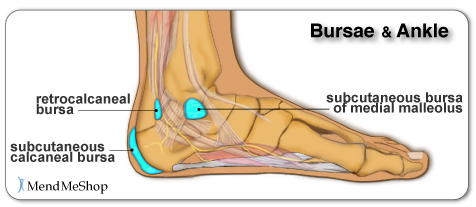
Retrocalcaneal bursitis
The retrocalcaneal bursa is located between the Achilles tendon and the posterior superior border of the calcaneus.
H&P: Inflammation and pain may follow repetitive dorsi/plantar flexion of the ankle (excessive running, jumping activities). Tenderness anterior and superior to the Achilles insertion on the heel.
Treatment: Minimize weight bearing. ½ inch elevation. NSAIDs.
Posterior calcaneal bursitis
This bursa is subcutaneous, just superficial to the insertion of the Achilles tendon.
H&P: Inflammation and pain may follow irritation from the upper border of the heel counter of a shoe. Posterior heel pain. Tender “bump” (the inflamed and swollen bursa) on the back of the heel.
http://podiatry.files.wordpress.com/2006/12/patient2.jpg

Treatment: Opened-heeled shoes, sandals, or placement of a “U-shaped” pad between the heel and the counter. NSAIDs. Advance to shoes with soft or less convex heel counters.
Show References
Evaluation of Potential Intra-Articular Joint Lacerations
Skin and soft tissue injuries in proximity to a joint often prompt concern of whether the injury violated the joint space. Joint Space involvement is important to exclude as it can lead to septic joints and long term disability.
One easy way to determine if the joint capsule has been violated is to inject methylene blue into the joint and watch to see if any of the methylene blue extravasates through the soft tissue.
Indications for a methylene blue injection include:
- Periarticular fracture
- Visible joint capsule
- Proximity to a joint
There are no absolute contraindications. Though clearly the procedure does not need to be done when the injury highly suggests an open joint injury and the patient will require operative debridement and exploration.
To watch a video of a injection head to eMedicine by clicking http://emedicine.medscape.com/article/114453-overview
Show References
Transverse Myelitis
A group of inflammatory disorders characterized by acute or subacute motor weakness, sensory abnormalities and autonomic (bowel, bladder, sexual) cord dysfunction.
Symptoms are usually bilateral but both unilateral and asymmetric presentations can occur.
Look for a well-defined truncal sensory level
-below which sensation of pain and temperature is altered or lost.
Causes: Autoimmune after infection or vaccination (60% of cases in children), direct infection, or a demyelinating disease such as MS. No cause is found in 15 – 30% of cases.
Incidence: Bimodal peak at 10-19 years and at 30-39 years.
Diagnostic testing: MRI of the ENTIRE spine to both rule out structural lesions and rule in an intrinsic cord lesion. If MRI is normal reconsider the original diagnosis.
Treatment: Steroids are first-line therapy. Dosing is controversial but generally involves high IV doses for 3-5 days (1000 mg methylprednisolone). Plasma exchange is second line for those who don’t respond to steroids.
Show References
Risk Factors for Spinal Epidural Abscesses
Building on Dr. Corwell's pearl from last week concerning Spinal Epidural Abscess, risk factors for Spinal Epidural Abscesses other than IV drug abuse are:
- Diabetes
- ESRD
- Septicemia
- HIV infection
- Malignancy
- Morbid obesity
- Long-term corticosteroid use
- Alcoholism
- Infection at a distal site
- Indwelling catheters
- Spinal surgery
The infection can occur via three routes 1) hematogenous spread 2) Direct Extension from a local infection such as osteoomyelitis, and 3) iatrogenic introduction which is thought to be responsible for 14-22% of the cases. A catheter in the epidural space for more than 2 days has a infection rate of 4.3%.
Show References
Epidural compression syndrome encompasses spinal cord compression, cauda equina syndrome, & conus medullaris syndrome.
Causes include:
- massive midline disc herniation (most commonly), usually at the L4 to L5 level.
- tumor
- epidural abscess
- spinal canal hematoma.
Measurement of a post-void bladder residual volume tests for the presence of urinary retention with overflow incontinence (a common, though late finding) (sensitivity of 90%, specificity of 95%). Large post-void residual volumes (>100 mL) indicate a denervated bladder with resultant overflow incontinence and suggest significant neurologic compromise. The probability of cauda equina syndrome in patients without urinary retention is approximately 1 in 10,000.
Use this in your daily practice!!
The administration of glucocorticoids can minimize ongoing neurologic damage from compression & edema until definitive therapy can be initiated. The optimal initial dose and duration of therapy is controversial, with a recommended dose range of dexamethasone anywhere from 10 to 100 mg intravenously. Consider traditional dosing (dexamethasone 10 mg) for those with minimal neurologic dysfunction, & reserve the higher dose (dexamethasone 100 mg) for patients with profound or rapidly progressive symptoms, such as paraparesis or paraplegia.
Show References
Subungual Hematomas:
- Subungual hematomas are collections of blood that form under the nail with injuries to the distal phalanx.
- Those that are < 25% of the nailbed can be drained via trephination and heal well.
- Up to 94% of subungual hematomas that are are associated with a distal phalanx fracture have a nailed laceration. It is commonly taught this hematomas should have the nail removed and the nailbed repaired. However studies from the 1990's have shown that as long as the nail is attached to the nailbed or paronychia and is not displaced; trephination alone can be done to achieve similar outcomes.
Show References
Previous pearls have described tips for smart and safe documentation of typical ED complaints such as chest pain. Properly assessing and documenting orthopedic complaints is likewise very important. No evaluation or chart is complete if it does not include include the following 7 components:
The joint above
The joint below
Motor
Sensory
Vascular
Skin
Compartments
The joint above/below is important in cases of shoulder and hip pain actually being radicular pain (from the neck and back respectively). Also, hip pain from trauma may be due to a femur fracture for example.
For motor and sensory evaluation, test the most distal isolated innervation of a particular nerve (L5 - great toe dorsiflexion for example).
Note distal pulses and check ABIs for injuries with potential subtle vascular findings.
Note intact skin especially in cases where the joint will be covered by a splint.
Note "soft" compartments especially in cases of forearm and lower leg fractures.