
Search
Subscribe to daily UMEM Pearls (FREE!) via:
Question
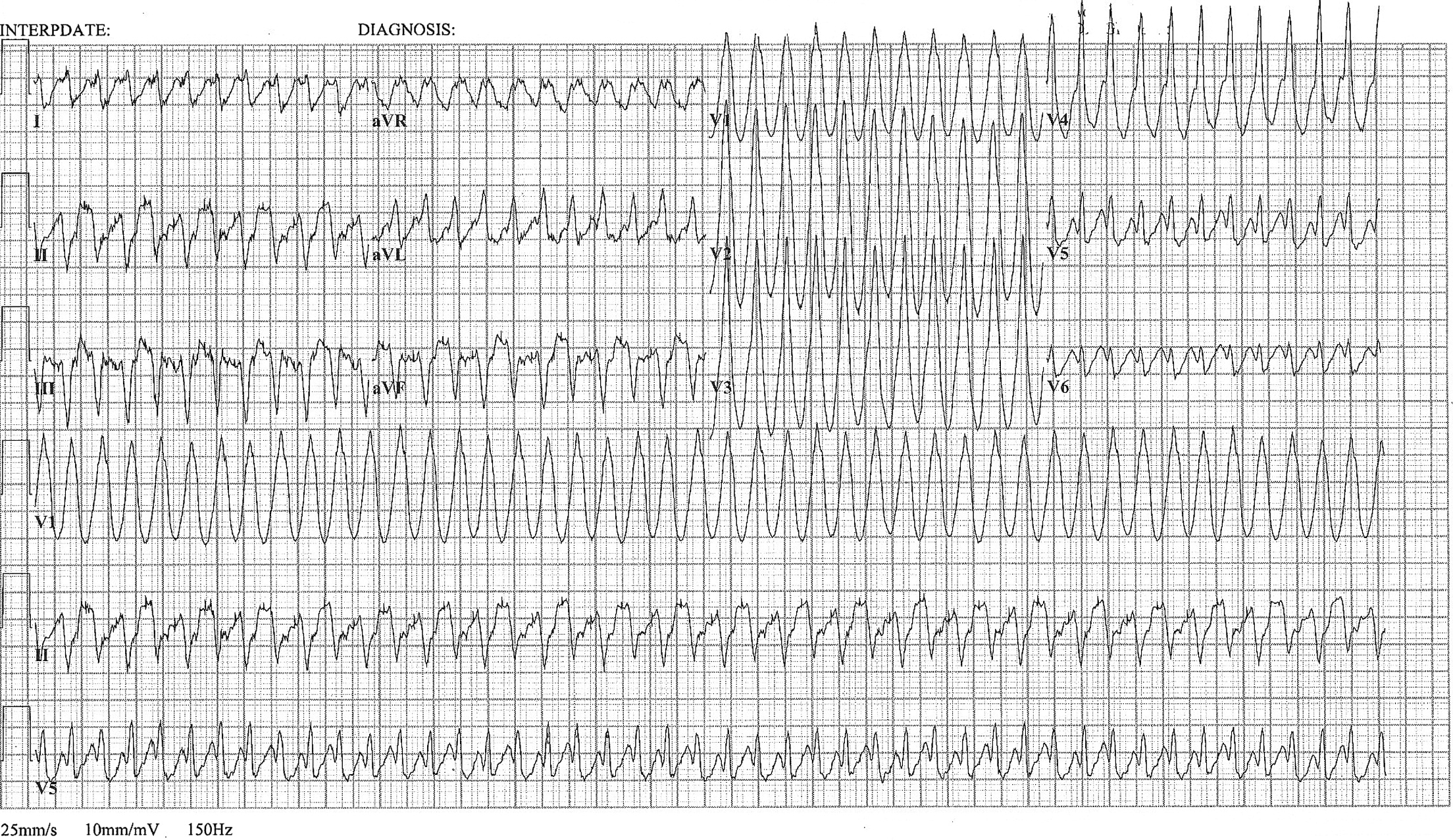
A 48 year old woman has acute chest pain and palpitations over the past several hours. She has felt similar palpitations in the past but never sought medical attention. She arrives to your ED alert and anxious. HR = 270, BP=130/100. ECG is below. What’s the diagnosis and treatment?
Answer
Most wide complex regular tachycardias are ventricular tachycardia (VT). However, supraventricular tachycardias can also cause wide complexes through aberrant conduction and accessory pathways.
The exact diagnosis of a tachydysrhythmia is often irrelevant in the ED management of unstable patients. Clinical stability is a more important determinant of treatment than the underlying rhythm. This patient was thought to have VT and was successfully cardioverted.
Subsequent EP study confirmed Atrial Flutter with 1:1 conduction and Wolff-Parkinson-White (WPW) Syndrome.
Why is this important?
Accessory pathways can be concealed, and lack of delta waves do not rule out preexcitation syndromes such as WPW.
Consider this diagnosis in patients with the triad of extremely rapid rate (>250 bpm), regular rhythm, and wide QRS complexes.
This is particularly important if pharmacological treatment is chosen rather than cardioversion. Any treatment that slows AV nodal conduction may cause preferential conduction down the accessory pathway and precipitate cardiovascular collapse.
Bottom-line:
When treating extremely fast wide complex rhythms, avoid the ABCD Meds (Adenosine, Beta-Blockers, Ca2+ Channel Blockers, & Digoxin). Instead, consider using Procainamide or cardioversion!
References
Nelson JG, Zhu DW. Atrial Flutter with 1:1 Conduction in Undiagnosed Wolff-Parkinson-White Syndrome. The Journal of Emergency Medicine. January 2014. Pubmed Link
Want more emergency cardiology pearls?
Follow me on Twitter @alifarzadmd