University of Maryland School of Medicine logo
Emergency Medicine
All Departments
UMSOM Assistant
UMEM Educational Pearls
  • Home
  • Departments
  • Emergency Medicine
  • CME
  • UMEM Educational Pearls
  • CME
  • Courses and Conferences
  • Free Open Access Medical Education
  • UMEM Educational Pearls

Search

1-8 of 8 results with category "Ophthamology"


Title: Increase Your Gain for Ocular POCUS

Category: Ophthamology

Keywords: POCUS, Ocular, Posterior Chamber (PubMed Search)

Posted: 8/7/2023 by Alexis Salerno Rubeling, MD

Prior research has shown that EPs can accurately detect ocular pathology using POCUS. 

A recent retrospective review looked at how ultrasound image gain levels impacted the accuracy of POCUS for detection of retinal detachment, retinal hemorrhage and posterior vitreous detachment.

They included 383 ED patients who received ocular POCUS and ophthalmology consultations. 

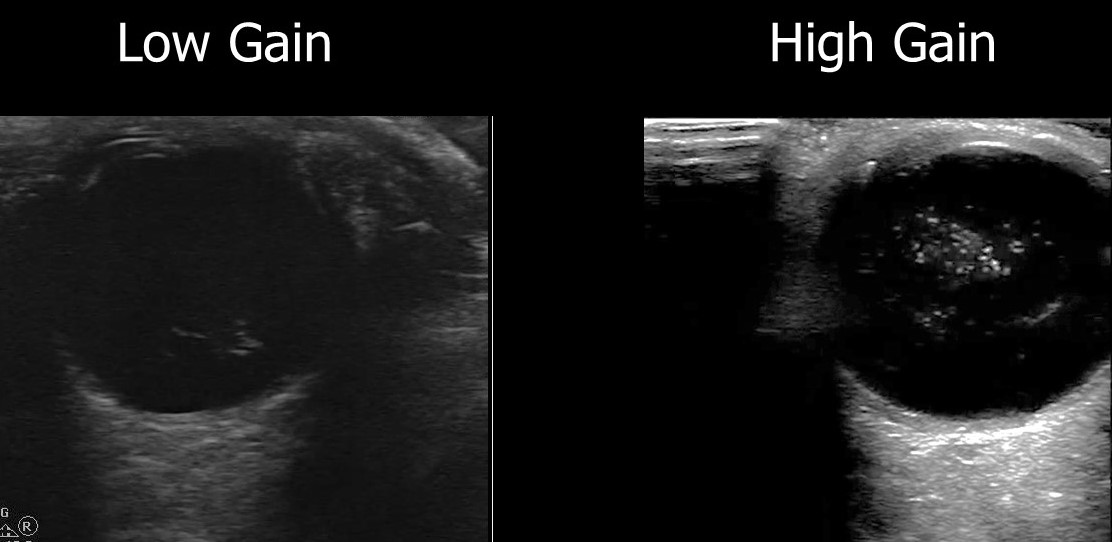
Conclusions: The authors found that increasing the gain for ocular POCUS images allowed for increased sensitivity.

Here is an example of a vitreous hemorrhage on ocular POCUS using low gain and high gain. 
Show References
Chang M, Finney N, Baker J, Rowland J, Gupta S, Sarsour R, Saadat S, Fox JC. Optimal Image Gain Intensity of Point-of-care Ultrasound when Screening for Ocular Abnormalities in the Emergency Department. West J Emerg Med. 2023 May 5;24(3):622-628. doi: 10.5811/westjem.59714.


Title: Identify this eye exam finding.

Category: Ophthamology

Keywords: Optho. (PubMed Search)

Posted: 6/29/2023 by Robert Flint, MD (Updated: 6/29/2023)

Question


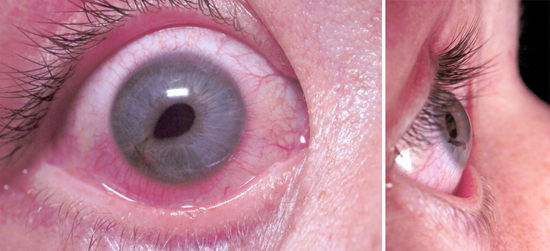
What is this called? What does it indicate? Treatment?

Show Answer

Tear Drop pupil. Globe rupture/corneal laceration. Protect the eye with a commercially available shield (Fox, etc) or if none is available use a paper/sytroform cup that can be cut to length to allow taping in place. Start IV antibiotics and emergency opthamology referal. 

Show References

1. https://www.jems.com/patient-care/traumatic-eye-injury-management-principl-0/

2. https://eyesoneyecare.com/resources/ophthalmic-emergencies-open-globe-injuries/


Title: What is this eye exam finding?

Category: Ophthamology

Keywords: corneal perforation (PubMed Search)

Posted: 6/19/2023 by Robert Flint, MD (Updated: 7/21/2026)

Question


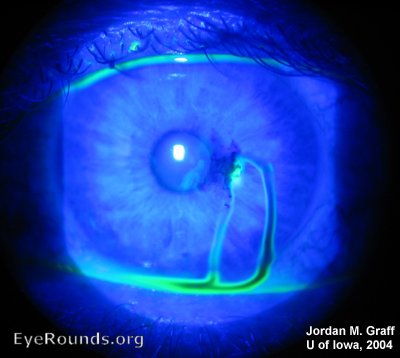
What is this called? What does it indicate?

Show Answer

Seidel Sign. Assoicated with corneal perforation. 

Show References

https://webeye.ophth.uiowa.edu/eyeforum/atlas/pages/corneal-perforation-seidel-posative-.html


Title: Conjunctivitis

Category: Ophthamology

Keywords: Conjunctivitis (PubMed Search)

Posted: 4/17/2010 by Michael Bond, MD (Updated: 8/28/2014)

All to often we see children that are sent to the ED for "Pink Eye" as the school nurse will not allow them back into class unless they are treated with antibiotics.  A recent study out of New York identified 4 factors that are associated with low risk (<8% chance) of bacterial (culture postive) conjunctivitis.  They are:

  1. age 6 years
  2. presentation during April through November
  3. watery or no discharge
  4. no glued eye in the morning

An editorial in journal watch comments that if this study can be replicated in other geographic areas we could change the practice of prescribing antibiotics that are not necessary.

Show References

Meltzer JA et al. Identifying children at low risk for bacterial conjunctivitis. Arch Pediatr Adolesc Med 2010 Mar; 164:263.


Title: Uveitis and Iritis

Category: Ophthamology

Keywords: Uveitis, Iritis (PubMed Search)

Posted: 1/16/2010 by Michael Bond, MD

Iritis is a common diagnosis in the ED, but did you know it was actually a subset of Uveitis.

Uveitis is an inflammation of one or all parts of the uveal tract which consists of the iris, the ciliary body, and the choroid.
 
The subsets of uveitis are:

  1. anterior
  2. confined to the iris and anterior chamber -- iritis
  3. confined to the iris, anterior chamber, and ciliary body -- iridocyclitis.
  4. Posterior uveitis -- choroiditis and chorioretinitis, is uncommon, with the exception of cytomegalovirus (CMV) retinitis in patients with AIDS.


Treatment of iritis and uveitis next week.

Show References

Emedicine Iritis and Uveitis  http://emedicine.medscape.com/article/798323-overview


Title: Sudden Vision Loss Causes

Category: Ophthamology

Keywords: Sudden Vision Loss (PubMed Search)

Posted: 12/5/2009 by Michael Bond, MD (Updated: 12/5/2009)

Some of the causes of acute vision loss are:

  • Cardiac Causes include:
    • Emboli -- causes can be atherosclerotic plagues, atrial fibrillation, endocarditis.
    • Arteritis
    • Dissection
  • Hematologic causes
    • Hypercoaguable state
    • Hyperviscosity
    • Anemia
  • Ocular Causes
    • Angle-closure glaucoma
    • Papilledema/neoplasm: Intracranial hypertension
    • Intraocular foreign bodies:
    • Central retinal artery occlusion
    • Anterior ischemic optic neuropathy
    • Ruptured globe
  • Miscellaneous
    • Migraine
    • Hysteria
    • Drugs (i.e.: viagra and its counterparts)

Show References

Farino GA, Feliciano A, Lorenzo NY. Sudden Visual Loss.  eMedicine. Accessed November 27, 2009.


Title: Sudden Vision Loss Nomenclature

Category: Ophthamology

Keywords: Suden Vision Loss (PubMed Search)

Posted: 11/28/2009 by Michael Bond, MD (Updated: 7/21/2026)

Vision loss whether acute or chronic is a common presenting complaint to the ED.  This will be the first in a series of pearls on the subject.  This pearl will address the nomenclature used by ophthalmology based on the length of vision loss.

    •    Transient visual obscuration - Episodes lasting seconds. Usually associated with papilledema and increased intracranial pressure.
    •    Amaurosis fugax - Brief, fleeting attack of monocular partial or total blindness that lasts seconds to minutes
    •    Transient monocular visual loss  or transient monocular blindness - A more persistent vision loss that lasts minutes or longer
    •    Transient bilateral visual loss - Episodes affecting one or both eyes or both cerebral hemispheres and causing visual loss
    •    Ocular infarction - Persistent ischemic damage to the eye, resulting in permanent vision loss

Show References

  • Farino GA, Feliciano A, Lorenzo NY. Sudden Visual Loss.  eMedicine. Accessed November 27, 2009.
  • Hedges TR. The terminology of transient visual loss due to vascular insufficiency. Stroke. Sep-Oct 1984;15(5):907-8.


Title: Multiple Evanescent White Dot Syndrome (MEWDS)

Category: Ophthamology

Keywords: MEWDS, White Dot Syndrome (PubMed Search)

Posted: 11/21/2009 by Michael Bond, MD

MEWDS (Multiple Evanescent White Dot Syndrome)

  • A rare, unilateral, self-limiting inflammatory disease
  • Afflicts young women more than men in a 4:1 ratio.
  • Patients typically present complaining of
    • Sudden, painless, monocular decline in central acuity
    • Photopsias-- def. appearance as of sparks or flashes in retinal irritation
    • Dyschromatopsia-- def> disorder of color vision
    • Central/paracentral scotomas
  • Visual acuity usually in the  20/40-20/400
  • Fluorescein angiography of active lesions typically demonstrate a "wreath-like" hyperfluorescence of the white dots
  • Disease is usually self limited (resolves in weeks to months) with an excellent prognosis.
  • There are no known treatment options.

Show References

Multiple Evanescent White Dot Syndrome (MEWDS): 24 y.o. woman with one week duration of central scotoma, OD.
Presented by Sudeep Pramanik, MD, MBA, Hilary A. Beaver, MD http://webeye.ophth.uiowa.edu/eyeforum/cases/37-MultipleEvanescentWhiteDotSyndromeMEWDS.htm


University of Maryland School of Medicine logo
  • Departments
  • Programs
  • Research Centers
  • Institutes
  • Graduate Education
  • CIBR Cores
  • Offices of the Dean
    • University of Maryland, Baltimore
    • University of Maryland Medical Center
    • Medical Alumni Association of the University of Maryland
    • Health Sciences and Human Services Library
University of Maryland School of Medicine
655 W. Baltimore Street
Baltimore, MD 21201
Contact Us

© University of Maryland School of Medicine

    • Webmaster
    • Web Accessibility
    • Site Index
    • UMB Hotline
    • Employment
    • Map