
Search
Subscribe to daily UMEM Pearls (FREE!) via:
1-5 of 5 results with category "Pulmonary"
Reminder that the Bova Score (2 points each for heart rate over 110, SBP less than 90, RV strain on CT or echo, and elevated troponin) along with an elevated lactate and BNP can help predict outcomes in hemodynamically stable PE patients.
"Low risk (score <2):
Proceed with standard anticoagulation therapy. Standard outpatient or inpatient monitoring, as appropriate.
Intermediate risk (score 3–4): Consider closer monitoring (e.g., stepdown/ICU). Discuss the possibility of advanced therapies (e.g., thrombolysis) in select cases, especially if clinical status worsens.
High risk (score >4): Maintain continuous ICU monitoring with a clear plan for rapid intervention if clinical status worsens (e.g., hypotension, worsening hypoxia, arrhythmias). Strongly consider multidisciplinary team involvement and potential advanced therapies (e.g., systemic thrombolysis or catheter-directed therapies)."
Show References
In 2023 there was a similar Canadian wildfire smoke pollution issue in the United States as there was in July 2026. The CDC found:
“Emergency department visits for asthma were 17% higher than expected during 19 days of wildfire smoke that occurred during April–August 2023.”
Show References
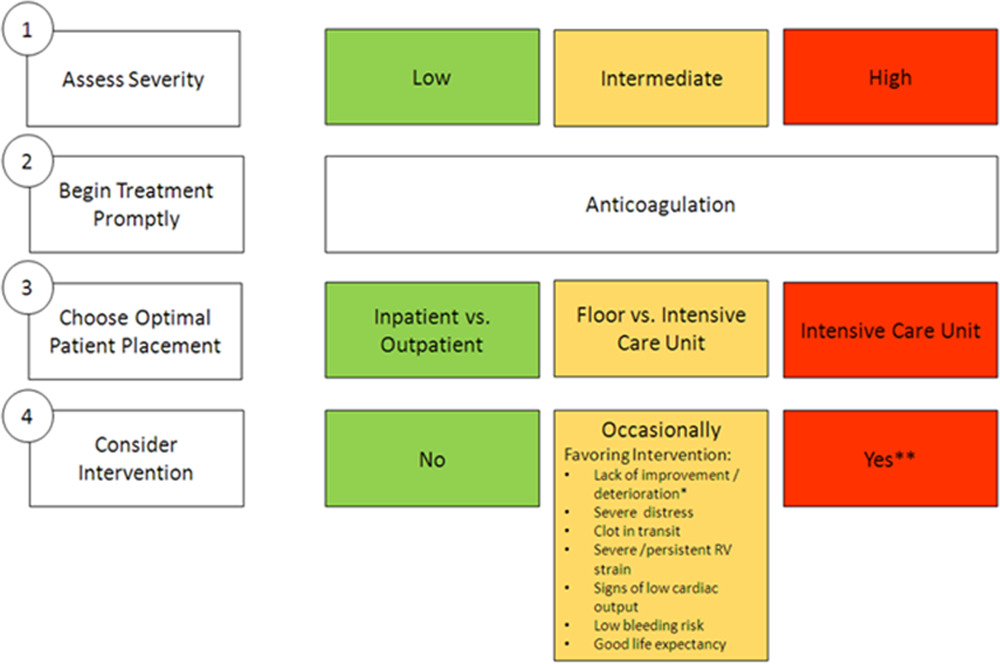
Deciding which pulmonary embolism patient needs thrombolytics/catheter based intervention is a shared decision among emergency physicians, intensivists, interventionalists, hospitalists, and the patient/family. This article provides evidence to help guide this decision. Keep in mind “The use of either CDL or catheter-based embolectomy in patients with intermediate-risk PE has, thus far, been correlated only with more rapid improvement of RV dysfunction than anticoagulation alone, not short- or long-term clinical or functional outcomes.”
"1. Massive (AHA) or high risk (ESC): Hypotension, defined as a systolic blood pressure <90 mm?Hg, a drop of >40 mm?Hg for at least 15 minutes (this latter criterion may be difficult to ascertain in some clinical circumstances), or need for vasopressor support, identifies these patients. They account for ?5% of hospitalized patients with PE and have an average mortality of ?30% within 1 month.
2.Submassive (AHA) or intermediate risk (ESC): RV strain without hypotension (see above) primarily identifies these patients. RV strain includes RV dysfunction on computed tomography pulmonary angiography or echocardiography (RV/left ventricular [LV] ratio >0.9)6,7 or RV injury and pressure overload detected by an increase in cardiac biomarkers such as troponins or brain natriuretic hormone.
3.Low risk (ESC and AHA): These patients do not meet criteria for submassive (AHA) or intermediate-risk (ESC) PE"
Show References
The Bova score has been validated to predict mortality and complications in hemodynamically stable patients with intermediate to high-risk pulmonary embolisms. There is some literature on using the Bova score to decide on thrombolytics/interventional therapy as well.
Scoring Criteria:
- Score 2: Systolic Blood Pressure 90-100 mmHg
- Score 2: Elevated cardiac Troponin
- Score 2: Right Ventricular Dysfunction
- Right Ventricle to Left Ventricle ratio >0.9
- Systolic pulmonary artery pressure >30 mmHg
- Right ventricular free wall hypokinesis
- Right ventricular dilatation (e.g. D-Sign)
- Score 1: Heart Rate >=110 bmp
Interpretation:
- Stage 1: Bova Score 0-2 (low risk)
- Mortality at 30 days: 3.1%
- PE Related Complications: 4.4%
- Stage 2: Bova Score 2-4 (intermediate risk)
- Mortality at 30 days: 6.8%
- PE Related Complications: 18%
- Stage 3: Bova Score >4 (high risk)
- Mortality at 30 days: 10%
- PE Related Complications: 42%
Show References
The new IDSA and American Thoracic Society guidelines for community acquired pneumonia were recently released. Major updates to the guidelines include but are not limited to:
1. It is not recommended to obtain sputum cultures in routine care. Consider only in patients who are intubated or empirically being treated for hospital associated pathogens such as MRSA or P. aeruginosa.
2. Blood cultures are only recommended for severe CAP managed in the hospital or those empirically being treated for MRSA or P. aeruginosa, or prior infection with those pathogens, or hospitalized and received parenteral antibiotics in the last 90 days.
3. Test for influenza during time periods when influenza is prominent (as in our current 2020 influenza outbreak).
4. Healthy patients can receive either amoxicillin 1g TID, doxycycline 100mg BID, or azithromycin 500mg followed by 250mg daily x 4 doses.
5. Patients with comorbidities such as chronic heart, lung, liver, or renal disease, diabetes, alcoholism, malignancy, or asplenia should receive combination therapy with a beta-lactam (amoxicillin/clavulanate, cefdinir, or cefpodoxime) + azithromycin or doxycycline. If allergies preclude the use of a beta-lactam, a fluoroquinolone (levofloxacin or moxifloxacin) can be used.
6. Patient admitted for non-severe CAP can receive combination beta-lactam (ampicillin/sulbactam, or ceftriaxone) and azithromycin therapy. Patients with severe beta-lactam allergies can receive either levofloxacin or moxifloxacin).
7. It is no longer recommended to add anaerobic coverage for suspected aspiration pneumonia unless the patient is suspected to have a lung abscess or empyema. It is most likely a chemical pneumonitis and should resolve within 24-48 hours with supportive therapy.