
Longitudinal Structure Overview
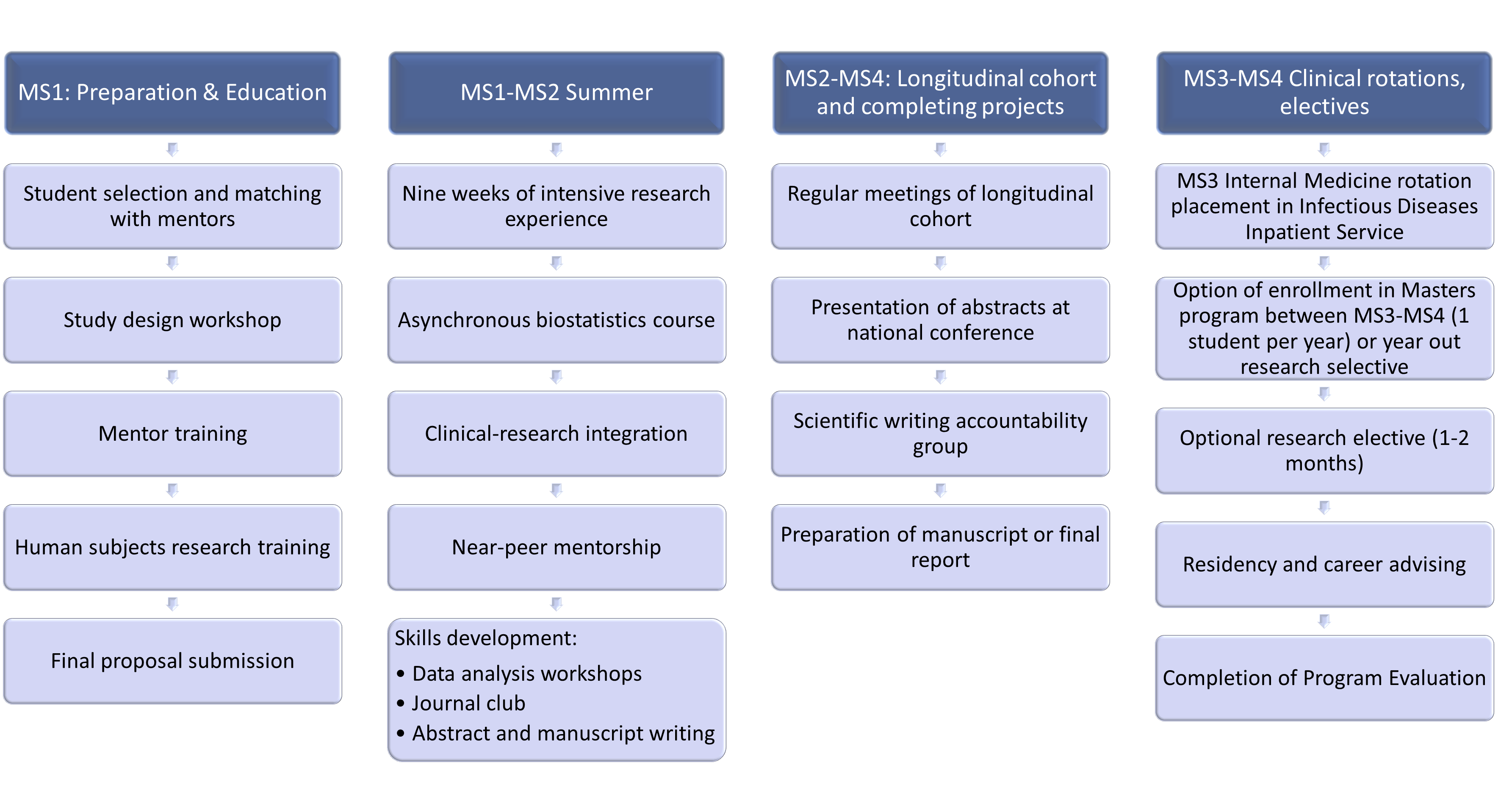
Key Student Activities – Year One
Key activities are required unless otherwise indicated.
- Fall
- Apply to M4I program
See Application Process for more details
- Apply to M4I program
- Spring
- Match with a mentor
- Develop and submit a research project proposal
- Other research training as applicable (e.g. human subjects research training)
- Complete UMB Graduate School Non-Degree Application
fees paid for by program
- This is required to take the biostats course in the summer
- This is required to take the biostats course in the summer
- Summer
- 9 weeks of intensive research experience, including clinical integration
stipend provided by program - Participate in virtual biostats course
tuition and fees paid for by program - Near-peer mentorship
- Additional skills development
- (Optional) Participation in OSR Summer Programming
- Presentation at the annual summer Student Research Forum
- 9 weeks of intensive research experience, including clinical integration
Year 1 Milestones*
Spring-Summer 2026 Milestones*
*Dates & deadlines are subject to change
.png)
Key Student Activities – Years Two to Four
MS2-MS4 students should complete the M4I Interest Form to stay up to date on developing opportunities.
- Access to additional infectious disease research mentors and projects
- Option to participate in an online biostats course
tuition and fees paid for by program - Priority clinical placement in Internal Medicine or Pediatric Infectious Diseases Service
- Participation in our scientific writing accountability group (SWAG)
- Participation in cohort meetings and near-peer mentorship opportunities
- Career and residency advising
Summer 2025 - Research Project Titles
- Antibody Cross-Reactivity Among Plasmodium falciparum Strains
- The Association Between Maternal Mental Health and Child Executive Function Among Children Who Are HIV Exposed and Uninfected
- A Comparison of Various MRI Acquisition Methods for Visualization of MRI Findings Critical to the New Multiple Sclerosis Diagnostic Criteria
- Continuum of Care in Hospitalized Patients with Opioid or Stimulant Use Disorder and Infectious Complications of Drug Use - NavSTAR, TAU, Addiction/ID Integrated Clinic to Prevent Infection Related Readmission (CHOICE-STAR)
- Emerging Clinical Patterns Among Young Adults Living With HIV
- Estrogen Modulation of Inflammatory Cytokine Responses in Human and Baboon Placental Cultures
- Identification of Parasite Targets of Whole-Organism Vaccination through Whole Genome Sieve Analysis, Using Plasmodium falciparum Isolates from a Field Trial of a Sporozoite-based Vaccine in Gabon
- The Impact of Structured Provider Education on HIV Pre-Exposure Prophylaxis Delivery in a Pediatric Primary Care Office
- Reprogramming Human Liver Cancer Tumor Microenvironment (TME) by uniSTING LNP to Improve Anti-PD1 Immunotherapy Response In Humanized Immune/Tumor (HIT) Mice
- Testing Camera Effectiveness to Study Red Zone Personal Protective Equipment Precautions
- Time to Patent Bloodstream Infection for Males Versus Females in Controlled Human Malaria Infection at the University of Maryland