Core Leaders
Li-Qun Zhang, PhD
Phone: 410-706-2145
Email: l-zhang@som.umaryland.edu
Kellly Westlake, PhD, MSc, PT
Phone: 410-706-5919
Email: kwestlake@som.umaryland.edu
Co-Investigators
Vicki Gray, MPT, PhD
Phone: 410-706-3778
Email: vicki.gray@som.umaryland.edu
Shari Waldstein, PhD
Phone: 410-455-2374
Email: waldstei@umbc.edu
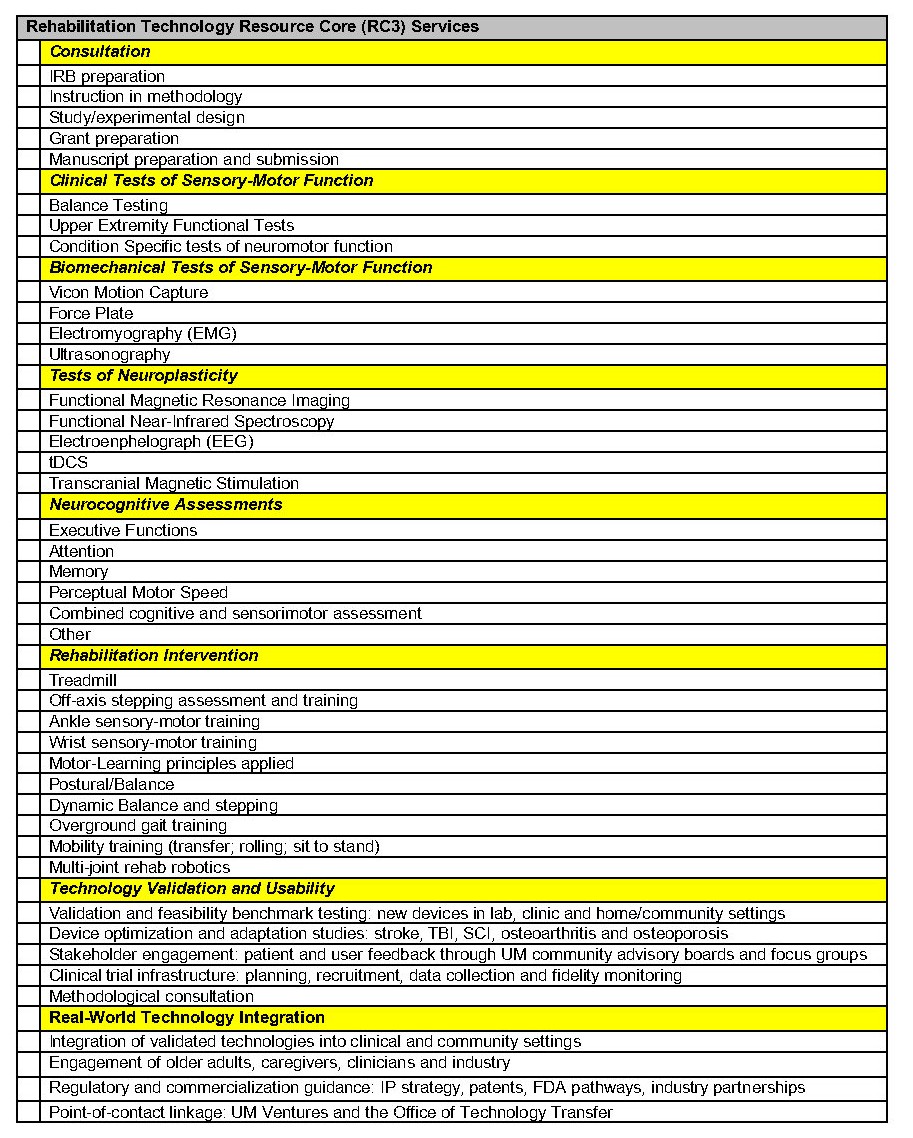
Older adults face growing risks of disability and loss of independence from the combined effects of aging-related physical impairments, inactivity, and chronic conditions or acute trauma such as stroke, Parkinson’s disease, hip fracture, arthritis, and cognitive impairment. These conditions accelerate progressive, multi‑system decline across neuromotor, musculoskeletal, and cognitive domains, resulting in functional limitations that diminish quality of life and increase health care burden. Mechanistically informed interventions targeting neuroplasticity, motor learning, and sensorimotor function can mitigate these declines, but their translation into clinical and community practice remains limited. The Rehabilitation Technology Resource Core (RC‑3) directly addresses these barriers by serving as the central hub linking mechanistic research with technology-enabled rehabilitation design, adaptation, validation, and real-world implementation.
The central hypothesis of RC-3 is that leveraging mechanistic insights and advanced multi-domain assessments, in combination with collaborative technology development, will enable the design, validation, and implementation of precision rehabilitation solutions that enhance recovery, restore function, and preserve independence in older adults with functional decline and disability and will be accomplished through the following Specific Aims:
- Advance mechanistic discovery in neuromotor, musculoskeletal and cognitive domains to guide precision, technology-enabled rehabilitation assessment and interventions.
- Accelerate the development, adaptation, validation, and readiness for adoption and implementation of mechanistically informed rehabilitation technologies.
- Foster investigator success through cross core collaboration and multidisciplinary expertise for high impact mechanistic, technological, and clinical rehabilitation research.
By integrating mechanistic discovery, technology development and adaptation, and comprehensive support for UM-OAIC investigators and scholars, RC-3 serves as both a driver and enabler of rehabilitation research and development. Through cross-core collaboration, stakeholder engagement, and targeted mentorship, RC-3 will deliver evidence-based, mechanistically grounded solutions that address the multisystem causes of late-life disability and accelerate their adoption in clinical and community settings, ultimately improving function, independence, and quality of life for older adults.