Core Leaders
Michelle Shardell, PhD
Phone: 410-706-1841
E-mail: mshardell@som.umaryland.edu
Roazlina McCoy, MD, MS
Phone: 410-706-7167
Email: Rozalina.McCoy@som.umaryland.edu
Co-Investigators
John Sorkin, MD, PhD
Email: jsorkin@som.umaryland.edu
Alan Rathbun, PhD, MPH
Email: arathbun@som.umaryland.edu
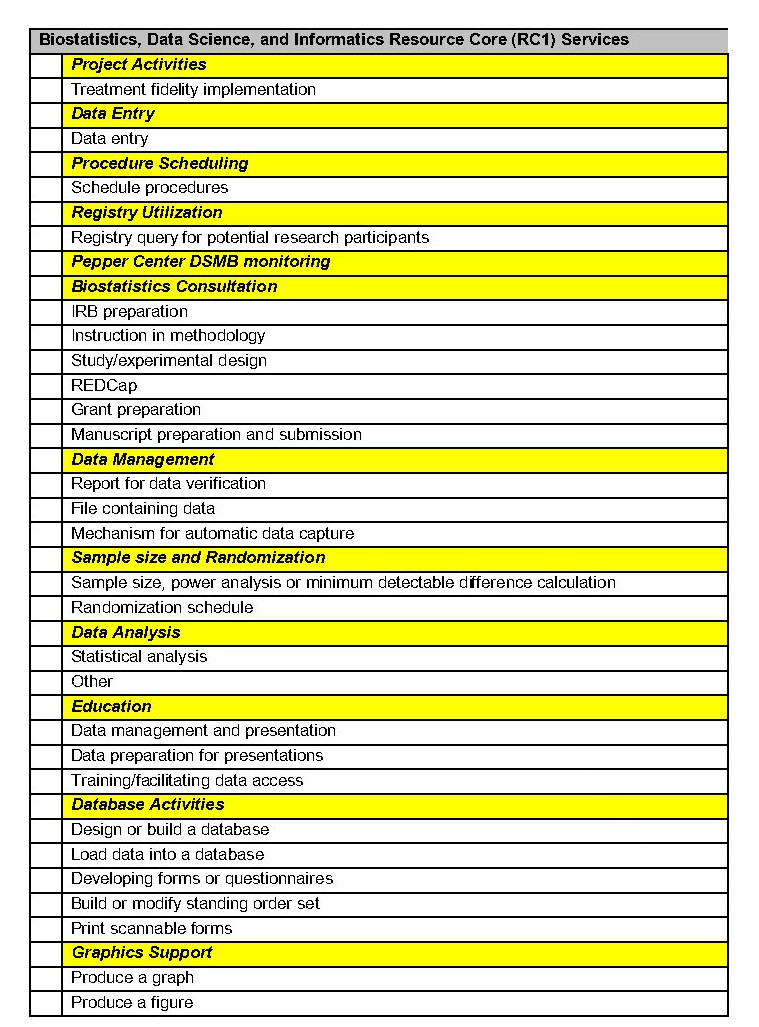
The Biostatics, Data Science and Informatics Core has been an important part of the UM-OAIC since its inception as the core continues to innovate and evolve to meet the needs of the UM-OAIC investigators, REC Scholars, pilot awardees, and other UMB scientists who conduct impactful research in enablement and aging. plays a central role in UM-OAIC research helping investigators design, conduct, and report results of research studies. RC-1 plays a key role in the coordination and integration of UM-OAIC. RC-1 both collaborates with UM-OAIC investigators by contributing to the design, conduct, data analysis, and reporting of results and develops innovative methods to overcome methodologic gaps and strengthen UM-OAIC research. As a result, the UM-OAIC theme of enablement and independence of older adults with disabling conditions informs RC-1 innovations at the nexus of aging, data science, and informatics research.
RC-1 has two major goals to: 1) support the conduct of studies that promote the independence of older adults with disabling conditions and 2) train the next generation of investigators who will conduct studies that promote health and independence in older adults. These goals are intertwined and motivate our Specific Aims.
Support studies designed to promote enablement, recovery, and functional independence
- Study design: sample size calculations, randomization schemes and statistical analysis plans.
- Informatics.
- Modern data analysis and interpretation.
Train investigators, and promote transparency, rigor, and reproducibility in research
- Train investigators via seminars, workshops and one-on-one training and mentoring.
- Promote transparency, rigor, and reproducibility (TR&R) in enablement research.
Develop and disseminate new statistical and data science methods and software to overcome challenges and propel research on enablement, recovery, and functional independence in older adults.