
What is a Medical Dosimetrist?
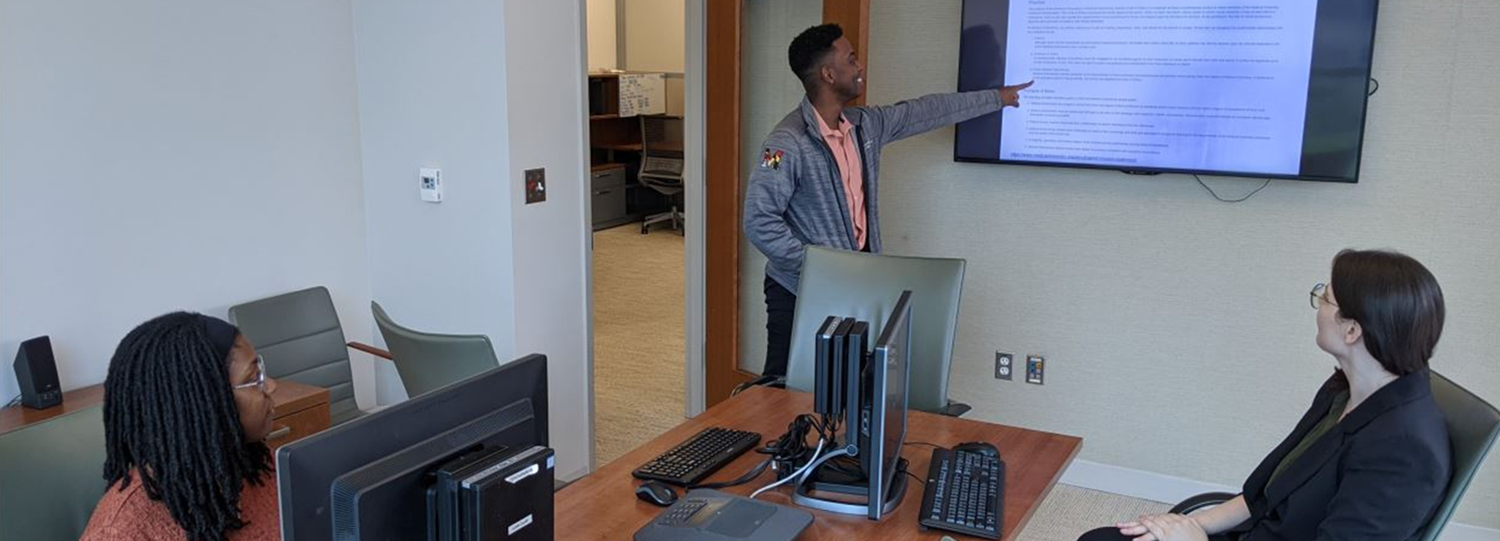
 Medical dosimetry is the subspecialty of radiation oncology that focuses on treatment planning, dose measurement, dose calculations and quality assurance for radiotherapy treatments designed to treat cancer. The medical dosimetrist is an integral member of the treatment team which includes radiation oncologists, medical physicists, and radiation therapists/ or radiotherapy technologists.
Under the direction of the radiation oncologist and the medical physicist, the dosimetrist determines the beam arrangements, shapes, weights, and energies which will provide the highest-quality treatment plan. The dosimetrist also contributes to quality assurance and to the construction of special treatment devices. In addition, the medical dosimetrist plays an important role in brachytherapy procedures, providing technical assistance and completing any necessary calculations.
Applying to the Program
Our application cycle opens on October 1 and closes on December 1 for a start date of July 1 of the following year. Individuals interested in applying to our program may download the required Application Form and Reference Form, and submit both completed documents, a statement of interest, and final official transcripts prior to the deadline to be considered for admission. Prospective applicants may also find extensive information about our program in the Program Handbook, however note that the handbook is subject to changes each year.
Degree Requirements
Applicants must:
a. Hold a Bachelor of Science or Applied Science in any field, or a Bachelor of Arts in Physics/Chemistry/Biology, with a minimum overall GPA of 3.0;
or
b. Be a graduate of an accredited radiation therapy program and hold a bachelor’s degree with a minimum overall GPA of 3.0.
Required Prerequisite Courses
Prerequisite courses require a minimum GPA of 3.0, or a grade of B or higher. All applicants must have completed post-secondary instruction from an accredited institution in the following areas:
| Prerequisite course | Credits minimum | Helpful Notes |
|---|---|---|
| Precalculus or equivalent | 3.0 | Basic mathematics to include: · Algebra · Trigonometry · Intro to Calculus |
| Physics I* | 3.0 |
*Radiation Physics meets this requirement |
| Physics II* | 3.0 | |
|
Biology |
3.0 |
n/a |
| Anatomy and Physiology I | 4.0 | Lab preferred |
| Anatomy and Physiology II | 4.0 | Lab preferred |
| Oral and Written Communication | 3.0 | Suggested oral and written courses (any of the below/ or similar): · English 101 · Literature 101 · Writing 101 |
Recommended Courses
The following courses are recommended, but not required, to help prepare for the interview and selection process:
| Recommended courses | Recommended credits | Helpful notes |
|---|---|---|
| Medical Terminology | 3.0 | Graduates of an accredited radiation therapy or medical imaging program are not required to take this course separately |
| Computer Basics | 3.0 | To include: · Introduction to computers and operating systems · Enterprise systems and Security · Practical software applications |
About the University of Maryland Medical Dosimetry Certificate Program
History of the Program & Accreditation
 The University of Maryland Medical Center Dosimetry Program is accredited by the Joint Review Committee on Education in Radiologic Technology (JRCERT).
JRCERT
20 North Wacker Drive
Suite 2850
Chicago, IL 60606-3182
312-704-5300
mail@jrcert.org
The program’s current award is for eight years. General program accreditation information and the current accreditation award letter can be found here on our program's page within the JRCERT website.
Accreditation of our program has been effective since May 10, 2007. In 2018, our program was re-accredited by the JRCERT for a total of eight years, until the second quarter of 2026. The program successfully completed its interim review in 2022.
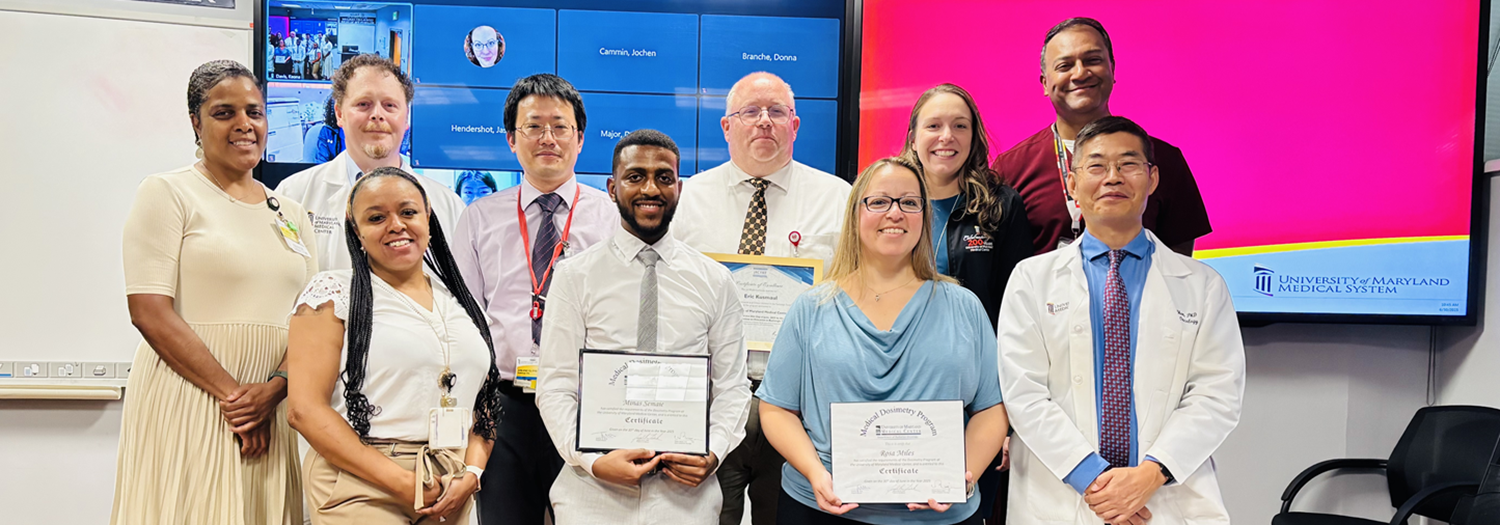
The Department of Radiation Oncology, under the auspices of the University of Maryland Medical Center, opened the School of Medical Dosimetry in 2001. As of 2025, the University of Maryland program has celebrated 54 dosimetry graduates, and is one of only 17 accredited programs in the United States. Students of this program are University of Maryland Medical Center dosimetry trainees, not students of the University of Maryland. Our one-year program combines an extensive curriculum with hands-on training to prepare our students for a career in medical dosimetry.
Program Effectiveness Data
Access the University of Maryland Medical Dosimetry Certificate Program's most recent Program Effectiveness Data document here.
For more information or to view the published program effectiveness data, visit our program page on the JRCERT website.
Mission Statement
To provide world-class education and training in medical dosimetry and produce competent dosimetrists who serve the needs of the community through the treatment of patients with radiation
Curriculum and Program Handbook
For information on the program including its curriculum, download the Dosimetry Program Handbook.
Our program provides each graduate who completes all courses a certificate of completion. We are not a degree-granting program. Therefore, the dosimetry program is not presently recognized as a degree-granting higher education organization, or branch of such, by student loan managing agencies.
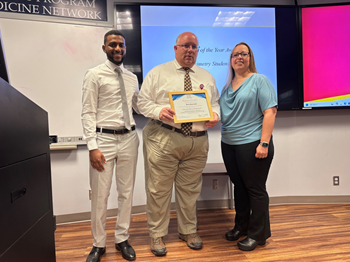 Course credits from our medical dosimetry program cannot be counted towards a higher education degree from a higher education organization, nor can credits from other programs be counted by our program. However, to demonstrate our commitment to educational excellence, the University of Maryland Medical Center's School of Medical Dosimetry was previously recognized by the Medical Dosimetry Certification Board (MDCB), and is presently accredited by the Joint Review Committee on Education in Radiologic Technology (JRCERT).
JRCERT accreditation is part of the eligibility requirements by the MDCB and our program fulfills this requirement. However, the applicant, student, or graduate is urged to contact the MDCB with questions of eligibility at any time.
Goals and Outcomes
Goals and Outcomes
Goal 1: Students will graduate as clinically competent dosimetrists.
Student Learning Outcomes:
- Students will be able to design usable plans for external beam radiotherapy including 3D conformal radiotherapy and intensity modulated radiotherapy.
- Students will be able to demonstrate an understanding of image-guided radiation therapy as it applies to planning and treatment.
Goal 2: Students will demonstrate the critical thinking skills required for medical dosimetry.
Student Learning Outcomes:
- Students will demonstrate an understanding of the physics and radiobiology of radiation therapy.
- Students will be able to sufficiently respond to questions from staff dosimetrists, physicists, and physicians regarding their treatment plans.
Goal 3: Students will effectively communicate within an interdisciplinary radiation oncology team.
Student Learning Outcomes:
- Students will effectively communicate with doctors, physicists, and dosimetrists.
- Students will display effective oral communication skills.
- Students will display effective written communication skills.
Goal 4: Students will conduct themselves in a professional manner and practice the ideals of professional growth and lifelong learning.
Student Learning Outcomes:
- Graduates will demonstrate lifelong learning.
- Students will conduct themselves in a professional manner.
Goal 5: Students will graduate as entry-level dosimetrists.
Student Learning Outcomes:
- Students will obtain a job in the field of medical dosimetry.
- Students will take the CMD board examination within one year of graduation.
- Students will feel prepared to enter the workforce as an entry-level dosimetrist.
- Students will complete the program within 12 months.
- Students will pass their CMD board exams within two years of graduation.
- Employers will be satisfied with the performance of graduates.
Information for Prospective Applicants and Current Students
Information for Prospective Applicants and Current Students
Admission Policies
The University of Maryland Medical Center is actively committed to providing equal educational and employment opportunities within all of its programs. We aim to recruit and support employees from a wide range of backgrounds and experiences, while providing an engaging, inclusive, and welcoming learning environment for all.
Our program’s admission policy is designed to find the best match of student interest, achievement, and ability with our own program's objectives, goals, and plans of assessment and development. We do not favor any particular group(s) of people over others. We consider applicants who are best suited to enter the program based on their academic excellence, interest in our program, and professional commitment and achievement. Such metrics are evaluated from the applications submitted, the recommendation letters, and the applicants' performance during interviews.
We provide equal consideration and opportunities to all employees and applicants in accordance with applicable federal, state, and local laws and regulations. For further information, visit the UMMC jobs website.
Credit Transfer
The UMMC Medical Dosimetry Program is not a degree-granting higher education organization. Hence, we do accept transfer of credits or provide credits that can be transferred to higher education organizations for degrees granted by those institutions.
Appeal Process
Students are expected to be in good standing in the program to continue employment and complete the one-year program. Good standing includes non-complaint of behavioral or professional misconduct. Complaints are resolved through an appeal process. The appeal process is only available to full-time employees of UMMC after an initial six-week probationary period, which starts on the first day of employment. The guidelines and regulations of the appeal process are set by the policies governing employees of UMMC. The appeal process is part of a due process procedure. Due process procedures provide students with an unbiased avenue to pursue complaints or grievances and the opportunity to be heard in a timely manner. The appeal process is available to students after their initial probationary period as hospital employees.
Information for non-U.S. nationals and non-permanent-US residents
Student visas, working visas, or work permits are not sponsored by our program on behalf of applicants who are not permanent residents or citizens of the U.S.
Additional Resources for Current Students of the School of Medical Dosimetry
You may learn about policies for timely resolution of complaints by accessing the employee handbook within our hospital system intranet (accessible only to employees and students of our program). This webpage is essentially your portal to hospital employee services.
Allegations of non-compliance with educational standards can be forwarded to the director of the program, or to hospital administration. Questions about our curriculum; admission policies, transfer of credits, tuition and fees, refund policies, academic calendars, academic policies, graduation requirements, student services not answered in this webpage, or our handbook can be obtained by contacting the program director.
Frequently Asked Questions (FAQs) About the Program
Exploring whether this program fits your goals
1. What Does the Program Offer?
The program prepares qualified applicants for a career in medical dosimetry. Graduates of our medical dosimetry program are eligible for national certification by the Medical Dosimetry Certification Board.
Up to four students are accepted into the program each year, depending on program funding. This ensures that each student receives ample personal attention and can work closely with our dosimetrists and physicists.
2. How Long is the Program?
Our medical dosimetry program is 12 months long. It starts July 1 and ends June 30 of the following year.
3. What Does the Program Offer?
- Provide an education that facilitates the mastery of entry-level dosimetry skills through didactic and clinical experiences.
- Provide an orientation to the range of health care settings in which dosimetrists practice.
- Foster continued development of critical thinking, analysis, and problem solving.
- Promote a commitment to community and professional service.
4. How is the department situated and how is it staffed?
The University of Maryland Department of Radiation Oncology has seven locations:
- University of Maryland Medical Center in Baltimore, MD
- Central Maryland Radiation Oncology in Columbia, MD
- Tate Cancer Center at UM Baltimore Washington Medical Center in Glen Burnie, MD
- UM Upper Chesapeake Health Kaufman Cancer Center in Bel Air, MD
- Maryland Proton Treatment Center in Baltimore, MD
- Requard Radiation Oncology Center at UM Shore Regional Health in Easton, MD
- Radiation Oncology at the UM Capital Region Health Cancer Center in Largo, MD
Each site is staffed with University of Maryland faculty. This affiliation opens the door to leading-edge treatment modalities, cutting-edge clinical trials and expert consultation with University of Maryland Greenebaum Comprehensive Cancer Center physicians.
In 2015, the University of Maryland School of Medicine announced the opening of the Maryland Proton Treatment Center (MPTC). This center was the first in the region to offer proton therapy, a highly advanced and precise form of radiation, to treat cancer. MPTC offers the most advanced form of proton therapy in the world, called pencil beam scanning. This technique is highly effective for a wide variety of solid, localized tumors in adults and children. Visit the MPTC website to learn more.
As a part of their clinical practicum, students rotate through the University of Maryland Medical Center (sponsoring location/primary site), the Maryland Proton Treatment Center, Central Maryland Radiation Oncology, and the Tate Cancer Center at UM Baltimore Washington Medical Center.
5. What does the curriculum include?
The curriculum includes didactic lectures, laboratory exercises, and clinical instruction. Information on our curriculum is provided in our Program Handbook.
6. Are students of your program considered students of the University of Maryland?
No. Under the contract provided to each student, a student joins our organization as a hospital employee (dosimetry trainee) of the University of Maryland Medical Center. Students are not students of the University of Maryland. Instead, students receive a certificate of completion from the medical dosimetry program. We do not grant a higher education degree. As a result, students cannot carry credits over to other programs that yield degrees from higher education organizations. For example, the time spent at the dosimetry program in our department cannot be carried over to credit a bachelor's, master's, associate, or doctoral degree from the University of Maryland.
7. Where can I obtain more information about medical dosimetry?
8. Can I request a virtual or in-person meeting to discuss the program?
At this time, we are unable to accommodate individual meetings. We kindly encourage you to explore our program website, where you’ll find detailed and current information about our curriculum, admissions requirements, and deadlines.
9. Is your medical dosimetry program offered online? If not, is it possible to enroll in the program and complete the clinical training at an institution outside of your system?
Our program is not offered online. All classes, labs, clinical trainings, and research activities take place at our clinical sites within the University of Maryland Medical System. We cannot partner with outside institutions at this time.
10. Is there a cost for this program, or do you offer financial aid?
Please refer to the “Tuition & Finances” section our Program Handbook, available under the “Curriculum and Program Handbook” section of our website. Note that the tuition and stipend are both subject to change annually based on program funding.
Application FAQs
Eligibility and how to apply
11. When is my application/ evaluation and transcript reviewed?
As a hospital-based program, we do not have a dedicated admissions office. Course completion/qualification, transcripts, and other application materials are reviewed only once per year by the selection committee after the December 1 application deadline upon receipt of the complete application package.
12. Can students with an associate degree apply to the program?
No, the MDCB requires a bachelor’s degree to be eligible for the dosimetry board exam. We do not accept applications from candidates who hold only an associate degree.
13. Are international candidates eligible to apply to the program?
Please see Information for Non-U.S. Nationals and Non-Permanent-U.S. Residents under the Information for Prospective Applicants and Current Students section. Please note we are not able to sponsor visas.
14. Is the ARRT certification required to be eligible to apply to the program?
No.
15. Does the program accept ACE credit courses?
No. Prerequisite course credit is limited to courses taken at an accredited academic institution, to ensure the rigor and consistency of the course material.
16. Could you recommend any accredited schools or specific courses that would fulfill the prerequisite requirements?
No. Prerequisites meeting the published requirements would be accepted from any accredited school. Ensuring that courses meet the requirements is the sole responsibility of the applicant. Please see the table in the Applying to the Program section.
17. Should the official transcripts be sent directly from the academic institution?
Yes. We accept official transcripts either sent directly from the institution or submitted by the applicant, provided they arrive in a sealed envelope with the registrar’s signature or stamp across the seal.
18. Should the letters of recommendation be sent directly from references?
Yes.
19. Would it be possible for me to submit my application materials in person?
No. All application materials must be mailed during the application open window. Our trainee program is embedded in an active radiation oncology department, and we do not have the capacity to accept materials in person.
20. Do I need shadowing experience?
Shadowing experience is not required and is not an evaluation factor for the interview, but having a good basic knowledge of medical dosimetry is important and can help you demonstrate readiness for the program. Radiation oncology departments are generally very open to shadowing for those who are interested in joining our discipline. Feel free to seek out a center close to your home to set up shadowing opportunities. Job shadowing is not required for applications and will not affect the selection process.
21. Am I eligible to apply if some of the prerequisite courses or my bachelor’s degree will still be in progress by the application deadline?
Yes, you are eligible to apply if classes are currently in progress at the time of application. Proof of enrollment in course needs to be provided in the application along with anticipated completion date. If selected, you will need to provide proof of completion prior to admission.
Interview and Post-Interview FAQs
What to expect during the interview and next steps
22. Can the selection committee provide personalized feedback during candidate interviews?
We cannot provide personalized feedback. However, being selected for an interview indicates you were a strong candidate.
23. What is the acceptance rate of your program?
Since this data is not required by JRCERT, we do not compile or publish it. Within the scope of our JRCERT accreditation we can offer up to four positions per year, with most program years limited to two positions. As a result, placement is very competitive.
24. Could you provide guidance on how I might strengthen my application to be a more competitive candidate?
No. We are not able to provide feedback on interviews. The program is highly competitive with only up to four positions being offered each year. If you are invited for an interview, it is because you are considered a competitive candidate who meets all the required criteria.
25. For reapplication, do I need to resubmit all my materials?
Yes. We require resubmission of materials to ensure the most up to date application. Candidates are evaluated for the current year’s submission to avoid any bias prior application submission. This includes recommendation letters.
Program Administration

Junliang Xu, PhD
Assistant Professor
Director, Dosimetry Training Program
Department of Radiation Oncology
University of Maryland School of Medicine

Keona Davis
Administrative Coordinator
University of Maryland
Department of Radiation Oncology
Contact
Please review the information on our website carefully, including our Program Handbook and FAQs. For additional questions regarding the program, please use the inquiry form below or email UMMC-DosimetryTraineeProgram@umm.edu, and our team will respond within one to two weeks. We kindly ask that you do not email program staff directly.