
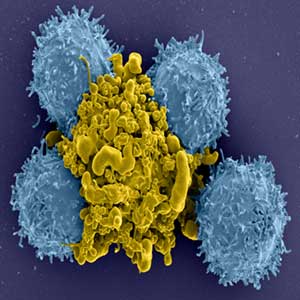
CD4 T cells (blue) interacting with an activated dendritic cell (yellow). Image courtesy of Kaveh Abdi(NIH) and Nevil Singh (UMSOM).
Our research is dedicated to understanding and harnessing the immune system to fight cancer. We take a bench-to-bedside approach, integrating fundamental immunology with cutting-edge translational research to develop innovative therapies that improve patient outcomes. We investigate key pathways that regulate early immune responses to tumors by investigating type I Interferon (IFN) signaling, OAS pathway, and the cGAS–STING axis to reveal the mechanisms by which antiviral signaling shapes tumor immunity and responses to therapy. These studies reveal how tumors evade detection and how we can reprogram the tumor microenvironment to restore immune surveillance.
We also focus on adaptive immune responses that provide targeted, durable tumor control by dissecting T cell activation, exhaustion, and memory formation in cancer. In addition, we are developing novel strategies to expand and harness natural killer T cells and other innate like lymphocytes for cancer treatment. We are engineering immune cells with chimeric antigen receptors (CAR) to selectively target tumor antigens.
Our goal is to design next-generation cellular therapies with improved efficacy and safety profiles. Our work also addresses the immune complications of bone marrow transplantation, with a focus on preventing and treating graft-versus-host disease (GVHD) and preserving the graft-versus-tumor effect critical for cancer remission. This research has direct clinical impact for patients undergoing stem cell transplant as part of their cancer therapy.