
Join Us Today!
Apply Now →Support Biomedical Discovery | Gain Research Experience | Explore Human Subject Research
The UMB BioBank is seeking motivated students to participate in a biospecimen inventory project supporting the University of Maryland School of Medicine's Amish Research Program.
This volunteer opportunity offers students a chance to contribute to an ongoing biomedical research initiative, gain practical exposure to biobanking operations, and participate in a complimentary mini-course exploring informed consent, participant protections, research oversight, and biospecimen stewardship
No previous laboratory or research experience is required.
About the Research Project
10,000+
Amish Participants
30+
Years of Research
400+
Scientific Publications
For more than 30 years, the University of Maryland School of Medicine's Amish Research Program has worked in partnership with the Amish community to advance understanding of human health, genetics, and disease.
The UMB BioBank is undertaking a biospecimen inventory initiative to support the organization, documentation, and long-term stewardship of research specimens associated with these studies.
Student volunteers will contribute to this important effort under the supervision of Dr. Gutierrez, Director of the UMB BioBank.
Learn more about the Amish Research Program
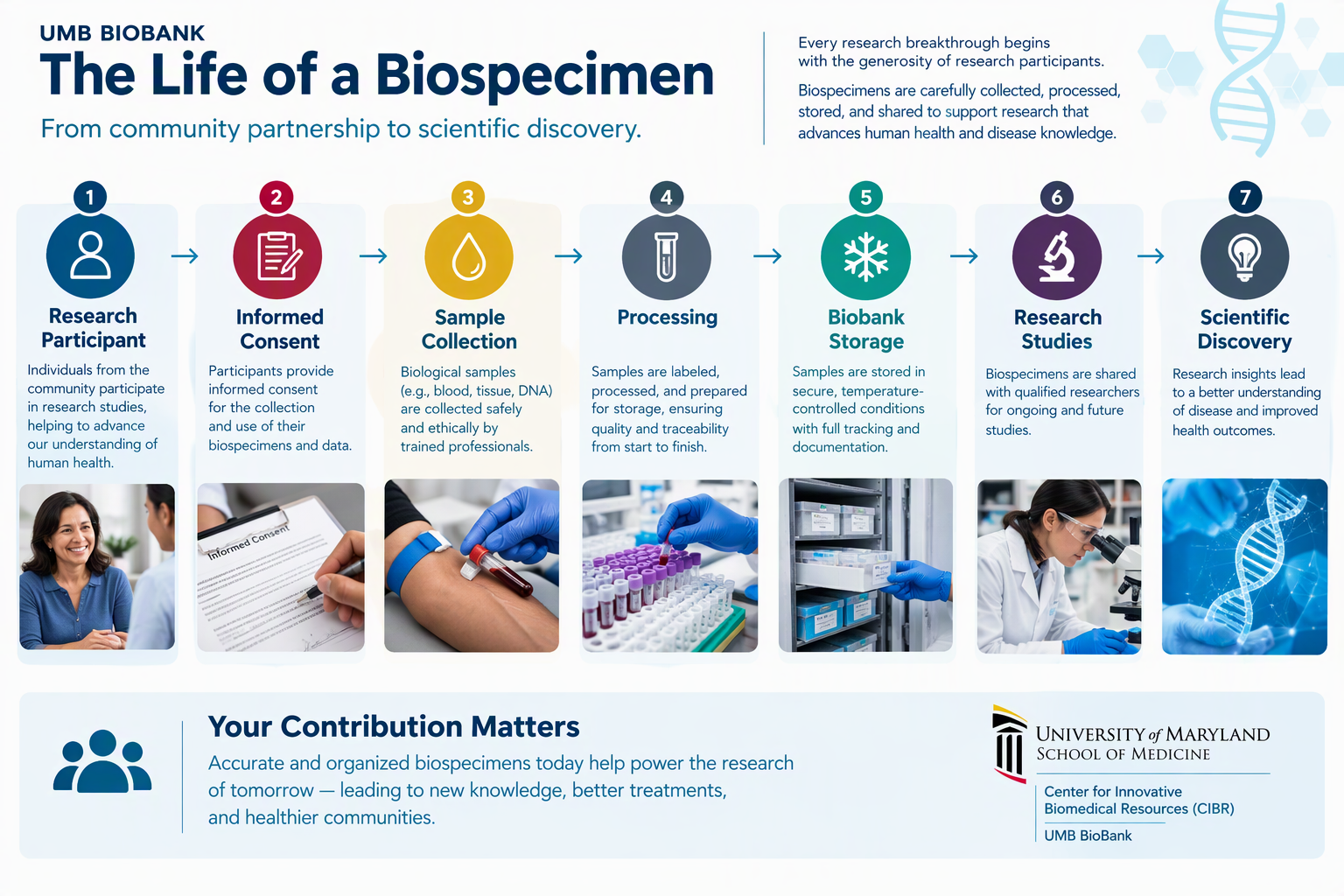
The Life of a Biospecimen
Every scientific breakthrough begins with the generosity of research participants. This infographic illustrates how biospecimens move from collection and storage to research studies and scientific discovery.
Where Do Volunteers Fit In?
The UMB BioBank is conducting a biospecimen inventory initiative to improve the organization and documentation of specimens collected through these studies.
As a volunteer, you will help ensure that biospecimens remain accurately tracked, accessible, and ready to support future research studies.
What Will You Do?
As a student volunteer, you may assist with:
-
Inventorying and organizing stored research biospecimens.
-
Verifying sample identifiers and storage locations.
-
Supporting accurate inventory records and documentation.
-
Learning about laboratory sample tracking and biobank operations.
-
Understanding how biospecimen quality and organization support scientific research.
All activities will be conducted under appropriate supervision, with required training and access permissions.
Skills You May Develop
-
Research documentation
-
Laboratory quality systems
-
Inventory management
-
Research compliance awareness
-
Scientific professionalism
What Will You Gain?
In addition to practical exposure to a biomedical research environment, participating students will be offered a complimentary four-part educational mini-course on the ethical, regulatory, and operational foundations of human-subjects research.
Depending on speaker availability, guest investigators may provide insights from population-based research studies, including research conducted with Amish communities.
From HeLa Cells to Biobanks. Ethics, Regulations, and Stewardship of Human Biospecimens Mini-Course
Overview
This four-part mini-course introduces students to the historical events, regulations, participant protections, and stewardship practices that guide modern biomedical research.
Session 1 — Introduction to Ethics and Research Ethics
Explore influential historical cases that shaped today's ethical standards and participant protections.
Session 2 — The Belmont Report, Common Rule, and Human Research Protections
Learn the principles and regulations that guide modern human-subjects research.
Session 3 — Informed Consent and Institutional Review Boards (IRBs)
Understand how participant protections are implemented in real-world research studies.
Session 4 — The Life of a Biospecimen
Follow the journey of a human biospecimen from collection and consent through processing, storage, sharing, and future research use.
Who Can Apply?
We welcome students aged 18 years and older who are interested in:
-
Biology, genetics, and biomedical sciences
-
Public health and healthcare
-
Biotechnology and laboratory sciences
-
Human subject protections, and regulatory affairs
-
Clinical and translational research