
Patient Advocacy & Industry Partnership Highlights
- Played pivotal role in the FDA advisory committee eliminating the risk evaluation and mitigation strategy program for clozapine which facilitated access to schizophrenia medication for those who need it.
- Collaborator on multiple, completed, industry-sponsored Phase 1-3 clinical studies.
- National pioneer in regulatory innovation and facilitation through a partnership with the FDA.
Behavioral Health Brochure
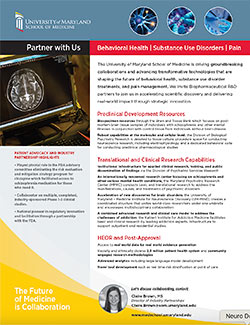
The University of Maryland School of Medicine is driving groundbreaking collaborations and advancing transformative technologies that are shaping the future of behavioral health, substance use disorder treatments, and pain management. We invite Biopharmaceutical R&D partners to join us in accelerating scientific discovery and delivering real-world impact through strategic innovation.
Preclinical Development Resources
Biospecimen resources through the Maryland Brain Connection which focuses on post-mortem brain tissue samples of individuals with schizophrenia and other mental illnesses in conjunction with control tissue from individuals without brain disease.
Robust capabilities at the molecular and cellular level: the Division of Biological Psychiatry Research is devoted to tissue culture, procedure space for conducting neuroscience research, including electrophysiology, and a dedicated behavioral suite for conducting preclinical pharmacological studies.
Translational and Clinical Research Capabilities
Institutional infrastructure for applied clinical research, training, and public dissemination of findings via the Division of Psychiatric Services Research
An internationally renowned research center focusing on schizophrenia and other serious mental health conditions, the Maryland Psychiatric Research Center (MPRC) conducts basic and translational research to address the manifestations, causes, and treatments of psychiatric disorders
Acceleration of new discoveries for brain disorders: the University of Maryland – Medicine Institute for Neuroscience Discovery (UM-MIND) creates a coordinated structure that unites world-class researchers under one umbrella and encourages multidisciplinary collaboration
A combined advanced research and clinical care model to address the challenges of addiction: the Kahlert Institute for Addiction Medicine facilitates basic and clinical research by leading addiction experts. Infrastructure to support outpatient and residential studies.
HEOR and Post-Approval
Access to real world data for real world evidence generation
Racially and ethnically diverse 2.3 million patient health system and community engaged research methodologies
Advanced analytics including large language model development
Novel tool development such as real time risk stratification at point of care
Let’s discuss collaborating, contact:
Claire Brown, MS
Director of Industry Partnerships
Claire.Brown@som.umaryland.edu