
CONTACT
David J. Weber, PhD
Director
dweber@som.umaryland.edu
Kristen M. Varney, PhD
NMR Center Director
Structural Biology (SB) NMR
KVarney@som.umaryland.edu
Jonathan Fay, PhD
Protein Engineering & Biophysics (PEB)
jfay@som.umaryland.edu
Gerald Wilson, PhD
Target Validation & Screening (TVS)
gwilson@som.umaryland.edu
Vincent Njar, PhD
Medicinal Chemistry (MC)
vnjar@som.umaryland.edu
Alex Mackerell, PhD
Computer-Aided Drug Design (CADD)
amackerell@rx.umaryland.edu
Rena Lapidus, PhD
In vivo Biology & Drug Testing (IVBDT)
rlapidus@som.umaryland.edu
Scott Devine, PhD
Genomics & Bioinformatics (GB)
sdevine@som.umaryland.edu
LOCATION:
Baltimore, MD 21201
HOURS:
Monday through Friday
9:00am - 5:00pm
PHONE:
Office: (410) 706-2110
MISSION:
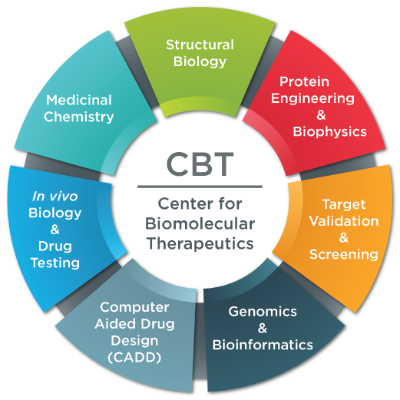
The Center for Biomolecular Therapeutics (CBT) is comprised of and serves faculty from the University of Maryland, Baltimore (including the Schools of Medicine & Pharmacy), the University of Maryland College Park, the University of Maryland, Baltimore County, the Institute of Bioscience and Biotechnology Research, and several other Universities within the USM. The goal of the CBT is to do state-of-the-art nationally funded research with a team science approach that focuses on basic science leading to therapeutic development. Toward this goal, important biomolecules and biological pathways are considered to aggressively target with chemical or biological molecules, and these reagents are developed further, so they can be tested in the clinic.
Keys to CBT’s Success:
- Promote a top-quality entrepreneurial scientific environment and contribute to the development of diagnostics and therapeutics.
- Collaborate with research and clinical faculty across all USM campuses to identify important biological targets.
- Enhance the educational expertise across USM surrounding the discovery-to-commercialization “pipeline”, including regulatory and business expertise, by creating a program of visiting faculty scientists and postdoctoral fellows.
- Interact with the biotechnology and pharmaceutical industries to help maintain CBT’s focus on the most biomedically and commercially important targets, diagnostics, and therapeutics.
Sections
Protein Engineering & Biophysics (PEB)
Provides expertise and assistance in producing purified proteins for investigators, including those needed for advanced uses in other CBT sections (i.e. Structural Biology (SB) and Target Validation & Screening (TVS)).
Capabilities
- Protein expression from a variety of expression systems
- Bacteria
- Yeast
- Baculovirus
- Mammalian
- Uniform stable isotope labeling (2H,13C,15N,19F) and selective methyl labeling of proteins for NMR
- Purification of tagged and untagged proteins using HPLC/FPLC techniques
- Characterization of proteins
- Stability
- Structure/dynamic properties
- Size
- Biophysical characterization (SDS-PAGE, FPLC, isothermal calorimetry (ITC)), differential scanning calorimetry (DSC), circular dichroism (CD), fluorescence, UV/Vis, DLS, analytical ultracentrifugation (AUC), kinetic stop-flow/quench-flow, and surface plasmon resonance (SPR) techniques.
Structural Biology (SB)
CryoEM, NMR, and X-ray crystallography provide users a suite of complementary structural biology approaches to determine three-dimensional structures and elucidate dynamic properties of proteins, protein complexes, and other macromolecules.
Capabilities
CryoEM
- Talos Arctica 200kV microscope equipped with DE Apollo electron detector and Dectris SINGLA detector
- ThermoFisher Scientific Glacios 200kV microscope equipped with Falcon4i direct electron detector and Selectris energy filters
- Sample prep labs (IBBR, Rockville/UMB, Baltimore) feature 5 grid freezing robots (Vitrobot Mark IV (2), Gatan Cryoplunge, and SPT Chameleon) and auxiliary equipment
- Computational infrastructure (40x GPU cluster, 900Tb storage that is 5-fold expandable on a 10Gb network)
NMR
- Bruker Avance III HD Ascend 400 MHz, with a SampleCase 24 automatic sample changer (IBBR, Rockville)
- Bruker Avance III 600 MHz, with a TCI cryogenic probe and 19F data collection capability (UMB)
- Bruker Avance III 800 MHz, with a TCI cryogenic probe and a BACS 60 automatic sample changer (UMB)
- Bruker Avance III 950 MHz, with a TCI cryogenic probe (UMB)
X-ray Crystallography
- Crystallization robots available in several locations
- TTP Labtech Mosquito with LCP option/Formulatrix UV RockImager (Rockville)
- Art Robbins Hydra/Douglas Oryx Nano (IHV/SOP/UMB)
- Oryx8 Protein Crystallization Robot (UMB)
- Spectrolight 610 Dynamic Light Scattering
- Data collection done at synchrotron facilities (SSRL/ALS/APS/BNL, multiple investigators sharing beamtime)
Target Validation & Screening (TVS)
Cell and molecular biology techniques are used to identify therapeutic targets and develop assays for chemical perturbagens as a step towards generating new drugs and therapies.
Capabilities
Libraries
Over 200,000 small drug-like compounds in a number of libraries, including:
- Chemical Diversity Labs-- Three non-overlapping diversity libraries (ChemDiv 40K, ChemDiv 55K, ChemDiv 100K) in a 384-well format, each at 10 mM in 100% DMSO.
- Maybridge HitFinder-- Collection of 14,400 drug-like compounds from Maybridge, preselected by the supplier (ThermoFisher), each at 10 mM in 100% DMSO.
- Maybridge Ro3 Fragment-- Collection of 1,000 fragments, meeting Rule-of-3 compliance, with exceptional diversity and having chemically linkable analogs. Guarantees solubility of the compounds @ 200 mM in DMSO.
- MicroSource Spectrum-- Collection of 2,060 compounds, 50% drugs, 30% natural products, and 20% other bioactive components available in a 96-well format, each at 10 mM in 100% DMSO.
- The Prestwick Collection-- A small library of 1,520 FDA (Federal Drug Administration), EMA (European Medicines Agency), and JAN (Japanese Accepted Name)-approved drugs and is designed with a large chemical and pharmacological diversity.
- NIH Clinical Collection-- Collection of 727 small-molecules that have a history of use in clinical trials.
- SBi Collection-- Collection of 4,381 compounds collected from several commercial sources plus 67 compounds synthesized in house.
- SelleckChem FDA Anticancer Library -- A collection of 1,789 FDA-approved compounds indicated for cancer therapy.
Instrumentation
- Liquid handling and plate reading instruments
- Biomek i7, Biomek i5, Biomek FX, and Biomek NxP
- BMG CLARIOstar, BMG CLARIOstar Plus, and BMG PHERAStar FS
- Other equipment such as biosafety cabinets, CO2 incubators, an inverted phase microscope, low speed centrifuges, and dedicated liquid nitrogen storage freezers
Assay Development
- in vitro protein-protein, protein-RNA, and protein-DNA assays
- Fluorescence polarization competition assays
- FRET and TR-FRET
- AlphaScreens
- Cell-based assays for screening small, drug-like compounds
- Mammalian cell viability
- Chemiluminescence gene reporter assays
- Yeast and bacterial growth
- Cell-based ELISAs
Medicinal Chemistry (MC)
Discovering and developing new drugs for improving human health.
Instrumentation
- 400 MHz Bruker Ascend walk-up NMR
- LC/MS and LC/MS/MS
- Milestone START microwave synthesizer
- Fully automated HPLC systems (analytical and preparative)
- CombiFlash Rf-200 automated Flash Chromatography System
- Autopol III – dual wavelength automatic polarimeter
- Perkin Elmer 1600 FTIR Infrared spectrometer
- High-resolution mass spectrophotometer (MS/HRMS)
Services
- Hit-to-lead medicinal chemistry
- Synthesis of research and proprietary compounds
- Rational design and synthesis of new molecules
- Lead optimization employing SAR
- Medicinal chemistry strategies to achieve superior ADMET properties
Computer-Aided Drug Design (CADD)
The CBT works with the UMB School of Pharmacy to provide computational approaches to speed drug discovery and design.
CADD Center Website
In vivo Biology & Drug Testing (IVBDT)
The CBT works with the UMB Translational Laboratory Shared Resource (TLSR) for in vivo pre-clinical evaluation of chemical probes and lead compounds from drug discovery efforts, as well as diagnostics.
TLSR Website
Genomics & Bioinformatics (GB)
The CBT works directly with the Institute for Genome Sciences (IGS) to generate high quality genomic data and genome annotation/analysis.