
Innate Immune Signaling Pathways
In biology, the term "signaling" refers to the communication process within an organism or cell. We are interested in the details of the communication mechanisms involved in Innate Immunity — starting with the recognition of foreign component to the response generated either by gene expression or by other cellular changes.
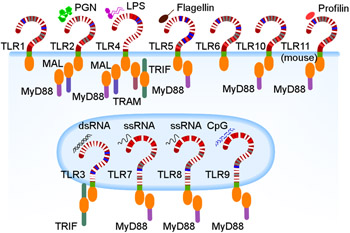 Activation of innate immune receptors with their respective ligands turns on a set of genes mainly via the NF-kB and/or IRF (Interferon Regulatory Factor) family of transcription factors. TLRs are integral membrane glycoproteins (type I) characterized by extracellular domains containing varying number of leucine-rich-repeat (LRR) motifs and a cytoplasmic signaling domain TIR (Toll/IL-1R homology) domain.
By forming either homo- or heterodimer with another TLR, they recognize conserved molecular patterns primarily found in invading microorganisms. For example, TLR4 homodimers, present on the plasma membrane, recognize lipopolysaccharides (LPS) from Gram-negative bacteria. TLR2, along with either TLR6 or TLR1 recognize lipopeptides from Mycoplasma or mycobacteria. Curiously, nucleic acids sensing TLRs, (TLR3, TLR7, TLR8 and TLR9) reside in intracellular membranes as opposed to plasma membrane where most microbial cell wall components are recognized by other TLRs.
Upon binding to the ligand, TLRs help to assemble a signaling complex in the cytoplasm composed of several adaptor proteins. These signaling complexes, through a cascade of events, lead to the activation of kinases. These kinases either directly phosphorylate to activate the transcription factors (e.g. IRFs, c-Jun), or help release transcription factors from inhibitory complexes (e.g. NF-kB). The transcription factors then translocate to the nucleus to cause specific gene induction.
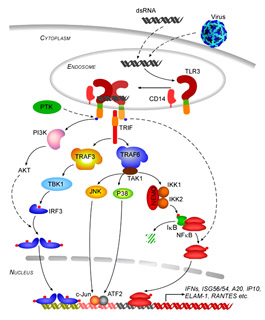 Although the genes induced by TLRs vary depending on the cell type involved, genes encoding pro-inflammatory cytokines and chemokines, anti-viral cytokines and adhesion molecules are most common. Together they trigger the so called host-defense response.
To understand the details of the networks involved in transcriptional induction or ‘switching on’ of genes following the detection of viral nucleic acids, we use various immortalized human cell lines engineered to make TLR3 and TLR7, as model systems.
These studies have led us to discover new roles of protein modifications (e.g. tyrosine phosphorylations) involved in TLR3 signaling. We have shown how these phosphorylations control subtle modifications of transcription machinery (transcription factors). Continuing this line of investigation we are now trying to understand how other signaling networks interact and modulate the innate immune signaling pathways in human cells.
Further Reading
Akira, S., Uematsu, S., and Takeuchi, O. (2006) Pathogen recognition and innate immunity. Cell. 124, 783-801. (PMID: 16497588)
Sen, G. C., and Sarkar, S. N. (2005) Transcriptional signaling by double-stranded RNA: role of TLR3. Cytokine Growth Factor Rev. 16, 1-14. (PMID: 15733829)