
Search
Early Critical Care Management of Aneurysmal SAH
- 30,000 patients per year have an SAH
- Early ED management certainly should focus on airway assessment, emergent CT scanning, continuous caridac monitoring, and serial neurologic exams
- A few other pearls regarding management:
- Volume management - maintain euvolemia with an isotonic crystalloid fluid
- Anticonvulsants - routine use is associated with cognitive impairment and is not recommended
- Steroids - once used to reduce meningeal irritation, however, there is no convincing evidence of a beneficial effect. As such, corticosteroids are no longer recommended.
- Rebleeding - risk of rebleeding is highest in first 24 hours after initial SAH. Definitive prevention is done by repair via surgery or endovascular coiling. A large, prospective study found outcome was better with endovascular coiling.
Show References
Keys to a Successful Intubation
- Use both hands-bimanual laryngoscopy should be a routine part of ED intubations.
- Don't forget that you CAN let up cricoid pressure-this can actually obscure your view and make your job more difficult.
- For obese patients, make sure you elevate them. You want their ear level with their sternal notch. This might require A LOT of pillows or towels.
- Use a "straight-to-cuff" technique for stylet shaping. This is accomplished by making the stylet straight down to the cuff and then making a 15-20 degree bend at the cuff.
Show References
A lot of what is taught about fracture patterns in abused children has been extrapolated from post-mortem studies which is a different population then what you will see in the Emergency Department. The study referenced did a metanalysis of all the literature in an attempt to determine what fractures suggest abuse and looked at all comers that had fractures. Some of the patterns they were able to extrapolate are:
- Fractures from abuse predominately occurred in infants and toddlers
- In children less than 12 one study showed that 80% of all fractures from abuse occurred in children less than 18 months old.
- In children over 5 years old 85% of fractures are not caused by abuse
- In children under 3 years old, skull fractures were by far the most common fracture type in both abused and non-abused children.
- However, the presense of a skull fracture only has a 1:3 chance of being from abuse.
- Skull fractures location and type are similar between abuse and non-abuse, though multiple fractures and fractures that cross suture lines are more highly associated with abuse.
- There is a strong relationship between multiple fractures and abuse
- 74% of abused children had two or more fractures compared to 16% of non-abused
- In the absence of a confirmed traumatic case, rib fractures have the highest probability (71%) of being caused by abuse.
- Humeral fractures have a 1:2 chance of being the result of abuse.
- Femur fracture like skull fractures have a 1:3 chance of being the result of abuse.
Show References
- For children under 5 years of age the rate of missing an appendicitis remains very high. (57%-67%)
- The rate of misdiagnosis increases as the age decreases.
- In cases of missed appendicitis the most common incorrect diagnosis is gastroenteritis.
- Think twice before you label vomiting alone, or diarrhea alone as gastroenteritis.
- If an appendicitis is missed there is an increased risk of perforation, abscess formation, and higher morbidity.
Show References
Add metoclopramide (Reglan) to the laundry list of medications with black box warnings from the FDA. Why was a black box warning added?
- Long-term metoclopramide use has been linked to tardive dyskinesia (involuntary and repetitive body movements) even after the drug is no longer being taken.
- Risk factors: Long-term or high-dose use, elderly, female gender.
- Recommended that metoclopramide treatment not exceed 3 months.
- None really.
- Just be aware of the dopamine antagonist effects (EPS - dystonic reactions) that are possible whenever you order metoclopramide in the acute setting.
- These effects can be treated effectively with an anticholinergic agent, such as diphenhydramine or benztropine.
Oxygenation goals
- In recent pearls we have talked about 'lung protective' ventilation strategies to reduce volutrauma, barotrauma, and oxygen toxicity.
- Using 'lung protective' strategies, such as low tidal volumes, results in higher levels of CO2 and a lower pH. These are tolerated in favor of lower and safer alveolar pressures.
- In addition to higher pCO2 values and lower pH, oxygenation goals are slightly lower than conventional teaching.
- In these patients, you want to maintain SpO2 > 88% and PaO2 > 55 mm Hg.
Follow-up for the Hypertensive Patient
We see hypertensive patients every day, every shift. And, we discharge many of them. So, when do you get them follow-up?
The JNC-7 recommends that patients with BPs > 180/110 mm Hg have follow-up within 7 days. Like most of the HTN recommendations in the primary care setting, this recommendation is based on a "smart person" concensus....and no data.
This is a tremendous issue for us in the ED, because we don't want to see a bad outcome in our discharged hypertensive patients.
Some pearls regarding discharging the very hypertensive (but asymtomatic) patient:
- Since there isn't any realy data on follow-up, it would be wise to use caution and have very high BPs checked the next day and to NOT wait a week.
- Discharge instructions should note when/where (if you have to...use the ED as a recheck) the patient is to follow-up
- ALWAYS warn patients about what can/will happen if they don't seek follow-up: MI, stroke, renal failure/need for dialysis, death, and disability and write this in the chart. The last thing you want to hear is that the patient went on to develop renal failure/stroke, etc. and that they claim they were not warned about what could happen.
- When it is possible, contact the patient's doctor to discuss management
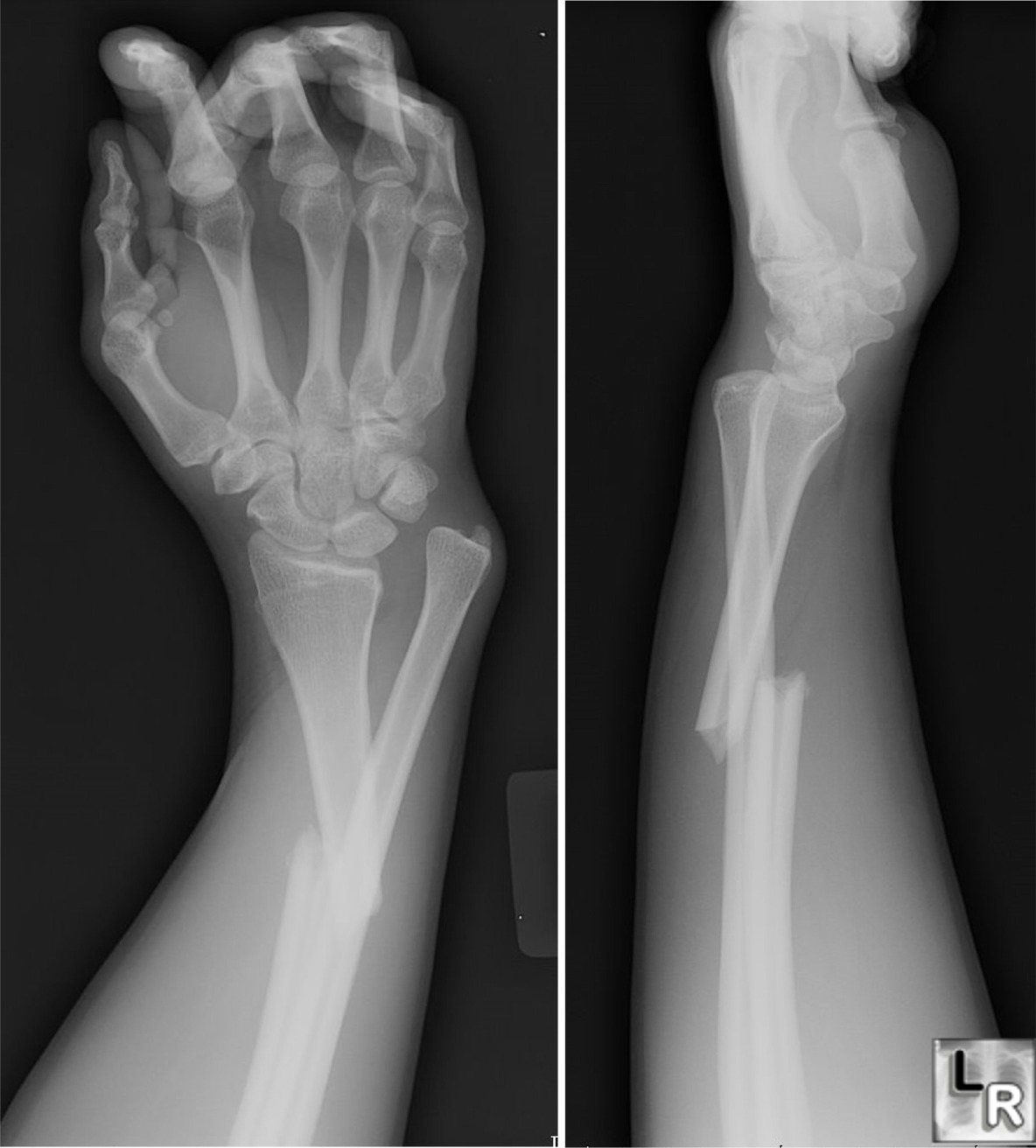
The Galeazzi Fracture:
- It is a fracture of the distal to middle third of the radial shaft with dislocation of the Distal Radio-Ulnar Joint.
- Typical mechanism of injury is a fall onto a outstretched hyperpronated forearm.
- Estimated to represent 7% of adult forearm fractures.
- This fracture requires surgical repair (Open reduction and internal fixation) in order to prevent presistant or recurrent dislocation of the distal ulnar which typically occurs with closed reduction techniques.
- Associated with injury to the Anterior interosseous nerve which is a purely motor branch of the median nerve. Injury results in paralys of the flexor pollicis longus (FPL) and flexor digitorum profundus (FDP) to the index finger, resulting in loss of the pinch mechanism between the thumb and index finger.
To see a photo of a Galeazzi fracture please visit the Learning Radiology Website by clicking on the following link:
http://www.learningradiology.com/caseofweek/caseoftheweekpix2/cow157lg.jpg
Rocky Mountain spotted fever (RMSF)
Systemic small vessel vasculitis caused by R rickettsii which is transmitted by a tick bite.
Clinical features: fever, headache, myalgia, nausea, vomiting, and characteristic rash. Rash usually appears before the sixth day of the illness initially on the wrists and ankles, and spreads to the trunk within hours. Initially. It is erythematous and macular, later becoming petechial.
Laboratory findings: thrombocytopenia, anemia, and hyponatremia.
Complications: meningitis, multiorgan involvement, DIC, shock, and death.
Treatment: doxcycycline (even despite the risk of dental staining in children younger than 8 years old)
Show References
Clevidipine
- A new intravenous antihypertensive agent
- Has a very rapid onset (2-4 min) and offset (5-15 min), in contrast to the available IV calcium channel blocker nicardipine, which has a duration of action of 3-6 hours
- Contraindicated in patients with soy or egg allergies, and in those with defective lipid metabolism
- Most common ADR's reported were headache, nausea, and vomiting
- Initiate at 1-2 mg/hr, most respond at doses between 4-6 mg/hr
- Maximum recommended dose is 16 mg/hr
- Costs between $86 to $140 per 50 mg vial
Show References
Evaluation of End Organ Damage in Hypertensive Patients
No evidence to date supports the ED workup for end-organ damage in asymptomatic hypertensive patients.
End-Organ Damage Pearls:
- Rarely, if ever, will an aimless search for lab abnormalities lead to any clinically meaningful change in patient management
- An elevated creatinine does NOT define acute, end-organ damage. Most of the time it is due to the effects of chronic hypertension.
- There is some evidence that a UA that has BOTH no protein and no red cells predicts a normal creatinine. The studies that have looked at this, however, are very small. Also, HTN in and of itself may cause some protein leak, even in the setting of normal renal function
- A CXR and/or ECG is not needed in an asymptomatic patient.
- Prompt followup is always necessary especially if no ED workup is started. All of this can be dome in the primary care doctor's office.
Neuromuscular Blocking Agent (NMBA)
- NMBAs are used to facilitate intubation when performing RSI
- Importantly, NMBAs have no analgesic or amnestic effects
- Indiscriminate and repeated dosing of NMBA can lead to prolonged recovery and critical illness polyneuromyopathy, a devastating complication of critical illness that prolongs ventilation, ICU/hospital length of stay, and increases mortality
- Take Home Point: provide adequate amounts of sedation and analgesia to your intubated ED patients rather then reflexively giving repeated doses of NMBA
Most people are familiar with the Ottawa Ankle Rules, but there are also Ottawa Knee and Foot rules. The Ottawa rules help to limit the number of x-rays you may need in patients that present with ankle, foot or knee pain after an injury.
The Ottawa Ankle Rule
An ankle x-ray is only needed if there pain in the mallelolar area and any of the following:
- Bone tenderness at the posterior tip of the base of the lateral mallelous
- Bone tenderness at the posterior tip of the base of the medial mallelous
- Inability to weight bear immediately and in the Emergency Department
The Ottawa Foot Rule
A foot x-ray is only needed if there is pain in the midfoot and any of the following:
- Bone tenderness at the base of the 5th metatarsal
- Bone tenderness over the navicular
- Inability to weight bear immediately and in the Emergency Department
The Ottawa Knee Rule
A knee x-ray is only needed for knee injury patients when they have any of the following:
- Age 55 or over
- Isolated tenderness of the patella (no bone tenderness of the knee other than the patella)
- Tenderness at the head of the fibula
- Inability to flex to 90 degrees
- Inability to weight bear both immediately and in the Emergency Department (4 steps - unable to transfer weight twice onto each lower limb regardless of limping).
- Pediatric seizures are common and 4-6% of all children will have a seizure by the time they are 16 years old.
- Afebrile neonatal seizures require an evaluation of electrolytes, glucose, calcium, magnesium, LP, blood and urine cultures.
- Simple Febrile seizures usually do not require any lab testing or admission if the child appears well.
- Dilution of formula with too much water is a common cause of hyponatremic seizures in infants. (Treat with 3ml/kg of 3% hypertonic saline)
- Complex febrile seizures have a higher risk for meningitis than simple febrile seizures, so perform an LP, give antibiotics, and admit.
- When intubating for Status Epilepticus consider using thiopental or propofol for induction given their antiepileptic properties.
Show References
The Crashing Intubated ED Patient
- For intubated ED patients who develop respiratory distress and are hemodynamically unstable, perform the following:
- Immediately disconnect from the ventilator
- Manually ventilate with 100% FiO2
- Exclude tension pneumothorax (decompress)
- Exclude auto-PEEP (allow for lung deflation)
- Check ET tube for kinks, twisting, or obstruction
- Check for air leak (check pilot balloon and listen for air coming from mouth/nose during manual ventilation)
- Check the ventilator circuit