
Search
- Ventricular assist devices (VAD) have become an option as bridge to transplant or destination therapy in many patients (prevalence heart failure in US 5.7 million)
- VADs have significantly improved quality of life by NYHA class & 6 min walk distance
- 2 main types of VAD exist, pulsatile (PF) and continuous flow (CF), with 98% being CF
- Both bleeding and thrombosis are frequently encountered complications
- Although required systemic anticoagulation increases the risk of bleeding, there is a inherent association between CF VADs and GI AVMs
- Hypotension a common complication, which should be assessed by ruling out: bleeding, thrombosis, mechanical obstruction, sepsis, and RV failure
Show References
"When can my child get back out on the field doc?"
Return to play
▸ Concussion symptoms should be resolved before returning to exercise.
▸ A RTP progression involves a gradual, step-wise increase in physical
demands, sports-specific activities and the risk for contact.
▸ If symptoms occur with activity, the progression should be halted and
restarted at the preceding symptom-free step.
▸ RTP after concussion should occur only with medical clearance from a
licenced healthcare provider trained in the evaluation and management
of concussions.
Short-term risks of premature RTP
▸ The primary concern with early RTP is decreased reaction time leading
to an increased risk of a repeat concussion or other injury and
prolongation of symptoms.
Long-term effects
▸ There is an increasing concern that head impact exposure and
recurrent concussions contribute to long-term neurological sequelae.
▸ Some studies have suggested an association between prior concussions
and chronic cognitive dysfunction. Large-scale epidemiological studies are
needed to more clearly define risk factors and causation of any long-term
neurological impairment.
Show References
- CDC recommends pediatric influenza antiviral treatment for those at higher risk for influenza complications, and include the following:
- less than 2 years of age;
- chronic diseases including: pulmonary (ie asthma), cardiovascular (except hypertension alone), renal, hepatic, hematologic (ie sickle cell disease), metabolic (ie diabetes), neurologic/neurodevelopmental (ie cerebral palsy, epilepsy), and intellectual disability (ie mental retardation)
- immunosuppression (ie HIV)
- less than 19 years of age and on chronic aspirin treatment;
- morbid obesity (BMI>40)
- adamantanes (amantadine and rimantadine) should not be used due to high levels of resistance to influenza A
- neuraminadase inhibitors (oseltamivir and zanamivir) should be started within 48 hours of illness onset to reduce the duration and severity of disease
- oseltamivir can be used in children as young as 2 weeks of age at a dose of 3mg/kg twice daily for 5 days.
Show References
Several medications can produce a false-positive result for methadone on the urine drug screen: diphenhydramine, doxylamine, clomipramine, chlorpromazine, quetiapine, thioridazine, and verapamil.
Add a new one to the list. Tapentadol, a relatively new opioid analgesic similar to tramadol, can also produce a false-positive result for methadone on certain immunoassays.
A separate study concluded that tapentadol does not affect the amphetamine screen.
Show References
Question
These two Ethiopian boys present with “back problems”. What are the diagnoses and what do you need to worry about with each of them?
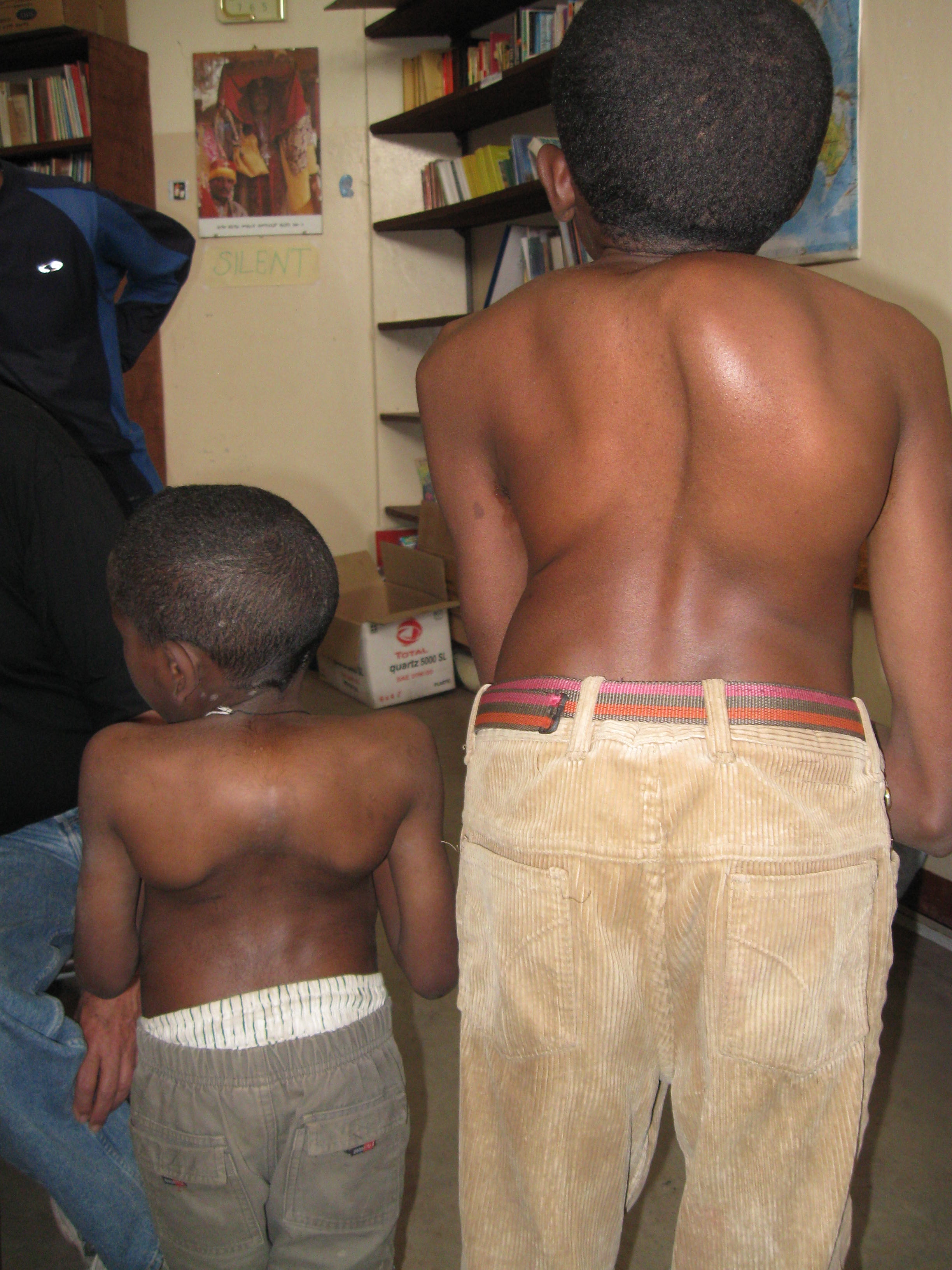
Show Answer
Show References
Attachments
The Crashing Cardiac Transplant Patient
- Approximately 2000 patients receive a cardiac transplant each year in the United States.
- With improvements in surgical techniques, immunosuppression, and management of complications, graft half-life is now approximately 13 years; thereby increasing the likelihood that a cardiac transplant patient will show up in your ED.
- In the crashing cardiac transplant patient, think of the following causes for acute decompensation:
- Acute rejection
- Primary graft failure
- RV failure
- Sepsis
- For patients with primary graft failure initiate inotropic support with dobutamine, epinephrine, milrinone, or isoproteronol. Those failing standard inotropes will likely require mechanical circulatory support (VAD) or ECMO.
- Patients with acute RV failure will often require the combination of a pulmonary vasodilator (inhaled NO, prostaglandins) and inotropic agent. In addition, it is critical to avoid hypercapnia and hypoxia.
Show References
Question
4 year-old female with the post-procedural CXR shown below. What's the diagnosis? (Hint: use the zoom...this one is tricky)

Show Answer

Show References
- BCI results in a spectrum of outcomes from asymptomatic to sudden cardiac death
- Normal screening ECG is associated with a 98% negative predictive value
- Sinus tachycardia is the most common ECG abnormality among trauma victims
- Myocardial contusion (MC) is the most common & ambiguous diagnosis following BCI
- MC has no consensus definition or uniform diagnostic criteria and can be loosely defined as BCI w/mild increase in cardiac biomarkers or frank cardiac dysfunction (e.g. wall motion abnormalities, arrhythmias, conduction disturbances, or SCD)
- BCI w/ a normal ECG & stable hemodynamics have a benign clinical course and rarely require further diagnostic testing or long periods of close observation
- Individuals w/ECG abnormalities, hemodynamic instability, or rapid deceleration injury concerning for blunt aortic injury (BAI) warrant imaging of heart and great vessels by echocardiogram and CT scan
Show References
The two available Tetanus/reduced diphtheria toxoid/acellular pertussis (Tdap) vaccine products in the U.S. are Boostrix and Adacel. Neither were originally approved in older adults age 65 and older. Boostrix received FDA-approval for use in this age group in July 2011, but Adacel never has.
However, in June 2012 ACIP issued new guidance recommending Tdap for all adults age 65 years and older.
"When feasible, Boostrix should be used for adults aged 65 years and older; however, ACIP concluded that either vaccine administered to a person 65 years or older is immunogenic and would provide protection. A dose of either vaccine may be considered valid."
Bottom line: Regardless of which Tdap product is stocked at your institution, both are considered safe to use in adults 65 years and older.
Show References
Rotavirus is the leading cause of gastroenteritis worldwide and a leading cause of infant death in the developing world.
95% of U.S. children have had a rotavirus infection by the age of 5 years.
Most cases occur in late winter and early spring.
Route of transmission is mostly fecal-oral but may be airborne in cooler months.
Most common presenting signs and symptoms include fever (1/3 of cases), vomiting (in the first 1-2 days), and diarrhea (copious, watery, lasting 5-21 days).
Diagnosis is largely based on clinical manifestations, but antigen assays are available and may be useful in patients with extraintestinal complications, such as hepatitis, pneumonitis, or encephalopathy.
Treatment is largely supportive with efforts to maintain hydration.
Prevention is key to disease control and accomplished with good hand hygiene and widespread vaccination.
Newly implemented vaccine programs worldwide have proven to be effective in decreasing hospitalizations and deaths in developing countries.
Show References
Creatine
- is the most popular nutritional supplement, accounting for $400 million in sales annually
- a nonessential amino acid
- has been shown to improve performance in short, high intensity exercises, including weight lifting
Adverse effects: weight gain, edema, GI cramping, fatigue and diarrhea
Show References
General Information:
-Leptospirosis is a tropical infectious disease that is also endemic in the US. (Estimated 16% seroprevalence in inner city Baltimore!)
-The spirochete is spread through animal urine and can survive in water or soil for weeks.
-Risk factors: rural exposure to animal urine (farming, adventure sports) or urban exposure to rat urine.
-Infection is acquired through breaks in the skin or mucus membranes
-Outbreaks are often seen following rain or floods.
Clinical Presentation:
-Non-specific febrile illness (usually not diagnosed in these cases)
-If untreated, 5-10% progress to jaundice, renal failure, thrombocytopenia, hemorrhage, and respiratory failure.
Diagnosis:
- Primarily based on clinical presentation and history
- Paired serum sent to CDC (the acute serum sample should be drawn in the ED)
Treatment:
- Doxycycline, Ceftriaxone and Penicillin are all effective
Bottom Line:
Consider and treat for Leptospirosis in patients with possible exposure animal urine (especially after a flood) who present in extremis with renal failure, jaundice, and thrombocytopenia.
University of Maryland Section of Global Emergency Health
Author: Andi Tenner, MD, MPH
Show References
DRESS (Drug Reaction with Eosinophilia and Systemic Symptoms) or DIHS (Drug-Induced Hypersensitivity Syndrome) is a potentially life-threatening adverse drug-reaction.
Incidence is 1/1,000 to 1/10,00 drug exposures. It occurs 2-6 weeks after the drug is first introduced, distinguishing it from other adverse drug-reactions which typically occur sooner.
The syndrome classically includes:
- Severe skin eruptions (typically morbilliform or erythrodermic eruptions)
- Hematologic abnormalities (eosinophilia or atypical lymphocytosis)
- Organ involvement; e.g., hepatic (most common), pneumonitis, renal failure, etc.
- Fevers
- Arthralgia
- Lymphadenopathy
The most commonly implicated drugs are anticonvulsants (e.g., carbamazepine, phenobarbital, and phenytoin), sulfonamides, and allopurinol.
Recovery is typically complete after discontinuing the offending drug; systemic steroids may promote resolution of the illness.
Show References
Question
31 year-old male with recently diagnosed hypertension presents with rapid lip swelling. He started taking an unknown medication for his hypertension last week. Further history reveals that he has had prior, although milder, episodes previously. Name two medications that may help treat him.

Show Answer
- Type 1: Ischemic myocardial necrosis secondary to plaque rupture (ACS)
- Type 2: Ischemic myocardial necrosis not secondary to ACS, but rather supply/demand mismatch, vasospasm, emboli, anemia, hypoperfusion, and/or arrhythmia
- Type 3: Sudden cardiac death
- Type 4a: PCI related
- Type 4b: Stent thrombosis
- Type 5: CABG related
Show References
Metacarpal Neck Fractures (i.e.: Boxer’s Fracture if 5th Metacarpal)
Depending on the MCP joint involved a certain amount of angulation is permissible before it adversely affects normal function.
- 2nd and 3rd Metacarpal fractures < 10۫ angulation ideally these should be perfectly aligned.
- 4th Metacarpal fracture <20۫ angulation allowed
- 5th Metacarpal fracture <30۫ angulation.
- Studies have shown that even 30۫ angulation will decrease normal function by 20%.
- Normal excursion of the 5th MCP is 15۫ to 25۫.
- No amount of rotation deformity should be allowed.
Wishing everybody a Happy and Healthy New Year.
- Nebulized epinephrine: 0.9mg/kg for racemic epi or 0.03 mL/kg of the 2.25% solution (diluted in 3mL) - improves oxygen saturation and respiratory rate, but does not affect admission rates
- Hypertonic saline (3%): decreases hospital length of stay and improves clinical scores, possibly by decreasing airway edema and mucus plugging
- Nasal CPAP: improves ventilation in children with bronchiolitis and hypercapnia
- Heliox: decreases respiratory distress, by reducing gaseous flow resistance and improving alveolar ventilation
Interventions that have shown no benefit and are not recommended:
- Anticholinergics
- oral and/or inhaled corticosteroids
Reference:
Joesph, M. Evidence-Based Assessment and Management of Acute Bronchiolitis in the Emergency Department. Pediatric Emergency Medicine Practice 2011; 8(3)
Despite a paucity of data, pain management clinics are administering topical gel mixtures that have included ketamine, tricyclics, calcium channel blockers and baclofen. Internet blogs have already identified this gel mixture as a way to "get high". This is one of those google searches you have to do on your own.
Show References
- Case Presentation from our ED
- 20 y/o presents 3 weeks after emigrating from Senegal with headache and malaise. CT/LP and work up was otherwise negative. Thin smear shows 1 plasmodium falciparum parasite in 7000 RBC.
- Appropriate therapy is initiated with malarone (atovoquone and progranuil). 24 hours later the patient represents with worsening headache and fever.
- Repeat smear shows 10% parasitemia and massive numbers of parasites
- Clinical Question: Can parasitemia rise after initiation of treatment?
- Answer: Yes
- Increase in blood parasite count in falciparum malaria after initiation of treatment (artemisinin derivatives or quinine) is not uncommon.
- Increased blood parasite count does not indicated treatment failure if it the parasitemia is LESS THAN 2.5 x the baseline count.
- Clinical Question: Did this patient have treatment failure with malarone?
- Answer: Yes
- The patient’s parasitemia rose to 10% after initiation of therapy.
- There are increasing case reports of treatment failure in West Africa with Malarone.
Bottom Line: A mild increase in blood parasite count after initiation of treatment is not uncommon. Marked increases should indicated treatment failure and the treatment drug should be changed to another class.
University of Maryland Section for Global Emergency Health
Author: Emilie J.B. Calvello, MD, MPH
Show References
Attachments
VV-ECMO for Refractory Hypoxemia
- In the absence of significant cardiac disease, patients with refractory hypoxic respiratory failure should be considered for venovenous extracorporeal membrane oxygenation (VV-ECMO).
- Though indications vary slightly among organizations, the Extracorporeal Life Support Organization states that ECMO is indicated when the PaO2/FiO2 is < 80 mm Hg on FiO2 > 90% or safe plateau pressures (< 30 cm H2O) cannot be maintained.
- A few pearls when initiating VV-ECMO:
- Fluids are often needed in the first few hours after initiation of ECMO
- Reduce tidal volumes to maintain plateau pressures < 25 cm H2O
- Decrease FiO2 to maintain oxygen saturations > 88%
- Use a hemoglobin threshold of 7-8 g/dL for blood transfusion