
Search
41-60 of 65 results by Andrea Tenner
General Information:
-MERS-CoV (Middle East Respiratory Syndrome) is a novel coronavirus that produces a SARS-like syndrome. (You might have seen a pearl about this from us in March...)
-Since that time there have been a total of 102 laboratory-confirmed cases with 42 deaths (almost half!)
-All known cases had links to the Arabian Peninsula, although there has been some local non-sustained transmission
Relevance to the EM Physician: Consider MERS-CoV in patients with SARS-like syndrome who have traveled or had contact with someone who has traveled to the Arabian Peninsula within the past 14 days.
Bottom Line: Ask about recent travel in patients with severe acute respiratory illness. If you suspect MERS-CoV, contact your local health department.
University of Maryland Section of Global Emergency Health
Author: Andi Tenner, MD, MPH
Show References
General Information:
XDR TB is “extensively drug resistant tuberculosis”—resistant to isoniazid, rifampin, any fluoroquinolone, and at least one of the 3 injectable 2nd line drugs
Clinical Presentation:
- Identical to regular TB (weight loss, fevers, night sweats, cough, hemoptysis)
- Suspect in patients who are failing usual treatment
-Exposure in Eastern Europe or Russia (highest prevalence, although 84 countries have had documented XDR, including the US.)
Diagnosis:
- Plating on agar or liquid media for drug susceptibility testing
Treatment:
- Should be guided by susceptibility testing
- Isolate the patient!
Bottom Line:
XDR TB is increasing in prevalence, have a high index of suspicion in patients with persistent symptoms who are receiving treatment and isolate if any concerns.
University of Maryland Section of Global Emergency Health
Author: Andi Tenner, MD, MPH
Show References
General Information:
As of July 30th, 2013, there have been 378 cases of Cyclospora infection from multiple states in the US. Cyclospora is most common in tropical and sub-tropical regions, and is spread via fecal-oral route. While the cause of the most recent outbreak is unknown, outbreaks in the US are generally foodborne.
Clinical Presentation:
- Symptoms usually begin 7 days after exposure
- Watery diarrhea, cramping, bloating, nausea, fatigue, increased gas, vomiting, low grade temperature
- Can persist several weeks to > 1 month
Diagnosis:
- Concentrated Stool Ova and Parasites— viewed under modified acid fast or fluorescence microscopy (labs can submit photos to the CDC for “telediagnosis”)
Treatment:
- TMP-SMX DS one tab po bid x7-10 days
- No effective alternate for failed treatment or sulfa allergy
- Most will recover without treatment but S/S can persist for weeks to months
Bottom Line:
Consider Cyclospora as a cause of prolonged diarrheal illness, treat with TMP-SMX.
University of Maryland Section of Global Emergency Health
Author: Andi Tenner, MD, MPH
Show References
Background:
Infection with the Hepatitis C virus can result in mild to severe liver disease. Morbidity and mortality from Hep C is increasing the US--many of the 2.7-3.9 million persons with Hep C are not aware of their infection.
Pertinent Information:
- Hepatitis C is now curable for many patients
- Current treatment recommendations are a combination of medications (pegylated interferon plus ribavirin plus a protease inhibitor).
- Research in this field is very active--treatment is likely to change in the next 3-5 years.
- Risk reduction strategies to protect the liver (i.e. eliminating alcohol and Hep A and B vaccination) are also recommended.
Critical New Recommendation
As much of the disease burden is in the “Baby Boomers,” the CDC now recommends one time testing of all persons born between 1945 and 1965.
Bottom Line:
While emergency department management is focused on the treatment of acute complications of liver disease, it is also important to have all age appropriate patients follow-up for testing and treatment of Hepatitis C with their primary care provider.
Show References
General Information:
An estimated 70 children in the world die every 5 minutes-- 99% of these deaths are from developing countries, half in Sub-Saharan Africa , and two-thirds from preventable or easily treatable causes.
Area of the world affected:
One study examining the quality of hospital emergency care of 131 children in 21 hospitals in 7 developing countries found:
· 66% of hospitals did not have adequate triage; 41% of patients had inadequate initial assessment;
· 44% received inappropriate treatment and 30% had insuf cient monitoring.
· Frequent essential drugs, laboratory and radiology services supply outages
· Staffing and knowledge shortages for medical and nursing personnel
Relevance to the US physician:
The International Federation of Emergency Medicine (IFEM) used a consensus approach to develop the International Standards for Emergency Care of Children in Emergency Departments, published in July 2012.
· The standards covering initial assessment, stabilization and treatment, staf ng and training
· Guidelines for coordinating, monitoring and improving the pediatric emergency care are addressed
Bottom Line:
The IFEM International Standards for Emergency Care of Children provide an excellent resource for both clinicians and hospital managers in developing countries.
University of Maryland Section of Global Emergency Health
Author:Terrence Mulligan DO, MPH,FIFEM, FACEP, FAAEM, FACOEP, FNVSHA
--thanks and acknowledgments to Baljit Cheema, University of Cape Town and Stellenbosch University, South Africa
Show References
General Information:
Hepatitis A is a food-borne illness that is prevalent in developing countries. Currently in the US we are experiencing an outbreak in 8 states related to a frozen blend of organic berries. (Linked to Townson Farms brand sold at Costco and Harris Teeter)
Clinical Presentation:
- Case definition: sudden onset of S/S + jaundice or elevated liver enzyme levels
- S/S: nausea, anorexia, fever, malaise, abdominal pain
Diagnosis:
- Hepatitis A IgM
Treatment:
- Exposed patients should be given the Hep A vaccine within 2 weeks of exposure
- Exposed patients >40 yrs old, <1 yr old, immunocompromised, or with chronic liver disease: give immunoglobulin instead (risk of more severe disease)
- Supportive care
Bottom Line:
Patients potentially exposed to Hepatitis A in the past 2 weeks should be given either the vaccination or immunoglobulin, depending on comorbid conditions. Treatment of active infection is supportive.
University of Maryland Section of Global Emergency Health
Author: Andi Tenner, MD, MPH
Show References
General Information:
-Listeria can cause serious infections in vulnerable groups: adults >65 years old, pregnant women, newborns, immunocompromised
-In a recent CDC report, infection with Listeria was associated with a 20% mortality rate.
Clinical Presentation:
- History of cantaloupe, soft cheese, or raw produce ingestion
- Non-specific symptoms: fever, myalgias, occasionally preceded by GI symptoms
-Can have headache, stiff neck, confusion, AMS, miscarriage or stillbirth in pregnant women
Diagnosis:
- Blood, CSF, or amniotic fluid culture showing Listeria monocytogenes
- Listeria is a reportable disease
Treatment:
- Ampicillin and Penicillin G are the drugs of choice
- Add gentamycin in CSF infection, endocarditis, the immunocompromised, and neonates.
Bottom Line:
Listeria infections have a high mortality rate and can be found worldwide. Suspect in patients who have febrile syndromes and travel to areas where they may consume unpasteurized cheese.
University of Maryland Section of Global Emergency Health
Author: Andi Tenner, MD, MPH
Show References
General Information:
-The global health world is faced with an unprecedented challenge of a trio of threats:
1. Infections, undernutrition, reproductive health issues
2. Rising global burden of non-communicable diseases and risk factors
3. Challenges arising from globalization (climate change and trade politics)
-Definitions of global health are variable and can emphasize anything from types of health problems, populations of interest, geographic area or a specific mission. This makes governance and analysis difficult.
-During the past decade there has been an explosion of more than 175 initiatives, funds, agencies, and donors. Health is increasingly influenced by decisions made in other global policymaking areas.
-The major governance challenges for global health are:
1. Defining national sovereignty in the context of deepening health interdependence
2. Maximizing cross-sector interdependence
3. Developing clear mechanisms of accountability for non-state actors
Relevance to the US physician:
The Global Health System and its governance affects our ability to work effectively within the US and how we structure efforts to expand the reach of timely, effective emergency care worldwide.
Bottom Line:
The Global Health System has become more complex. Any development of Emergency Care Systems must take into account the complexity of actors in the field of global health.
The University of Maryland Section of Global Emergency Health
Author: Emilie J. B. Calvello, MD, MPH
Show References
General Information: Antibiotics are generally classified as time- and concentration-dependent.
Concentration-dependent antibiotics
- Rate of kill is highly dependent on peak concentrations and is tissue-specific (generally 10x MIC needed for optimal bactericidal effect)
- As concentrations of the drug decrease, the bactericidal effect decreases
- Need less frequent dosing but higher doses
- Examples:
-Fluoroquinolones (i.e. Levofloxacin)
-Aminoglycosides (i.e. Gentamicin)
-Azithromycin
Relevance to the EM Physician:
Concentration-dependent antibiotics should be given at the highest appropriate dose for the target tissues (i.e. Levofloxacin 750mg for pneumonia is preferable to 500mg). This is also the rationale for high dose, extended-interval dosing for Gentamicin (>5mg/kg initial dose).
University of Maryland Section of Global Emergency Health
Author: Andi Tenner, MD, MPH
Show References
General Information:
The two main units used by medical laboratories are "conventional (used in the US) and SI (used by most other countries).
Pearls to know:
- For monovalent ions (i.e. Na+, Cl-) -- mEq/L=mmol/L (135 mEq = 135 mmol/L)
- For divalent ions (i.e. ionized Ca2+, Mg2+) -- mEq/2=mmol (Mg2+ of 2 mEq/L = 1 mmol/L)
- Creatinine -- Multiply conventional untis by 88 (1 mg/dL = 88 mmol/L)
- Glucose -- Multiply SI units by 18 (4 mmol/L = 72 mg/dL)
- Hemoglobin--Multiply conventional units by 10 (14 g/dL = 140 g/L)
Relevance to the EM Physician:
These tips will help you convert labs to familiar values when reading medical literature, when working in another country, or when working with international colleagues.
University of Maryland Section of Global Emergency Health
Author: Andi Tenner, MD, MPH
Show References
General Information:
-As of April 5th, 14 confirmed cases of a new influenza A virus (H7N9) have occurred in China. Six of those have died.
-Presumed transmission via infected poultry in bird markets, and thus far no person-to-person transmission has occurred.
-Likely susceptible to oseltamavir or inhaled zanamivir
Area of the world affected:
-China
Relevance to the US physician:
- Suspect in patients with a respiratory illness and appropriate travel history.
- Refer to CDC within 24 hours if test positive for flu A but cannot be subtyped
- If H7N9 is suspected, patients should be under droplet and airborne precautions
Bottom Line:
No human-to-human transmission from H7N9 thus far, but the possibility exists. Any unsubtypeable influenza A patient should be placed on droplet and airborne precautions and oseltamavir or zanamivir started immediately.
University of Maryland Section of Global Emergency Health
Author: Andi Tenner, MD, MPH
Show References
General Information:
14 cases of lower respiratory infection caused by a new coronavirus (not the original SARS virus, but with a similar picture) occurred in the past year. Mortality rate of this virus is >50%.
Area of the world affected:
- Arabian Peninsula
- United Kingdom
Relevance to the US physician:
- Suspect this with a lower respiratory tract infection not responding to therapy and a travel history
- Person to person transmission possible
- Can have coinfection with influenza
- PCR testing can be done at the CDC in suspected cases
Bottom Line:
Consider this infection in patients with a lower respiratory tract infection who have traveled to or had contact with someone who traveled to the above regions in the past 10 days.
ASK ABOUT RECENT TRAVELS IN PATIENTS PRESENTING WITH SYMPTOMS OF SEVERE LOWER RESPIRATORY TRACT INFECTION!
University of Maryland Section of Global Emergency Health
Author: Veronica Pei MD, MPH
Show References
Background Information:
Ever wonder what you would do if you were the first on scene after the earthquake in Haiti or in the Superdome as Hurricaine Katrina survivors started to arrive? How could you save the most lives? As is typical of emergency medicine, blood and gore tend to get the most attention, but if you want to save lives you have to think about what is the greatest life threat. In a large-scale disaster, it turns out, lack of water and abundance of feces kill the most the fastest and need to be addressed first.
The Sphere Project Handbook:
-one of the core documents of humanitarian response
-outlines what should be done to save the most lives in the first days, weeks, and months of a disaster.
-available free online (see reference below)
Pertinent Conclusions: (need-to-know recommendations for the first few days)
-Water: 15L/person/day (any quality--sanitize as per our previous pearl)
-Latrines: max 20 people/latrine, <50m from dwellings, >30m from water sources
-What kind?
-First 2-3 days: demarcated defecation area
-days-2 months: trench latrines (shallow trenches to defecate in)
Other hygeine:
-Solid waste disposal: one 100L refuse container/10 households, emptied at least 2x/week
-Dead bodies: dispose of according to local custom. Generally not an immediate source of infection
-Shelter: >3.5 sq. meters/person of covered floor space
Bottom LIne:
People's need for water and defecation will not stop in a disaster and too little water and too much excrement are the greatest immediate life threats to disaster survivors. Plan to deal with these early to save the most lives.
University of Maryland Section of Global Emergency Health
Author: Andi Tenner, MD, MPH
Show References
Japanese Encephalitis
Show References
Just a quick clarification to last week's melioidosis pearl:
An astute reader noted the typo: "The patient should also be covered for melioidosis, and infection caused by Burkholderia pseudomallei." The sentence should read "...meliodosis, an infection caused by Burkholderia pseudomallei."
Just to clarify, melioidosis is caused by the bacteria Burkholderia pseudomallei.
Many apologies for any confusion this might have caused.
Thanks for reading!
Andi Tenner, MD, MPH
Background Information:
Active tuberculosis (TB) develops in 5-10% of individuals who become infected with M. tuberculosis, typically after a latency period of 6-18 months (but sometimes decades later). Compliance with the 9 month self-supervised isoniazid (INH) regimen has been porr with completion rates <60%. Until recently, daily rifampin for 4-6 months has been the only alternative when the bacterium is resistant or INH cannot be used.
Pertinent Study Design and Conclusions:
- Another rifamycin class antibiotic, Rifapentine (RPT) is approved for MDR-TB but had not been approved for latent TB treatment.
- Recent RCTs show 12 weekly doses of INH-RPT administered as directly observed therapy (DOT) are efficacious in preventing active disease and are better tolerated.
- CDC now recommends the 12 week INH-RPT DOT regimen as an equal alternative to 9 months of self supervised daily INH in patients aged >12 years who have a high likelihood of developing active TB.
Bottom LIne:
A substantially shorter course of therapy with INH-RPT is now the recommended treatment for latent TB.
University of Maryland Section of Global Emergency Health
Author: Emilie J. B. Calvello, MD, MPH
Show References
Case Presentation:
A 43 year old diabetic woman presents with dyspnea and a dry cough. Her vital signs are: BP 84/42, HR 135 RR 37 T 38.5. Lobar consolidation is seen on chest xray. She decompensates and is intubated, a central line is placed, and IV fluids are started. Her husband reports that they had just returned from a vacation in Thailand one week earlier.
Clinical Question:
Does the recent travel change your choice of empiric antibiotics?
Answer:
The patient should also be covered for melioidosis, and infection caused by Burkholderia pseudomallei.
- Infection can occur via direct contact with, inhalation of, or ingestion of the bacteria.
- B. pseudomallei is highly endemic in Thailand and Northern Australia, but melioidosis has been contracted in the Americas and other parts of Asia and Australia. (True epidemiology is unknown due to difficulties in culturing the bacteria)
- Clinical presentation most frequently involves pulmonary infection, abscess formation, or bacteremia.
- Labs that don't have experience with this bacteria have difficulty culturing it and it is often misidentified.
- Treatment is 10-14 days of ceftazidime or a carbapenem.
- After recovery, the patient requires TMP-SMX for 3-6 months for bacterial eradication.
Bottom Line:
Patients presenting with severe infections and recent travel to an endemic area should receive emperic antibiotics with ceftazidime or a carbapenem until another source is identified.
University of Maryland Section of Global Emergency Health
Author: Jenny Reifel Saltzberg, MD, MPH
Show References
Question
A 38 year old man is brought in by ambulance for a seizure. His medical history is not known. On exam he is post-ictal and otherwise has a non-focal neurologic exam. He has an abrasion above the right eye, a small tongue laceration, and was incontinent of urine. A head CT was done and is shown below. What was the cause of this man's seizure?

Show Answer
Show References
Attachments
Question
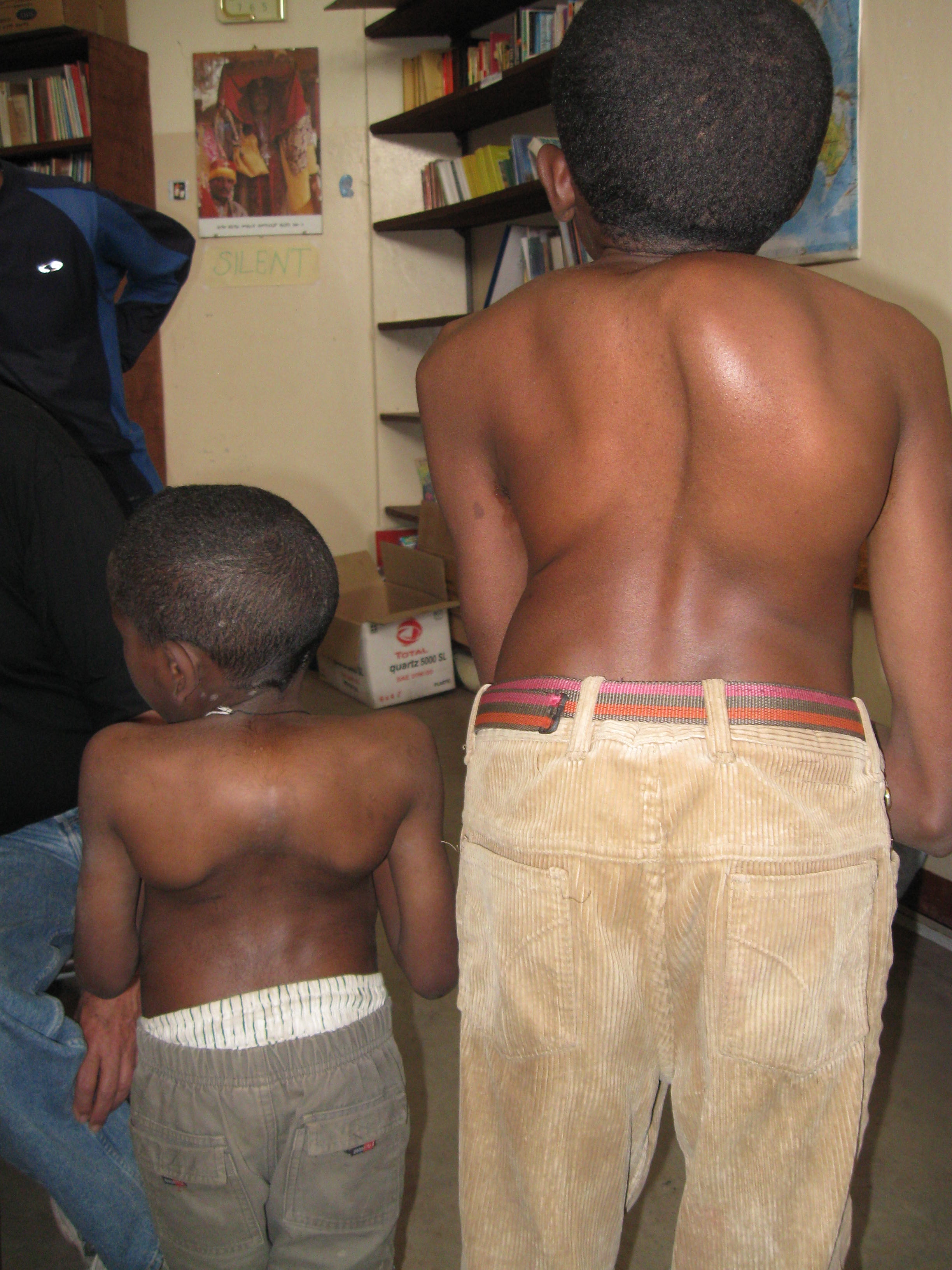
These two Ethiopian boys present with “back problems”. What are the diagnoses and what do you need to worry about with each of them?
Show Answer
Show References
Attachments
General Information:
-Leptospirosis is a tropical infectious disease that is also endemic in the US. (Estimated 16% seroprevalence in inner city Baltimore!)
-The spirochete is spread through animal urine and can survive in water or soil for weeks.
-Risk factors: rural exposure to animal urine (farming, adventure sports) or urban exposure to rat urine.
-Infection is acquired through breaks in the skin or mucus membranes
-Outbreaks are often seen following rain or floods.
Clinical Presentation:
-Non-specific febrile illness (usually not diagnosed in these cases)
-If untreated, 5-10% progress to jaundice, renal failure, thrombocytopenia, hemorrhage, and respiratory failure.
Diagnosis:
- Primarily based on clinical presentation and history
- Paired serum sent to CDC (the acute serum sample should be drawn in the ED)
Treatment:
- Doxycycline, Ceftriaxone and Penicillin are all effective
Bottom Line:
Consider and treat for Leptospirosis in patients with possible exposure animal urine (especially after a flood) who present in extremis with renal failure, jaundice, and thrombocytopenia.
University of Maryland Section of Global Emergency Health
Author: Andi Tenner, MD, MPH