
Looking into the Crystal Ball of Your Future
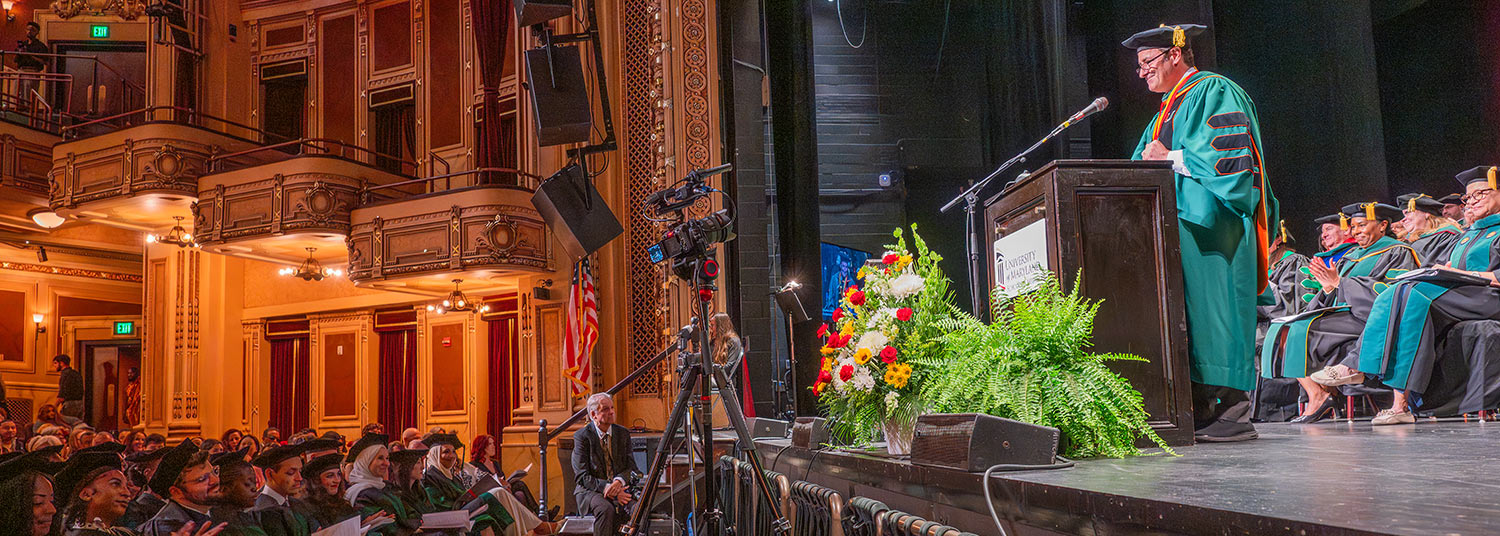
Graduation Address for the University of Maryland School of Medicine’s Class of 2026 Delivered by Dean Mark T. Gladwin on May 14.
Watch the Video
- Introduction
- What do I see in my crystal ball for the future of medicine?
- Two major revolutions converge
- Groundbreaking Drug Development and Nobel Prize Discoveries
- What will not change in the future
- Conclusion: Your Greatest Strength
Speech Transcript
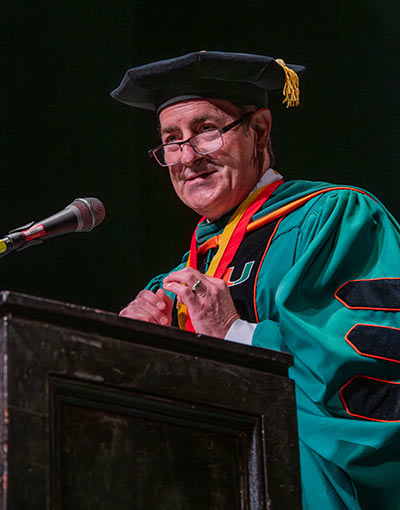
Good afternoon, Class of 2026!!! Since we are all wearing this Harry Potter Wizardly regalia, I thought I would take a moment and look into my crystal ball at your future. What will my crystal ball tell us about what medicine and our world will look like over the next 10-20 years?
What do I see in my crystal ball?
First of all, I want to you all to reflect throughout this event today that you are sitting here as servant leaders who will refine and define medical care over the next 50 years. I will argue that you are the first generation of physician leaders who are riding the crest of the big wave of two REVOLUTIONS in human civilization: computation and molecular biology!
We are living through an engineering revolution in chip design, data storage, advances in machine learning, natural language processing and large language computation – resulting in the evolution of artificial intelligence systems that use vast data sets to generate communications and drive discovery. The sum of all medical knowledge and the electronic health care record is now available to these systems to advance health care and potentially help you perform better as a doctor in the future, and certainly transform the practice of medicine.
Think about this: When I was in medical school, in the late 1980s, medical knowledge doubled every seven years; 30 years later in 2010, the doubling period was fewer than 75 days. Today, everything that you learned in one year of medical school is less than five percent of known medical information today. 1 During the course of my speech you will already be way behind!
You are going to need AI based systems that access and collate the riches of available data to assist you in diagnosis, risk assessment, and population health. 2
The pace of the current transformation is breath-taking: This year alone we have deployed AI systems to support reading and reporting of radiology imaging studies, we have deployed AI note writing scribe systems in our clinics to allow our doctors to talk to patients and not constantly type notes, and we are deploying AI systems to support revenue cycle and claims in our faculty practice.
NOW imagine the AI scribe systems in your clinic that don’t just write notes but listen, diagnose, and suggest needed tests and therapies? Imagine agentic systems that are constantly monitoring all records and lab results to identify early kidney disease, pre-diabetes, hypertension, heart failure, and identify and activate treatment for your patients at high risk of hospital readmission, or even substance use disorder and overdose. Imagine the integration between advanced home robots, wearable technology, and agentic home health care systems that monitor and manage your patients at home and coordinate with you as the physician leader.
This revolution in computation you will experience is only matched by the similar paced revolution in molecular biology.
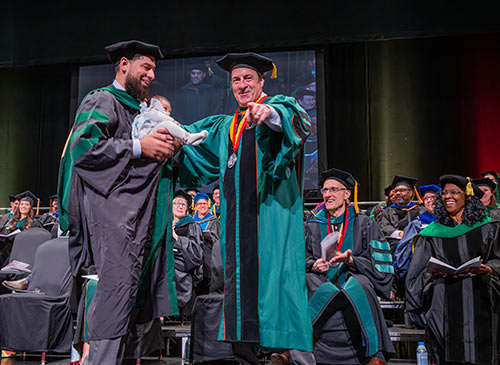
To best understand what your world will look like, we should reflect on three Nobel Prize winning discoveries that have been rapidly transforming the scientific and medical world during the course of your medical school training. I am such a believer in life long learning, and such a medicine nerd that every weekend I like to drink my coffee and read the New England Journal of Medicine. If you pick up last week’s May 7th issue you will read three remarkable studies highlighting how these Nobel prize discoveries are already transforming medicine.
You can try to guess what Nobel awards I am going to list, but above all you can now relax, there will be no more medical school tests!
The first Nobel prize in chemistry I will mention was awarded in 2024 to Demis Hassabis and John Jumper at Google DeepMind for developing Apha Fold, and to David Baker at the University of Washington for computational protein design. 3
How many of you know what alpha fold is? Alpha fold is an AI computational system that predicts the three dimensional protein structure from amino acid sequences, by comparing homologous or similar amino acid sequences from other proteins that already have known structures determined by X-ray crystallography. This work revolutionized protein structure prediction and design and has been able to predict the structure of more than 200 million proteins. Understanding the protein structure allows us to actually see the surface of proteins and enzymes and design small molecules and antibodies that can bind with high affinity to modify function, either inhibit or speed up an enzyme function. 4
This overlapping revolution in computation and molecular biology has impacted all areas of drug development. For example, a ground breaking scientific development this year was the development of a new class of drugs that inhibit what was considered to be an undruggable target, mutant KRAS, which is responsible for many uncurable cancers like non-small cell lung cancer, colon cancer and pancreatic cancer. 5
KRAS is a key enzyme that controls cellular growth and differentiation. Think of the KRAS enzyme as a nano-machine that, when turned on, binds to and turns on other down stream signaling machines that make cells grow and proliferate faster. KRAS is essential for life but has to be turned on and off. In cancers, it is mutated and locked in the ON state, and the gas pedal for growth is turned on. Using advanced crystallography and structure-function prediction AI tools like alpha fold, we can now actually visualize – we can see – the entire surface of nano-sized enzymes like KRAS to figure out how they work and how to dock small molecule drugs on their surface to block their function. 6
An amazing clinical trial of this new molecule was published in the May 7th issue of the NEJM, demonstrating safety and tumor reduction in patients with previously heavily treated uncurable pancreatic cancer, and the FDA has been asked to grant fast-track approval for patients with pancreatic cancer. 7
The second transformative discovery is Crispr-CAS9 based gene editing. The Nobel prize in physiology and medicine was awarded in 2020 to Emmanuelle Charpentier and Jennifer Doudna, notably the first time two women shared the Nobel prize [without a male co-laureate]! 8 They used a bacterial enzyme called CAS9, which is an endonuclease and referred to as “genetic scissors,” to make a cut in mammalian DNA at just the right place to edit the DNA. This CAS9 enzyme binds to a strand of RNA to guide it to the exact place where the cut needs to be made. The cut DNA is then repaired with a new corrected DNA nucleotide.
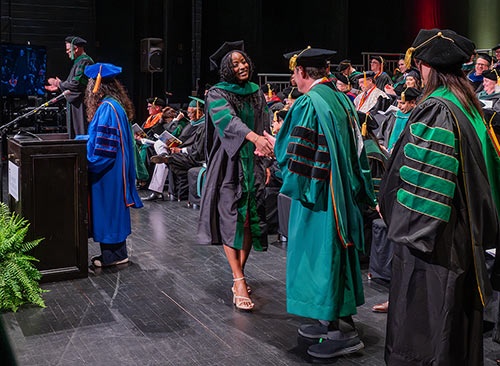
At dizzying speed this technology and other viral-based gene therapies have revolutionized experimental research and have rapidly translated to the clinic, with cures for sickle cell disease, thalassemia and many inherited errors of metabolism. 9 In fact, the FDA has already approved more than 20 new gene therapies, and the number is rapidly growing. Only last week the results of a gene editing study for patients with sickle cell disease was reported in that same May 7th issue of the NEJM, effectively curing 31 patients. 10
You may have read our own local news last week: Right here down the street at the Greenenbaum Comprehensive Cancer Center, a young mother with a terrible genetic disease that has caused ageless suffering across thousands of years, sickle cell anemia, had her stem cells collected and treated with a gene therapy viral vector to genetically replace her abnormal hemoglobin and cure her sickle cell disease. She is the first [adult] patient in Maryland to receive this curative therapy. I appreciate and am proud of the work of her team in our Cancer Center led by: Dr. Yared, Dr. Law, Octavia Clopton, CRNP, and Dr. Rapoport.
The third transformative discovery laid the groundwork for messenger RNA therapeutics. The 2023 Nobel prize was awarded to Katalin Kariko, and Drew Weissman, for their discoveries about nucleoside base modifications that stabilized mRNA so it could be injected and read by our own cells to make proteins, like the COVID-19 spike protein vaccines. 11
These scientists modified the nucleosides in mRNA, substituting uridine with pseudouridine, which stabilized the mRNA, allowing the mRNA to evade our innate immune system and improve reading, translation and protein production in our cells. Their discovery transformed mRNA from a fragile, unusable strand of nucleic acids into a viable therapeutic platform, allowing us to make vaccines rapidly without traditional cell culture.
How many of you in this room received a vaccine made of mRNA from Moderna or Pfizer? You all are intimately aware of this technology because you had a strand of messenger RNA in a lipid particle injected into your shoulder to encode spike proteins from the SARS-CoV2 virus that caused the COVID-19 pandemic.
While apparently simple, this is an essential discovery for humanity. This technology allows us to take the DNA sequences from new viruses using computational analysis and synthesize small strands of messenger RNA for new vaccines. Again, in last week’s issue of the NEJM. a major new clinical trial was published evaluating a new mRNA vaccine for seasonal influenza in 40,000 people, comparing it to the standard egg-grown flu vaccine we have used for more than 80 years. And it was just as safe and significantly more effective. 12 This now gives us the technology we need to be prepared for the next major flu or zoonotic pandemic. Imagine when the first case of a new coronavirus or Avian influenza emerges in China and we can simply print the RNA sequence for the new spike protein or hemagglutinin and have a vaccine ready in a month. In fact, scientists have already tested an RNA flu vaccine that has 20 conserved antigens from avian flu that is highly effective in mouse models.
As we look at our crystal ball and into your future, let’s also take a moment to think about what will not change:
Like all physicians throughout history, just when you think our medical world is stable and predictable, you will certainly be faced with emerging pandemics that rapidly change the face of medicine and human behavior, like the HIV and the SarsCoV2 pandemics. And while this may not have registered, in your lifetimes you have lived through the H1N1 influenza epidemic in 2009, the west Africa Ebola epidemic in 2014, SARsCoV1 in 2002, and Sars-CoV2 in 2019. And many of us older people in this room lived through the West Nile outbreak in 1999 and the Anthrax biological attack after 9/11. Even this week we are now worried about human to human transmission of Hantavirus on a cruise ship.
As we look into our crystal ball we will see more of these events, and your experiences with the COVID-19 pandemic will steel you for the next challenge. Even as newly minted interns on the wards, you will be considered role models and leaders among your health care teams. You will have to communicate what you learned from the COVID-19 pandemic about the value of science and knowledge and compassion in controlling disease and fear and intolerance.
And one more important thing that will never change: Is the “Laying on of hands.”
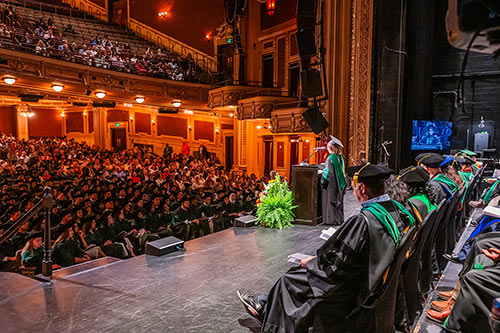
Later today, you will all take the Hippocratic Oath.
Every time you walk into a room and put your hand on a patient’s shoulder and perform your physical examination, you send a powerful message of connection and healing. Every time you apply your stethoscope, one of our oldest tools and potent symbols of medicine, you will lay on of hands. You place the stethoscope under the palm of your hand, lay your hand across your patient’s chest, close your eyes, and listen.
The role of touch in healing is not only confined to the patient. When I was in the Medical ICU last week, I was very purposeful about walking around the patient’s bedside to standing right next to their mother, brother, sister, partner, and reaching out and putting a hand or an arm around their shoulders. I am always amazed that, without saying a word, with this touch -- physical, cultural and emotional barriers dissipate. This touch opens the doors to shared grief, tears and so often a desperate embrace. There is no need to find the right words, just the touch that opens our hearts to our shared human experience. Last week, we took care of two young patients in our ICU, 31 and 33 years old, both with uncurable cancers, and despite all of our advanced medicines and technologies, this was all I could offer.
As physicians, it is our obligation to embrace our evolving field while remaining true to a tenet that has guided our predecessors: “to cure sometimes, to relieve often, to comfort always.” By doing so, we ensure that the sacred tradition of medicine remains an art, rather than an algorithm. 13
So in conclusion, I remind you all that today you all are symbolically crossing a privileged threshold, whether you are ready for this or not, you are empowered with a sacred right to share in our patients and their families’ lives, secrets, joys and suffering on their journey from birth to death.
You will be leaders in our academic medical centers confronting seemingly insurmountable challenges and leveraging tools that I could only have dreamed of at your age, the twin revolutions in computation and molecular biology.
But your greatest strength remains your humanism and altruism, and your stethescope. I am impressed that your generation is the most in touch with their core values and humanism than any I have worked with. You are the most fluent with high speed synthesis of data and use of technology. You have the greatest command of science, medicine, and the human bonds that define the doctor patient relationship. Above all, your generation has embraced a desire to accept yourselves and recognize your own vulnerabilities – this seems to me an essential evolutionary breakthrough in the successful practice of doctoring.
By taking the Hippocratic oath later today, you are committing to a future that will never be stable and always require as much or more from you than the generation before.
God Speed Class of 2026!
References
- Sahn Ni, Carrus, B. Artificial Intelligence in U.S. Health Care Delivery. N Engl J Med 2023;389:348-58. DOI: 10.1056/NEJMra2204673.
- Lee P, Bubeck S, Petro J. Limits, and Risks of GPT-4 as an AI Chatbot for Medicine. N Engl J Med 2023; 388:1233-1239. DOI: 10.1056/NEJMsr2214184.
- The Nobel Prize in Chemistry 2024. NobelPrize.org. Nobel Prize Outreach AB. Awarded to David Baker “for computational protein design” and jointly to Demis Hassabis and John M. Jumper “for protein structure prediction.”
- Altman R. A Holy Grai—The Prediction of Protein Structure. N Engl J Med 2023; 389:1431-1434. DOI: 10.1056/NEJMcibr2307735.
- Der CJ, Yeh JJ. Science behind the Study: Advances in RAS Therapeutics for Pancreatic Cancer. N Engl J Med 2026;394:1857-1858. DOI: 10.1056/NEJMe2600517.
- Park W, Kasi A, Spira AI, et al. Setidegrasib in Advanced Non–Small-Cell Lung Cancer and Pancreatic Cancer, N Engl J Med 2026; 394: 1409-1420. DOI: 10.1056/NEJMoa2600752.
- Wolpin BM, Park W, Garrido-Laguna I, et al. Daraxonrasib in Previously Treated Advanced RAS-Mutated Pancreatic Cancer. N Engl J Med 2026;394:1790-1802. DOI: 10.1056/NEJMoa2505783.
- The Nobel Prize in Chemistry 2020. NobelPrize.org. Nobel Prize Outreach AB. Awarded jointly to Emmanuelle Charpentier and Jennifer A. Doudna “for the development of a method for genome editing.”
- Gostimskaya I. CRISPR–Cas9: A History of Its Discovery and Ethical Considerations of Its Use in Genome Editing. Biochemistry (Moscow), 2022; 87, No. 8: 777-788.
- Gupta AO, Sharma A, Frangoul H, et al. Base Editing of HBG1 and HBG2 Promoters for Sickle Cell Disease. N Engl J Med 2026;394:1824-1835. DOI: 10.1056/NEJMoa2504835.
- The Nobel Prize in Physiology or Medicine 2023. NobelPrize.org. Nobel Prize Outreach AB. Awarded jointly to Katalin Karikó and Drew Weissman “for their discoveries concerning nucleoside base modifications that enabled the development of effective mRNA vaccines against COVID-19.”
- Leroux-Roels I, Huang G, Ferguson M, et al. Efficacy and Safety of an mRNA Seasonal Influenza Vaccine in Adults. N Engl J Med 2026;394:1803-1813. DOI: 10.1056/NEJMoa2516491.
- Kumar A, Allaudeen N. To Cure Sometimes, to Relieve Often, to Comfort Always. JAMA Internal Medicine 2016;176: 731-732. DOI:10.1001/jamainternmed.2016.1220.