
Search
Vaginal douching is a common and potentially dangerous practice. Women engage in this practice predominately for personal hygiene reasons but also with the false belief it will prevent or treat infections and for contraception. Numerous public health agencies and medical societies discourage douching as it has been associated with many adverse outcomes including pelvic inflammatory disease, bacterial vaginosis, cervical cancer, low birth weight, preterm birth, human immunodeficiency virus transmission, sexually transmitted diseases, ectopic pregnancy, recurrent vulvovaginal candidiasis, and infertility.
An increasing fad is the use of intravaginal detox products. Claiming to enhance female health by removing toxins, these mesh cloth-covered balls containing herbs such as mothersworth, osthol, angelica, borneol, and rhizoma, not FDA-approved, are inserted into the vagina for 3 days. Clinical experience demonstrates these products decompose into numerous pieces which become scattered retained intravaginal foreign bodies, cause mucosal irritation, and thereotically could serve as a nidus for serious infections.
Show Additional Information

Show References
When surveyed, half of general medicine patients interviewed stated that they would prefer to have a loved one present if they were to develop cardiac arrest and require CPR. So far, studies have demonstrated that…
Allowing family presence during CPR is associated with the following benefits to family members:
- Decreased rates of PTSD-related symptoms
- Decreased scores on anxiety and depression scales
- Decreased incidence of complicated grief
- Decreased incidence of family member regret (at having been present vs absent during CPR)
And is NOT associated with a difference in:
- Survival rate
- Duration of resuscitation efforts
- Type or dose of administered medications
- Number of shocks delivered
- Emotional stress level of medical providers
- Occurrence of medicolegal conflict
Show Additional Information
Show References
Take Home Points:
- A radial head subluxation that is common in 1-3 year olds
- Often secondary to a longitudinal traction on an extended arm
- With a classic story radiographs are not required
- The hyperpronation technique has been show to be more effective and less painful in reducing it
Show Additional Information
Hydrogen peroxide (H2O2) is a common household liquid that is used for wound irrigation/antiseptic and cosmetic purposes. The concentration of household product is 3% to 5% and is considered to be relatively safe except in large volume ingestion.
High-concentration H2O2 (>10%) is commercially available as “food grade” (35%) that is diluted for household use or for alternative medicine therapy (i.e. hyperoxygenation).
Ingestion of high-concentration of H2O2 can result in caustic injury as well as ischemic injury from gas embolism.
Ingestion of 1 mL of 3% H2O2 produces 10 mL of O2 gas while 1 mL of 35% H2O2 produces 115 mL of O2 gas.
Common symptoms/findings of H2O2 ingestions includes:
- Nausea/vomiting
- Abdominal pain due to gas in portal venous system
- Caustic injury of GI track (ingestion of > 10% H2O2)
- Arterialization of O2 gas result in end-organ injury (e.g. CVA)
A retrospective review of >10% H2O2 ingestion from National Poison Data System showed:
- 13.9% developed gas embolic event
- 6.8% experienced permanent disability, including 5 deaths.
Management
- Minor symptoms: primary supportive
- CT ABD/Pelvis should be considerd if abdominal pain is present
- If significant gas is present in portal vein or evidence of end-organ injury (i.e. CVA), HBO therapy is recommended (limited evidence).
- Endoscopy should be considered in concentrated H2O2 ingestion to evaluate for caustic injury.
Show References
Question
50 YOF with acute onset of worst headache of life associated with nausea and vomiting. Patient is somnolent, will rouse to noxious stimuli and complains of a headache as well as decreased vision.
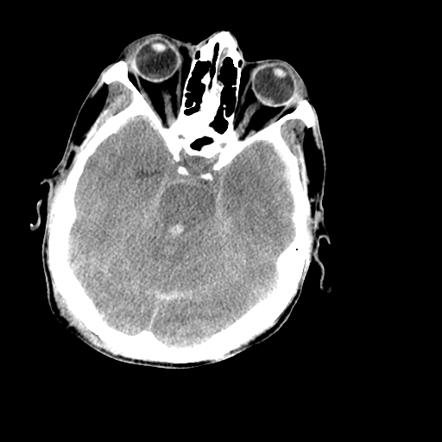
Show Answer
Show References
Question
Idiopathic osteonecrosis of the femoral head
Children as young as 2 or as old as 12 but generally 4 to 8 (worse in older children)
Fare better than adults with osteonecrosis of femoral head
1 in 10,000
4-5x more common in males, much less common ini African Americans
Unilateral femoral head involvement 90% of the time (Bilateral 10% of the time)
Long term consequences are deformity and arthritis
Typical presentation: Subacute limping for weeks (Painless)
As activity worsens limp, it is maximal at the end of the day (Intermittent)
As in adults with hip pathology, IF pain is reported, it is located at the upper anterior thigh and groin
On examination, look for restriction in range of motion of the hip (compare with contralateral side)
May only present with mild to moderate decreased range of motion of the hip
30 versus 60 degrees for example
ABduct both legs with pelvis in neutral OR Place one hand on contralateral pelvis and ABduct affected leg with other hand.
Show Answer
Show References
Cholera is an acute diarrheal disease that can kill within hours if left untreated.
Rising cholera, diarrhea and malnutrition is a deadly combination in war torn countries, such as Yemen, South Sudan, Somalia and Sudan, especially for children.
Yemen currently has the worst outbreak globally, with over 260,000 suspected cases and over 1,600 deaths. In Yemen:
o Half the suspected cases are children
o A quarter of the deaths are among children
Bottom Line:
Cholera remains a major cause of morbidity and mortality globally, especially in areas of conflict.
Show References
When you are working up an elderly patient for trauma look for patterns such as circumferential bruising on the wrists that have the pattern of fingers the same way you would look at the injuries of a child. Remember that the person who is sitting next to them is frequently the person that is abusing them. Therefore, it is important to interview the patient alone.
Show References
When you look up dosing for levofloxacin for community acquired pneumonia (CAP), you will find that both of the following options are approved:
- Levofloxacin 500 mg IV/PO daily x 7-14 days
- Levofloxacin 750 mg IV/PO daily x 5 days
This is based on a multicenter, randomized, double-blind, active treatment trial comparing these two regimens in CAP (mild to severe). This non-inferiority trial shows that the 750 mg dose of levofloxacin for 5 days is "at least as effective and well tolerated" as the 500 mg dose of levofloxacin for 10 days.
So why should you choose the 750 mg daily x 5 day regimen?
- Higher doses maximize the concentration-dependent pharmacokinetic profile of the drug
- Higher doses and shorter duration may be associated with less drug resistance
- Patients subjectively report feeling better at day 3 with the higher dose regimen
As alway with levofloxacin, don't forget to renally dose adjust subsequent doses when writting a script or scheduled inpatient order for patients with reduced creatinine clearance!
Show Additional Information
Show References
Black widow spiders belong to the genus Latro dectus which include 31 species of widow spiders found throughout world. Approximately 1500-2500 black widow bites are reported to American poison control centers annually. A black widow can be identified by their hourglass pattern (red or orange) on the ventral aspect of their shiny globular abdomen. Fortunately, envenomation is rare but when it does occur it causes severe pain, muscle cramping, abdominal (may mimic acute abdomen) often refractory to traditional analgesics and antivenom (Antivenin Latrodectus mactans) is available and effective . Alpha-latrotoxin is the potent toxin causing presynaptic cation channels to open (calcium) and release of neurotransmitters such acetycholine. The neurological signs and symptoms caused by predominantly autonomic and include tachycardia and hypertension. The antivenom is equine based and infused over 20-30 minutes with pain relief in 20 minutes.
Show References
Attachments
Show References
Ventilation During Cardiopulmonary Resuscitation
- Cardiopulmonary resuscitations are often highly stressful and chaotic situations. As a result, it is no surprise that ventilation rates can be as high as 60 breaths per minute.
- Hyperventilation during cardiopulmonary resuscitation can increase intrathoracic pressure, impair venous return, decrease coronary perfusion pressure, and ultimately decrease survival.
- It is imperative that the team leader pay close attention to ventilation and ensure that approximately 8 to 10 breaths per minute are delivered.
- Once ROSC is achieved, the respiratory rate should be adjusted to maintain a PaCO2 between 40 and 45 mm Hg.
Show References
Adhesive Capsulitis aka Frozen Shoulder
Spontaneous gradual onset stiffness and pain of the Glenohumeral joint
Shoulder capsule becomes thickened and contracted
Often affects patients between 40 and 60 years old
Left> Right shoulder
Women> men
Association with diabetes and thyroid disease
3 clinical stages
1) Pain – gradual onset, diffuse, severe, disabling, often worse at night
2) Stiffness – decreased ROM, affects ADLs, improved pain
3) Thawing – gradual return of motion
Physical examination: Painful and decreased ROM. Evaluate active and passive movement, external rotation and ABduction of the shoulder most affected
Surgical or post traumatic shoulder stiffness usually resolves within 12 months.
Adhesive capsulitis is generally self-limiting lasting an average of 18-36 months.
DDX: Chronic locked posterior shoulder dislocation (VERY IMPORTANT), tumor.
Treatment: NSAIDs, Physical therapy, Intra articular steroids
If this fails, manipulation under anesthesia and/or arthroscopic surgical release
Every year in the U.S., preventable poisonings in children result in more than 60,000 ED visits and around 1 million calls to poison centers. Calls relating specifically to pet medication exposure and children have been on the rise.
A recent study in Pediatrics was the first was kind to characterize the epidemiology of such exposures.
This study is a call to arms for an increased effort on the part of public health officials, pharmacists, veterinarians, and physicians to improve patient education to prevent these exposures from occurring.
Summary of major findings:
- Children less than or equal to age 5 are at greatest risk
- Ingestion accounted for the exposure route in 93% of cases.
- Exploratory behavior(61.%) was the most common mechanism of exposure
Most commonly Implicated exposures:
- Pet medications with no human equivalent (17.3%)
- Antimicrobials (14.8%
- Antiparasitic 14.6%)
- Analgesics (11.1%)
Key contributors to exposure risk:
- Lack of recognition by caregivers of potential hazards of pet medications
- Inappropriate or lack of home storage practices
- Inconsistent compliance by veterinary providers in terms of proper product labeling and child-resistant packaging
Take home point: Make sure your pet's medications are appropriately stored for safety!
Show Additional Information
Show References
Chest injuries represent the second most common cause of pediatric trauma related death. ATLS guidelines recommend CXR in all blunt trauma patients. Previous studies have suggested a low risk of occult intrathoracic trauma; however, these studies included many children who were sent home.
Predictors of thoracic injury include: abdominal signs or symptoms (OR 7.7), thoracic signs of symptoms (OR 6), abnormal chest auscultation (OR 3.5), oxygen saturation < 95% (OR 3.1), BP < 5% for age (OR 3.7), and femur fracture (OR 2.5).
4.3 % of those found to have thoracic injuries did not have any of the above predictors, but their injuries were diagnosed on CXR. These children did not require trauma related interventions.
Bottom line: There were still a number of children without these predictors that had thoracic injuries, so the authors suggest that chest xray should remain a part of pediatric trauma resuscitation.
Show Additional Information
Show References
Street names for illicit substance are diverse and unique. Knowing what your patient used prior to ED presentation can help with the management of their intoxication.
DEA recently released 7 page list of common street names for drugs of abuse.
https://ndews.umd.edu/sites/ndews.umd.edu/files/dea-drug-slang-code-words-may2017.pdf
But keep in mind that what our patients purchase and use may not actually contain the drug that they intended to purchase (e.g. fentanyl being sold as heroin).
Attachments
What is the role of EEG for first-time seizures in the ED?
- Wyman and colleagues performed a prospective trial on the use of 30-minute routine electroencephalogram (EEG) in the ED after a first-time seizure or recurrent seizure without performance of a previous EEG to guide decision making in the initiation of antiepileptic medication.
- A diagnosis of epilepsy based on EEG findings was made for 21% of patients (n=15/71).
- Antiepileptic medication was initiated in 24% of patients (n=17/71), including 2 patients with abnormal but not epileptic EEG findings.
Take Home Point: A 30-minute routine EEG in the ED in adults with an uncomplicated first-time seizure revealed a substantial number of epilepsy diagnosis and can change ED management with immediate initiation of antiepileptic medication.
Show Additional Information
Show References
In patients with persistent VT/VF cardiac arrest, giving epinephrine before the 2nd defibrillation attempt (which should follow initial shock and 2 minutes of CPR) is associated with decreased ROSC, decreased hospital survival, and decreased functional outcome.
Take Home Point:
"Electricity before Epi" in patients with persistent VT/VF arrest, at least for the initial epinephrine dose.
Show Additional Information
Show References
Shin Splints
Medial tibial stress syndrome (MTSS) aka shin splints is an overuse injury of the tibia
Very common
-10 to 15% of running injuries and over 50% of leg pain syndromes
3 Characteristics
1) Pain along the posteromedial border of the tibia
2) Diffuse pain
3) Pain that is activity related
Risk Factors
Female sex, increased weight, previous running injury, and
Higher navicular drop (amount of foot pronation) and
Greater hip external rotation with the hip in flexion
Differential Diagnosis
Tibial stress fracture, compartment syndrome, nerve entrapment (sural), lumbar radiculopathy and popliteal artery entrapment.