
Search
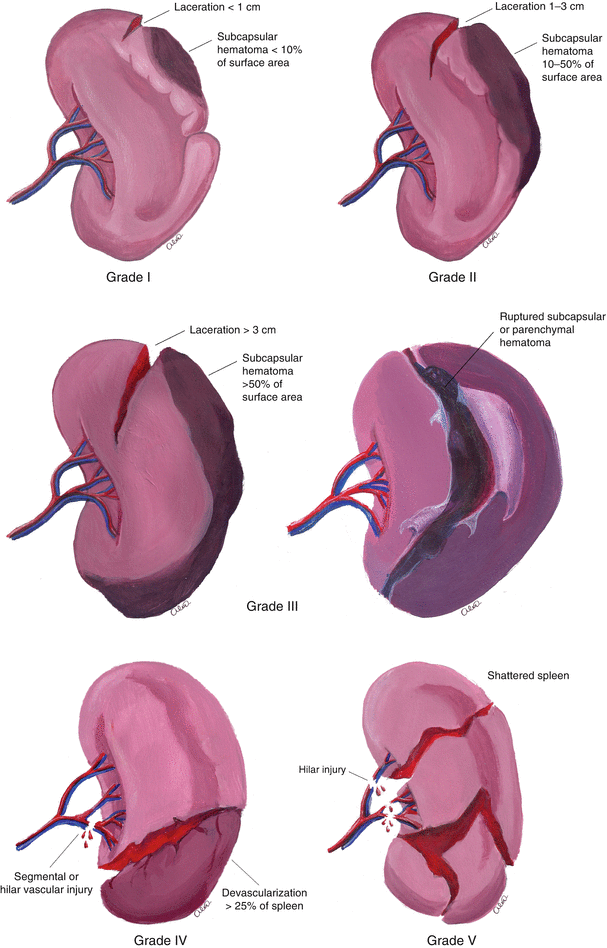
Splenic injury treatment depends on the grade of injury. In general, grades 1 and 2 are non-operatively managed. Grades 4 and 5 tend to be managed operatively. Interventional radiology is used commonly for grade 3 and grades 1 and 2 if active contrast extravasation is seen. Below is a refresher on splenic injury grading.
Table 1
Adaptation of AAST Organ Injury Scale for Spleen
| Grade | Injury type | Description of injury |
|---|---|---|
| I | Hematoma | Subcapsular, <10% surface area |
| II | Hematoma | Subcapsular, 10% to 50% surface area |
| Laceration | Capsular tear, 1 cm to 3 cm parenchymal depth that does not involve a trabecular vessel | |
| III | Hematoma | Subcapsular, >50% surface are or expanding: ruptured subcapsular or parenchymal hematoma: intraparenchymal hematoma_>5 cm or expanding |
| IV | Laceration | Laceration involving segmental or hilar vessels producing major devascularization (>25% of spleen) |
| V | Laceration | Completely shattered spleen |
- Adapted from American Association for the Surgery of Trauma organ injury scale for spleen.
References
1. An update on nonoperative management of the spleen in adults. BMJ Trauma Surgery and Acute Care Open. Volume 2, Issue 1. Ben L Zarzaur, Grace S Rozycki
2. https://www.google.com/search?q=splenic+laceration+grading&rlz=1C9BKJA_enUS1063US1063&oq=splenic+laceration+grading&aqs=chrome..69i57j0i512l3j0i22i30l6.9531j0j4&hl=en-US&sourceid=chrome-mobile&ie=UTF-8#vhid=0ARTxhEO89dgGM&vssid=l