
Search
401-420 of 465 results with category "Orthopedics"
Wound Care:
Patients and many providers want to irrigate or wash a wound with an antiseptic solution in order to decrease the risk of infection. Most studies have shown that irrigation whether with tap water or sterile water is effective enough in reducing bacterial counts in a wound so does adding an antiseptic solution offer any additional benefit.
It turns out that hydrogen peroxide, and iodine based solutions can actually hinder wound healing as they causes delays in the migration and proliferation of fibroblasts at concentrations that are not even bactericidal. Chlorhexidine, and silver containing antiseptics [i.e.: silver sulfadiazine and silver nitrate] are bactericidal at concentrations that do not affect fibroblasts.
So in the end, if you feel the need to use an antiseptic, use chlorhexidine or a silver containing antiseptic. The use of hydrogen peroxide and iodine based solutions should be abandoned as they are not even bactericidal at concentrations that have profound affects on the fibroblasts.
Show References
Septic Arthritis versus Arthritis:
Though CRP and ESR levels are significantly higher in patients that have septic arthritis, a 1998 study showed that there is extensive overlap between patients with septic arthritis crystal assoicated arthritis that both CRP and ESR have low sensitivity, specificity and predictive values. Peripherial WBC counts did not differ between the two disease processes..
The morale of the story: If you are suspecting septic arthritis you need to perform an arthorcentesis to analysis the synovial fluid. Systemic biomarkers can not support one diagnosis over the other.
Show References
Osteomyelitis:
- An acute or chronic inflammatory, infectious process of bone. Can occur via hematogenous spread or direct innoculation of bone.
- Can be diagnosed on plain radiographs but bony changes might not be evident for 14-21 days. By 28 days 90% of patients will demonstrate a bony abnormality.
- Initially plain radiographs will show periosteal elevation. Later cortical or medullary lucencies are seen.
- Additional tests to help make the diagnosis include:
- Three phase bone scan: often not practical for the ED.
- CT Scan: better in areas with complex anatomy [i.e.:spine, pelvis, ,mid and hind foot]
- MRI: most effective in early detection and to guide surgical approaches. Sensitivity is estimated at 90-100%.
Show References
Radial Head Fractures:
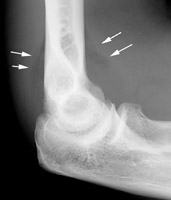
Radial head fractures can often be difficult to visualize on plain films especialing Mason Type 1 fractures (see prior pearl on classification system) which are nondisplaced. Often the only sign of a fracture will be a posterior fat pad sign which is always considered to be pathologic. The posterior fat pad lies outside the synovium of the elbow joint and is normally hidden in the fossa of the distal humerus preventing it from being seen on lateral films of a normal elbow. Trauma to the elbow that results in a intraarticular fracture (typically a radial head fracture) produces an intra-articular hemorrhage that distends the synovium and displaces the fat out of the fossa, producing the typical triangular radiolucent shadow posterior to the distal end of the humerus.
Show References
Conservative Treatment of Back Pain:
Muscle relaxanats and benzodiazipnes are often used in the non-operative management of sciatica and non-specific low back pain. In fact, a 2003 Cochrane review concluded that muslce relaxanats were effective in the management of non-specific low back pain. However, a recent analysis of randomized trials reported little efficacy or only minor benefits with the use of benzodiazapines in treatment of low back pain.
A recent prospective, randomized, placebo-controlled, double-blinded trial conducted in Germany that enrolled a total of 60 patients found that the use of diazepam was equivilant to placebo in the reduction of distance of referred pain at day 7 of treatment. Diazepam was also noted on average to increase the length of stay of those patients hospitalized by 2 days (median hospital days of 8 for placebo versus 10 for diazepam), and the probablility of pain reduction on a visual analog scale by more than 50% was twice as high in the placebo group (p< 0.0015). Placebo reduced the patients pain more than diazepam.
Though the sample size was small; this study should really make one reevaluate the use of diazepam in the treatment of back pain. Early movement and discouraging bed rest have been associated with decreased back pain, so one mechanism by which benzodiazepines may make things work is by causing enough sedation to prevent early movement.
Show References
Carpal Tunnel Syndrome (CTS):
- A compressive neuropathy of the median nerve at the wrist as it travels through the carpal tunnel.
- Median nerve is bound on three sides by carpal bones and anteriorly by the transverse carpal ligament. Surgical repair typically consists of cutting this ligament to allow decompression of the nerve.
- The neuropathy results in:
- parasethesia of the thumb, index and middle fingers
- weaknesss of the thumb and thenar muscles.
- NO physical exam test has great senstivity or specificity for CTS. The two most common are:
- Phalen's test: hyperflexion of the wrist. Need to hold for 60 seconds. Sensitivity ~68% and Specificity ~73%
- Tinel Sign: tapping over cubital tunnel to produce parasthesia along the median nerve. Sensitivity ~50% and Specificity ~77%.
- Increased risk in those patients with:
- Diabetes
- Rheumatoid arthritis
- hypothyroidism
- amyloidosis
Prosthetic hip dislocations are a common occurance in the Emergency Department. After you have gotten the hip back in place there are several ways to prevent the hip from coming out again. An abductor pillow will work but it confines the patient to bed. A better option to prevent further hip dislocations until the patient can get an appropriate brace made or reparative surgery is to place the patient in a straight leg knee immoblizer. It is nearly impossible to dislocate your hip if your knee is fully extended.
So after reduction of their simple hip dislocation (i.e: no fractures) place the patient in a straight leg knee immobolizer and they can followup with their orthopedist as an outpatient.
Review of the Appearance of Ossification Centers in Children's Elbows
Determing if a child's elbow has a fracture or if you are looking at an ossification center is easier if you remember the mnemonic CRITOE. This is the order that the ossification centers appear:
- Capitellum 1 to 8 months
- Radial Head 3 to 5 years
- Internal (medial) Epicondyle 5 to 7 years
- Trochlea 7 to 9 years
- Olecranon 8 to 11 years
- External (Lateral) Epicondyle 11 to 14 yeras
Knee Dislocation:
- It is not uncommon for a patient to have dislocated their knee and it to spontanously reduce prior to presenting to the ED.
- Consider the possibility of a spontaneously reduced knee dislocation in any patient with bicruciate (ACL and PCL) ligament instability.
- Normal pulses and capillary refill does not exclude occult vascular injury to the popiteal artery.
- At a minimum the patient should have Ankle Brachial Indexs performed and if <0.9 serial exams and Doppler ultrasound studies should be obtained.
- Angiography is not absolutely required, and several studies have shown that a selective approach to angiography is acceptable. As the studies below showed, most patients with findings requiring operative repair on angiography had abnormal physical exams.
Show References
Pelligrini-Stieda Lesion:
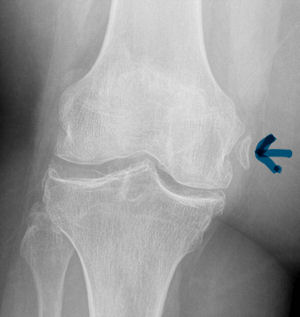
A Pelligrini-Stieda lesion is shown in the radiograph below. This lesion was originally described in 1905, and is associated with a tear of the Medial Collateral Ligament. Heterotrophic calcification forms causing chronic pain, which typically needs to be surgically excised.
So for the students out there, it is possible to diagnosis an MCL tear on plain radiographs. Just not very often.
The Segond Fracture:
An benign appearing avulsion fracture of the lateral tibeal plateau that is marker for more significant injuries such as:
- Anterior Cruciate Ligament (ACL) tear associated with this fracture 75-100% of the time
- Injury to the Medial Meniscus occurs with a Segond fracture 66-75% of the time.
If this avulsion fracture is seen consider immobilzing the patients knee until they can follow up with Orthopedics and/or get an MRI to determine if additional injuries are present.

A recent study by Smith et al showed that the general abdomen/pelvic CT scan in trauma patients obtained with 5mm slices is a better screening test for spine fractures than plain films. They also showed that when compared to dedicated reconstructed thoracolumbar CT scan (2mm slices focused on the spine) it did not miss any clinically significant fractures.
The statistic for plain radiographs and the nonreconstructive CT scan are shown below.
| | Plain Radiographs | Nonreconstructive CT Scan | ||
| | Lumbar | Thoracic | Lumbar | Thoracic |
| Sensitivity % [95% CI] | 47 [33 to 62] | 13 [3 to 32] | 94 [83 to 99] | 73 [50 to 89] |
| Specificity % [95% CI] | 91 [78 to 97] | 71 [54 to 85] | 95 [85 to 99] | 94 [79 to 99] |
| Positive Predictive Value % [95% CI] | 85 [66 to 96] | 15 [2 to 45] | 95 [86 to 99] | 89 [67 to 99] |
| Negative Predictive Value % [95% CI] | 61 [48 to 72] | 56 [41 to 71] | 93 [82 to 99] | 83 [66 to 93] |
The take home point is that dedicated Spine CT scans are probably not needed unless they are going to be used to guide surgical or non-surgical management, and plain films should probably be abandoned in patients that are undergoing CT scans of the chest/abdomen/pelvis.
Show References
Impingement Syndrome and the Diagnostic Accuracy of 5 Common Tests
It is also reported that subacromial impingement syndrome (SAIS) is the more frequent cause of shoulder pain.
The authors of this study attempted to determine the diagnostic accuracy of the following 5 tests for SAIS:
- Hawkins-Kennedy
- Neer
- Empty Can
- Painful Arc
- External Resistance
The study demonstrated that any 3 positive tests out of the 5 has a sensitivity of 0.75 (0.54-0.96) , specificity of 0.74 (0.61-0.88), positive likelihood ratio of 2.93 (1.60-5.36) and negative likelihood ratio of 0.34 (0.14-0.80). See the table below for the individual test characteristics. No single test was deemed accurate enough to make the diagnosis by itself.
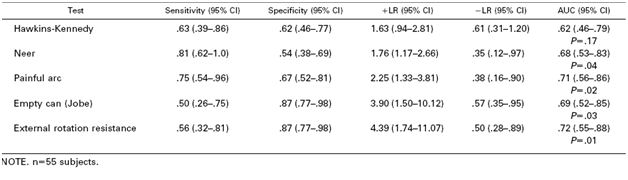
So in the end you should be familiar with most of these tests in order to use a combination of them to make the diagnosis of impingement syndrome. Future pearls will review how to perform these tests.
Show References
Scaphoid Fractures:
For suspected scaphoid fractures with negative radiographs it is common practice to put a person in a short arm thumb spica splint until followup up radiographs can be obtained in 10-14 days.
However, there is evidence that a short arm thumb spica splint is not enough for people that have a true scaphoid fracture. Gellman et al demonstrated that long arm thumb-spica cast immobilization for six weeks followed by short arm thumb-spica cast immobilization decreased time to union by 25% when compared to short arm thumb-spica casting alone.
The theory is that the short arm splint still allows for forearm rotation that can cause shearing motion of the volar radiocarpal ligaments. A long arm splint prevents this shearing action. The disadvantage of a long arm splint though is potential elbow joint stiffness and muscle atrophy that can occur during the prolonged period of immobilization.
So for your next patient with a scaphoid fracture seen on radiographs place them in a long arm thumb spica splint.
Show References
Acute paronychia
- Usually result from minor trauma of the skin around the fingernail such as biting, manicures, picking a hangnail or finger sucking.
- Staphylococcus aureus is the most common infecting organism. However other mouth flora such as Streptococcus and Pseudomonas species, gram-negative bacteria, and anaerobic bacteria can also be a cause.
- Recommended treatement consists of incision and drainage and placing the patient on amoxicillin / clavulanic acid or clindamycin to cover all the organisms noted above.
Scaphoid Fractures in Children:
- Rare before the age of 11.
- Make up less than 0.34% of all pediatric fractures
- Scaphoid fractures may be missed 12.5% - 37% on the initial presentation.
- 30% of patients will have an radiographically apparant fracture on repeat films done 2 weeks later.
- These physical exam findings are more specific for fracture:
- Volar tenderness over the scaphoid
- Pain with radial deviation
- Pain with active wrist range of motion.
- Though snuff box tenderness was seen in 100% of patients eventually proven to have a fracture, it was also seen in 92% of the patients that did not have a fracture at follow-up making it non-specific but sensitive.
Because of the high (30%) fracture rate seen on followup films it is recommended that all children be placed into a thumb spica splint until followed up.
Show References
Slipped Capital Femoral Epiphysis (SCFE)
SCFE can present as hip, thigh or knee pain in the young adolescent. Risk factors include hypogonadism, hypothyroidism, hypopituiratism, and obesity. One way to make the diagnosis is to obtain a AP view of the pelvis and draw a line(Klein's line) along the superior border of the neck of the femur. This line should intersect the femoral epiphysis. If it does not the diagnosis of SCFE can be made.
However, this is only about 40% sensitivity. Green et al recently published a study that demonstrated that if you measure the distance from Klein's line and the lateral edge of the femoral epiphysis on both sides, and the difference between the two is more than 2mm you can make the diagnosis of SCFE more accurately and sooner.
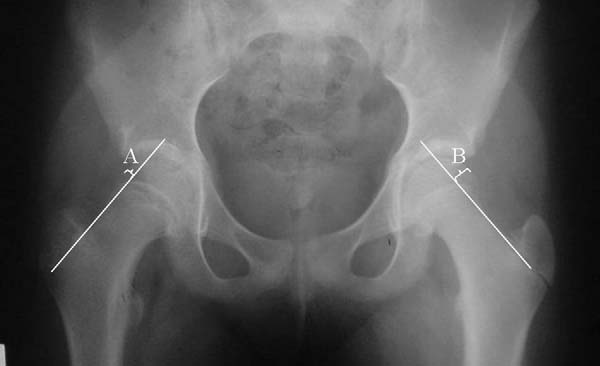
FIGURE 1. Measurement methods on an anterior-posterior radiograph of a right slipped capital femoral epiphysis. White lines indicate Klein’s line for each hip. A and B, indicate maximum epiphyseal width lateral to Klein’s line. As A is 2mm narrower than B, the right (A) hip qualifies as a slip using our modification but not Klein’s original definition.
Show References
Wound Irrigation
A recent article by Thomas et al showed that any concentration of betadiene and hydrogen peroxide used to irrigate a wound was more toxic to fibroblasts (required for wound healing) then it was to bacteria. Low concentrations of chlorhexidine remained bactericidial while having minimal affects on fibroblasts.
WIth the addition of this study the routine practice of soaking a wound in betadiene or hydrogen peroxide should be abandoned. Good irrigation with normal saline or even tap water is all that is really needed to decontaminiate a wound. If a bactericidal agent is needed then low concentrations of chlorhexidine should be used.
Show References
Winged scapula is caused by muscular injury or damage to corresponding muscular innervation. Mechanism can be due to blunt or penetating thoracic trauma.
- Trapezius muscle
- Long thoracic nerve
- Serratus Anterior muscle
- Spinal Accessory Nerve
Clinical findings include
- Protruding medial edge of the scapula
- Exacerbation by pushing against resistance
- Difficulty lifting arm over head
Treatments
- Initial splinting and orthopedic referral
- Depending on mechanism - trial of physical therapy
- Surgical treatments include fascial grafts or adjacent muscle attachment

Show References
Snuff Box Tenderness:
It has become the standard of care that individuals with snuff box tenderness, or pain with axial loading of the thumb, be placed in a thumb spica splint for 1-2 weeks until follow up x-rays can be done. This is done to rule out an occult scaphoid fracture. However, this practice can be hugely inconvenient to the patient and result in some atrophy of their forearm.
An alternative approach is to obtain a CT scan through the wrist to look specifically at the scaphoid bone. If the CT scan is negative you can send them home with some pain control, RICE (Rest, Ice, Compression, Elevation) treatment and let them use thier thumb. No splint is needed. If it is positive then you can splint them and have them follow up with orthopedics or hand surgery.