
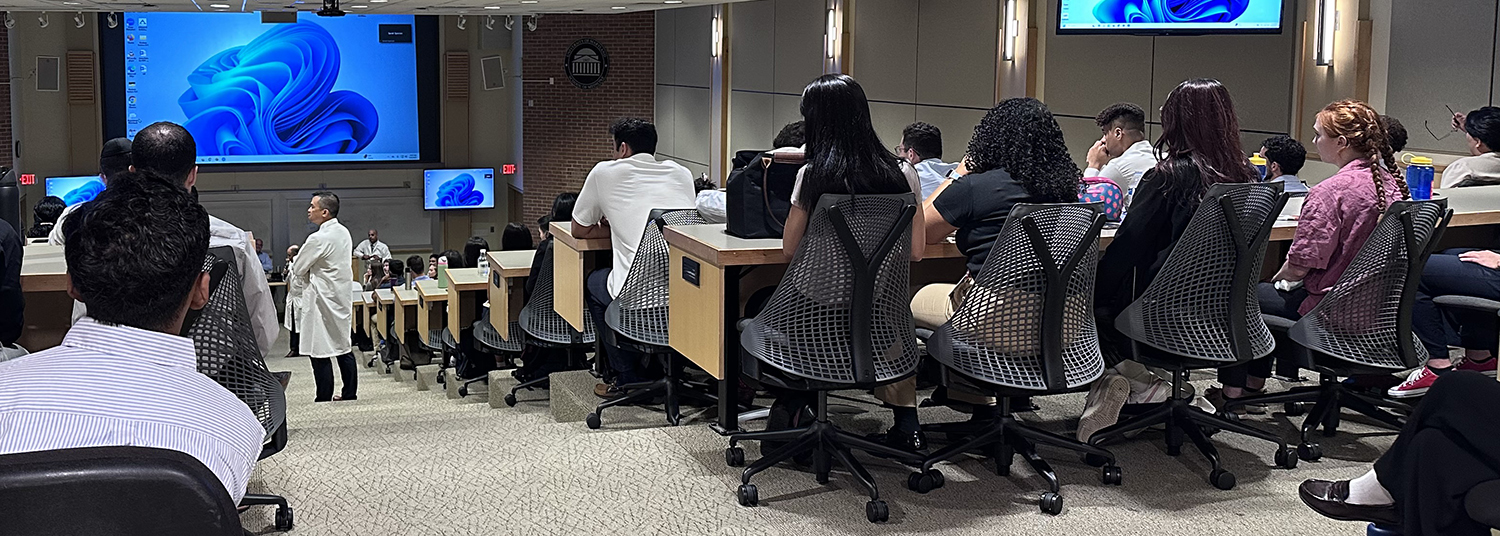
Designated Spaces
Study, Lounge, Meditation, and Prayer Areas in the School of Medicine Spaces
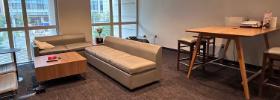 Student Houses: Eva Dodge, Julius Friedenwald, Mario Garcia-Palmieri, Lois Young-Thomas
Lounge/meeting spaces for MD student members. Includes lounge furniture, tables, whiteboard, wall-mounted TV w/direct TV subscription, cleaning supplies, and utensils.
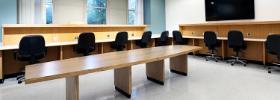 MD Program Instruction Spaces: Lecture halls, Reid A & B, and Howard Hall 229 (A-D) Rooms
Available to students after programmed instruction has commenced, students have card access to these respective areas.
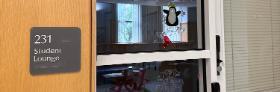 Student Lounge (A): Howard Hall 231
Available via card access 24/7 to all medical students. Includes lounge furniture, table, kitchen with refrigerator, sink, microwaves, Keurig coffee machine, cleaning supplies, and utensils.
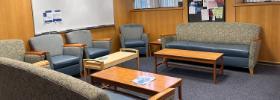 Student Lounge (B): Howard Hall Floor 2 (adjacent to Reid B)
Includes lounge furniture and whiteboard. Shared open access available 24/7.
HSRF I: Lounge areas on Floors 3 and 4
Compact space with whiteboard.
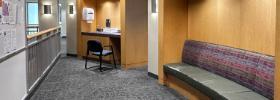 Prayer / Meditation Space: MSTF PED level Room A
Available on a first come, first serve basis. The door has a vacant/occupied door lock.
HSRF I: Penn St. Courtyard (seasonal)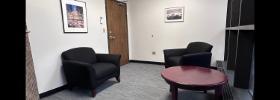 HSRF I: 5th Floor Small Group Rooms
Available to students after programmed instruction has commenced. Shared open access.
HSRF III: Lobby (accessible until 3:30p)
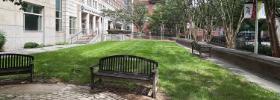 HSRF I: Penn St. Courtyard (seasonal)
HSRF III: Patio (seasonal)
Study and Wellness Areas of Greater UMB Spaces
Health Sciences and Human Services Library (HS/HSL)
https://www.hshsl.umaryland.edu/
Southern Management Campus Center (SMC) – Student Union https://www.umaryland.edu/campuscenter/about-us/
URecFit and Wellness Center
https://www.umaryland.edu/urecfit/wellness/dimensions-of-wellness/
Law School Library
https://www.law.umaryland.edu/library/
Law School Garden/Patio (seasonal)
School of Nursing Courtyard (seasonal)
Learning Environment
[Coming Soon]
Academic Environment
Academic Environment
The Dean, the Senior Associate Dean for Undergraduate Medical Education, the Associate Dean for Medical Education, and the Associate Dean for Student Affairs, along with the Chairs of the Curriculum Coordinating Committee and its subcommittees, work to ensure that there is an appropriate learning environment in all settings.
It is the expectation that each department chair will maintain an appropriate learning environment for the medical students assigned to that department. The clinical leadership of the main teaching hospitals and affiliates are responsible for maintaining an appropriate learning environment at those sites.
All educational spaces used for required classes in years one and two of the medical curriculum are within the School of Medicine and are reserved for School of Medicine students alone when classes and small group learning occur.
This is primarily from 8am until noon, Monday through Friday, with occasional afternoons reserved for additional learning activities. Large lecture halls, multidisciplinary labs, and smaller meeting rooms may be reserved by SOM and other University of Maryland students and faculty if available.
Over the past several years, the School of Medicine has continued to provide and maintain an educational environment that is comfortable, technologically current, and conducive to learning.
The renovated Taylor and Hosick Lecture Halls are clean, bright, modern, and designed to facilitate wireless connectivity during teaching activities. The multi-disciplinary labs have been completely renovated into 2 large collaborative learning spaces, the Reid Rooms, with state-of-the art technological capabilities.
Within the past five years, technological capabilities of both lecture halls and the multidisciplinary labs have been upgraded from analog to digital, allowing for high-definition quality of audiovisual materials used in teaching our medical students.
The Reid Anatomy Lab has been outfitted with "smart dissection tables," in which a touch-screen computer is attached to each dissection table via an ergonomic arm. This allows students to access electronic atlases and other learning materials relevant to their cadaver with the touch of a computer screen.
In general, all teaching space, locations, and times of use are assigned and managed by the Office of Medical Education to prevent scheduling conflicts and to ensure that students have access to appropriate space and resources.
Contact OME
Dr. Joseph Martinez
Associate Dean of OME
410-706-6613
jmartinez@som.umaryland.edu
Kevin Brown
Assistant Dean for UME Operations
410-706-7668
kbrown@som.umaryland.edu
Donna Reynolds
Academic Services Specialist
410-706-7662
dreynolds@som.umaryland.edu