About Rural-MD Scholars Program
Maryland’s rural residents face challenges in accessing quality healthcare and navigating health disparities.
The Rural-MD Scholars Program aims to educate medical students to gain a deeper understanding of rural medicine to better relate the field to their future goals and aspirations.
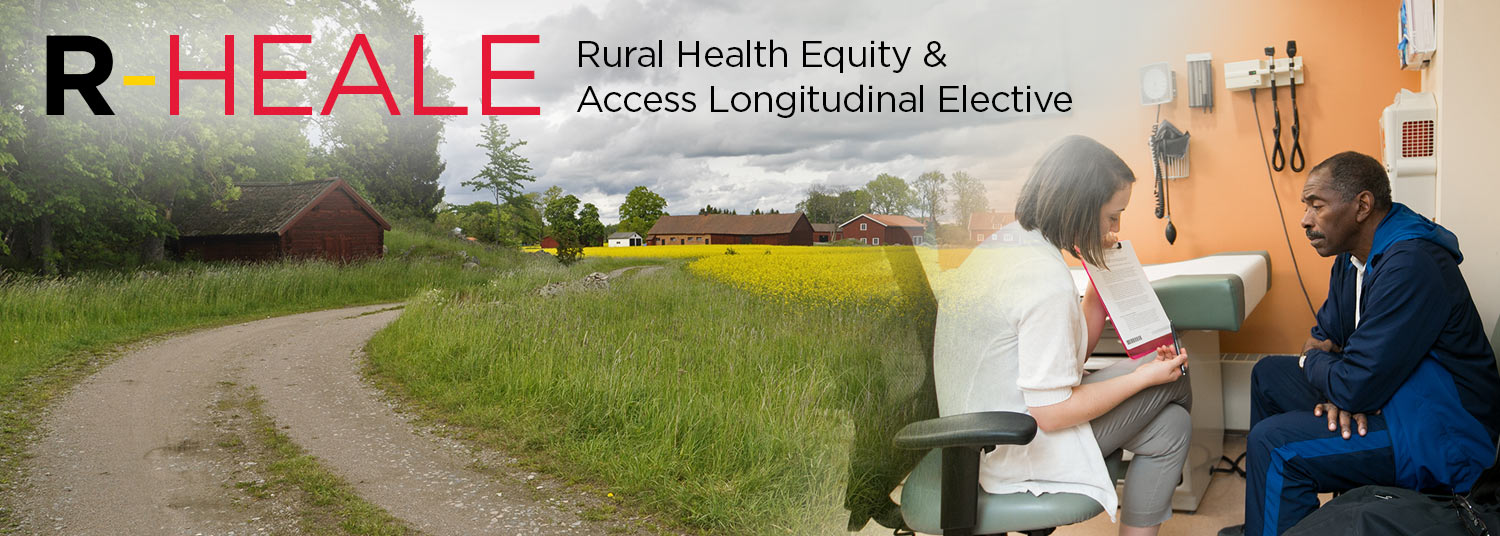
The Rural-MD Scholars Program curriculum starts with a pre-matriculation program at University of Maryland Eastern Shore (UMES), followed by the two-year Rural Health Equity and Access Longitudinal Elective (R-HEALE) and includes mentoring, research, and clinical experiences during the 4-year medical school training program.
Rural MD Overview
Goals
- Introduce students to rural patients and rural practitioners
- Gain an understanding and respect for the breadth of care for rural patients
- Participate in didactic and procedural learning sessions focused on the knowledge and skills essential for the care of rural patients
- Develop an understanding of social determinants of health specific to rural populations
- Provide longitudinal clinical experience with health care delivery in eastern Maryland
- Increase the number of UMSOM graduates who elect to practice in a rural setting
- Learn about roles of other health professionals and community resources instrumental in the care of rural patients
- Form relationships with rural health physicians who can serve as role models and provide mentorship
- Support for our Core Physicians is provided by funding from the Rural Maryland Council.
- Support for our Core Physicians is provided by funding from the Rural Maryland Council.
Training Rural Physicians
We have developed a program within our medical school curriculum in collaboration with the University of Maryland, Eastern Shore whose purpose is to train physicians who will practice in underserved areas of Maryland’s Eastern Shore. Ten students will be recruited annually who meet all the requirements for admission to our medical school and will possess additional qualities that make them uniquely qualified for the program.
Qualities of ideal candidates:
- Rural background
- Intention and commitment to practice in a rural setting
Increased Access to Physicians is Essential
Almost the entire Eastern Shore is designated by the federal government as a medically underserved area (MUA) and as a “health professional shortage area,” according to the Maryland Rural Health Association. There is a shortage of primary care providers, medical specialists, dentists, and mental health providers. The result is that some people fail to obtain all the care they need.
Eight rural Eastern Shore counties have 76% of their population living in MUAs, with Caroline, Kent, Somerset and Worcester each having 100% of their populations residing in designated MUAs. Four Eastern Shore counties are among the top five in Maryland for infant and child mortality, with Somerset and Caroline counties in the top five in both age groups. Health disparities increase and access to health care decreases as Maryland’s counties become more rural. Unfortunately, with these variables also comes lower life expectancy, as much as seven years shorter in some Eastern Shore counties than in top-ranked suburban Montgomery County.
Rural Maryland represents almost 80% of Maryland’s land area and 25% of its population. Maryland recognizes 18 of its 24 jurisdictions as rural, half of which are on the Eastern Shore or West of Chesapeake Bay. All five of the state’s counties with the fewest primary care physicians per capita are on the Eastern Shore, with Caroline County having the greatest need with only one provider per 2,500 residents.
As the state’s only public medical school, the University of Maryland School of Medicine is dedicated to teaching our state’s healthcare providers of the future.
Program Curriculum
Rural-MD Scholars Program Curriculum
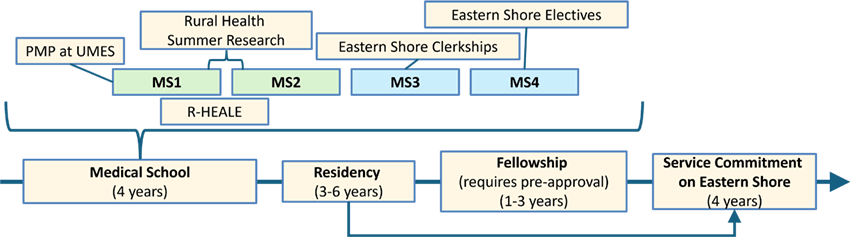
Pre-Matriculation Program
- Summer immersive program focused on rural healthcare
- Held at UMES in collaboration with ESAHEC and local health department
- Rural didactics
- Introduction to AHEC Scholars program
- Shadowing and community outreach events on the Eastern Shore
MS1/MS2
2 Year Elective with 1-hour small group sessions with simulation and clinical cases: R-HEALE
- Introduction to Rural-MD Scholars Program and rural medicine in MD
- Rural physician panel discussion
- Rural health didactics
- Procedural sessions
MS1-4
- Rural health physician mentorship
MS3
- Clinical clerkships on Eastern Shore
- Optional participation in MS1/2 small group sessions
- Continue community research and following rural patient
MS4
- Final year project – may build on MS1/2 research project
- Clinical focus (QI), cultural focus (qualitative research), advocacy focus (policy), teaching focus (mentoring, curriculum building)
- Ambulatory rotation - Eastern Shore AHEC
- Other rural clinical opportunities as schedule allows
Rural Research
Rural-MD Research Experience
Mentored scholarship - either research or quality improvement (QI) - is a cornerstone of the Rural-MD program, offering students an opportunity to apply scholarly methods to address real-world challenges in rural health. The goal of the Rural-MD research experience, which occurs primarily in the summer after the first year but may extend throughout the second year, is to engage in meaningful, mentored scholarship that directly advances the program’s mission—to improve the health and healthcare of rural Maryland communities, particularly those on the Eastern Shore.
Focus: Improving Rural Health and Healthcare Delivery
The scholarly activity should directly address an aspect of health or healthcare delivery that affects rural populations in Maryland. Examples include improving access to care, addressing social determinants of health, enhancing chronic disease management, evaluating care delivery models, or identifying barriers to preventive services in rural communities. Projects may focus on clinical, community, or systems-level issues, but they should have a clear connection to improving outcomes or equity for rural residents.
Rigor: Research or Quality Improvement
The project must be designed and executed with scholarly rigor. It should fall into one of the following categories:
- Research Study— employing quantitative, qualitative, or mixed-methods approaches to generate new insights or data related to rural health or healthcare delivery.
- Systematic or Scoping Review— synthesizing existing evidence in a structured, transparent, and reproducible manner to address a well-defined question relevant to rural Maryland.
- Quality Improvement (QI) Initiative— grounded in recognized QI methods such as Plan-Do-Study-Act (PDSA) cycles, root cause analysis, or implementation science frameworks, aimed at improving a measurable aspect of healthcare delivery in a rural setting.
Through this work, students gain first-hand experience tackling a wide range of challenges facing communities and health systems in rural Maryland, often working with physicians and scientists on the Eastern Shore. Some of the projects Rural-MD Scholars have worked on to date include:
- Rural-Urban Parity and Socioeconomic Gaps in Traumatic Brain Injury Outcomes Within a Regional Trauma Center
- The Role of the Maryland Primary Care Program (MDPCP) in Expanding Self-Management and Support Outreach Services: A Comparative Analysis of Rural and Non-Rural MDPCP Practices
- Statin Refusal Among TidalHealth Primary Care Patients: Variations Across Rural, Suburban, and Urban Communities
- Assessing Cancer Disparities in Maryland: A Retrospective Cohort Study
- Characterizing Infant Lumbar Puncture Outcomes at a Community Hospital
Faces of Rural-MD
In the Media
R-HEALE in the News
R-HEALE has been featured in the following press release and media reports:
Press Release
October 2024: UMSOM Launches New Rural Health Initiative to Address Physician Shortage on Maryland's Eastern Shore