
Standardized Patients, Simulation Technology, and Ultrasound
Standardized patients (SPs) and simulation technologies are incorporated into the medical student curriculum throughout all four years.
Standardized Patient Program
Standardized patients (SPs) are incorporated in the medical school curriculum throughout all four years. Interviews are videotaped so students can review their performance in conjunction with evaluation and feedback from both faculty and the standardized patients.
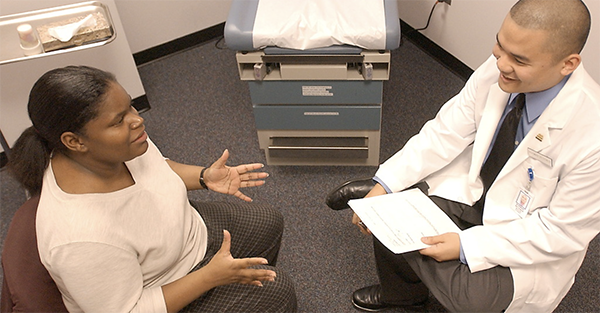 The Standardized Patient Program is a state-of-the-art facility dedicated to the evaluation, assessment and teaching of technical skills for students, faculty and health care providers throughout the State of Maryland.
The experiences conducted at the Standardized Patient Program are a joint venture of the University of Maryland School of Medicine and School of Nursing.
Students experience and assessments include:
- Ability to conduct an appropriate history and physical examination
- Ability to identify presenting problems and risk factors
- Ability to formulate a differential diagnosis and plan of management
- Interpersonal communication skills, including verbal, paraverbal, and nonverbal communications
- Overall technique
Year 1
During Practice of Medicine I, students have multiple encounters with standardized patients and physical exam teaching associates (PETAs) that encompass the medical interviews with common medical problems, the neurological exam, head/eyes/ear/nose/throat (HEENT) exam and abdominal exam.
Year 2
During Practice of Medicine II, students have multiple encounters with standardized patients and physical exam teaching associates (PETAs) that encompass the medical interviews with common medical problems, the cardiac exam, pulmonary exam, musculoskeletal exam, and the genitourinary exam.
Year 3
Family Medicine Clerkship and the Obstetrics & Gynecology Clerkship have Objective Structured Clinical Examination (OSCEs), which are experiences which involve simulated patient interactions specific to those specialties.
Year 4
Students are required to pass a multi-station Objective Structured Clinical Examination (OSCE) for graduation.
Simulation
MASTRI Center
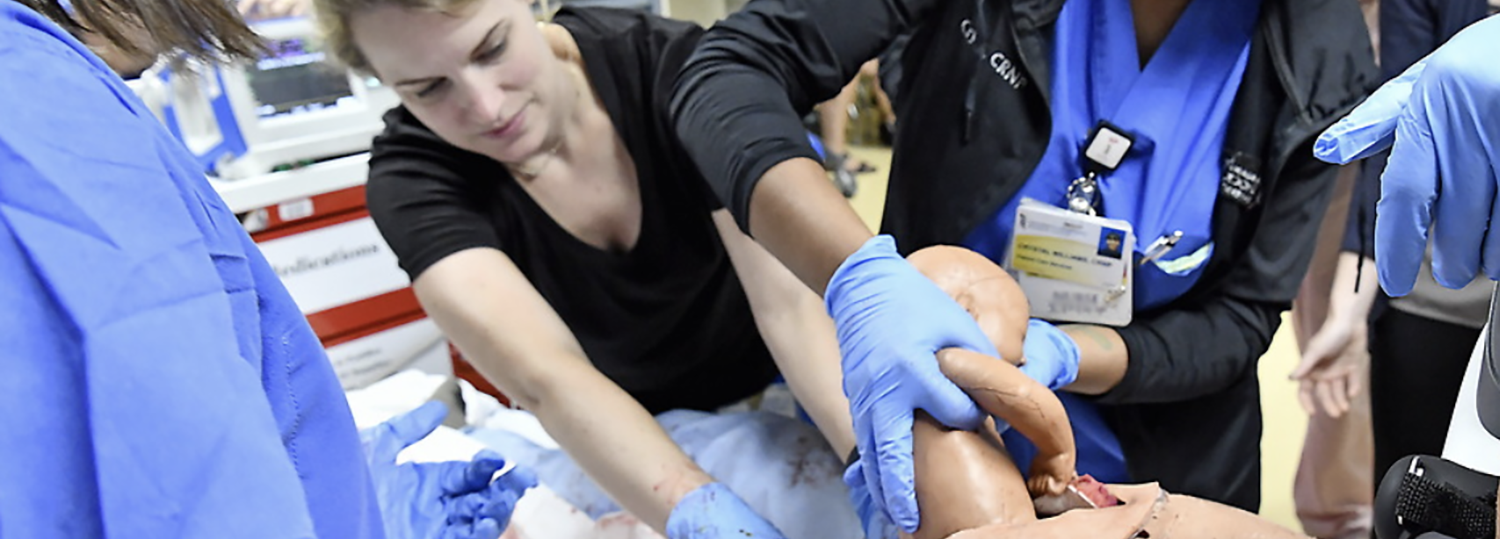
The MASTRI Center opened in December 2006 and was created through collaborative efforts by the departments of Surgery, Anesthesiology, OB/GYN and the US Air Force Center for Sustainment of Trauma and Readiness Skills (C-STARS). The MASTRI Center is supported by the University of Maryland Medical Center and the University of Maryland School of Medicine and provides a safe learning environment which is available to the University of Maryland Medical System and the University of Maryland School of Medicine in addition to providing services for industry and outside hospitals.
The MASTRI Center exists to support research and to provide a safe learning environment using high fidelity simulation, skills training and standardized patient activities to develop and enhance the learner’s knowledge, skills and confidence.
Obstetrics/Gynecology
Students on the Ob/Gyn Clerkship spend a portion of their orientation day in the MASTRI Center performing birth simulation and basic Ob/Gyn simulation - such as pelvic checks, fundal height measurements, Leopold maneuvers, etc. In addition, students visit the Standardized Patient Program for pelvic exam instruction with the Genitourinary Teaching Associates (GUTAs).
Pediatrics
In pediatric SIM, students experience five brief clinical scenarios at the MASTRI Center in which they are required to assess the situation at an appropriate education level and then debrief about management and patient evaluation. The clinical scenarios are relative to pediatric clinical encounters that are part of the required curriculum for the clerkship.
Point-of-Care Ultrasound
[Coming Soon]
Contact OME
Nirav Shah, MD
ngshah@som.umaryland.edu
Philip Dittmar, MD
pdittmar@som.umaryland.edu
Norman Retener, MD
noretenter@som.umaryland.edu